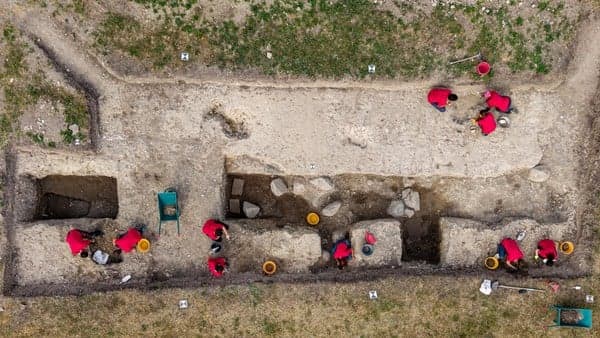
Archaeologists from Ca’ Foscari University of Venice have identified the remains of a church dating from between the late fourth century and the first half of the fifth century in the ancient city of Altino, northern Italy.
The building has a rectangular floor plan measuring approximately 30 by 20 metres, with no apse, and is oriented towards the east, in keeping with Christian liturgical tradition.
Archaeologists believe its size and architectural features suggest that it may have been the city’s ancient bishop’s church.
“For the first time, we can say with a very high degree of confidence where the church and the bishop’s palace of Altino stood. Written sources told us they must have existed; now we have archaeological evidence to support this,” said Diego Calaon, director of the archaeological research and professor at Ca’ Foscari University of Venice.
A church mentioned in the letters of St Jerome
Historical sources previously attested to a significant Christian community in Altino, particularly the correspondence of St Jerome with Heliodorus, the city’s first bishop.
In a letter dating from 396, St Jerome mentions the care the priest Nepotian, Bishop Heliodorus’s nephew, showed for the church, referring to its altar, walls, floors, doors, and sacred vessels.
The period described in the letter corresponds to the date archaeologists have established for the building’s construction.
Elisa Possenti, a professor at the University of Trento and co-director of the research, highlighted the importance of the discovery for understanding the region’s Christian history.
“What we could only imagine from descriptions in written sources is finally taking physical form. This will help us reassess the lives and roles of Altino’s earliest bishops, whose histories have largely been shrouded in legend,” the researcher explained.
Remains of a possible episcopal palace
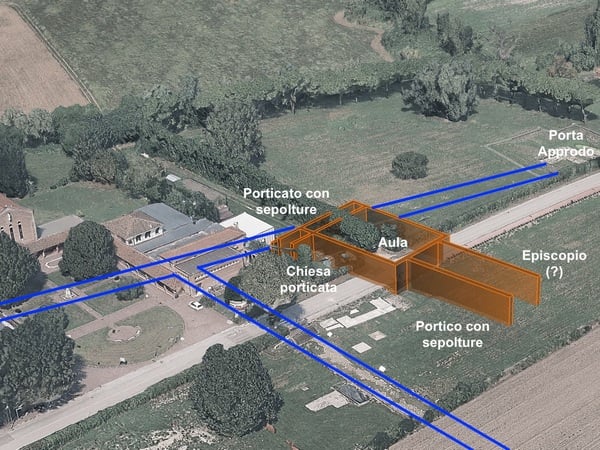
To the east of the church, archaeologists identified the foundations of another large building, with a complex layout and porticoed spaces, which they believe may have been the episcopal palace.
The building may have had two levels, one used as living quarters for clergy and the other containing burial spaces reserved for bishops or other prominent members of the community.
This hypothesis is also supported by the discovery of fragments of Late Antique mosaics.
One distinctive feature of the buildings is the reuse of stone blocks taken from Roman road paving.
According to the researchers, the use of these materials, which had originally formed part of public infrastructure, indicates the authority the bishop had acquired in the administration of the city.
Near the church, archaeologists also identified traces of a cemetery dating from the sixth and seventh centuries, with brick-built tombs.
Objects bearing Christian symbols were also discovered, including a small vessel decorated with a cross.
New insights into the relocation of the episcopal seat
The research also provides clues about the changes Altino underwent during the formation of communities in the Venetian Lagoon.
According to archaeologists, the relocation of the episcopal seat from Altino to Torcello may not have resulted from a hurried population departure due to invasions, as one historical tradition suggests.
Instead, it may have been the outcome of a prolonged process influenced by demographic and environmental changes.
Diego Calaon described this development as “not as a sudden flight, but as a long, managed transformation”, in which the city’s inhabitants participated in the region’s economic and political changes.
Research to continue
Researchers believe the church at Altino was gradually dismantled by the first half of the seventh century, with some of its building materials reused in the development of settlements in the lagoon.
Identifying the building was made more difficult by the systematic recovery of stone and bricks from ancient structures, as well as modern agricultural activity, which destroyed some of the archaeological layers.
Research will continue with the analysis of discovered artefacts, the study of human remains, radiocarbon dating and geophysical investigations in areas that have not yet been explored.
One of the archaeologists’ objectives is to identify the baptistery, which could complete the early Christian episcopal complex.