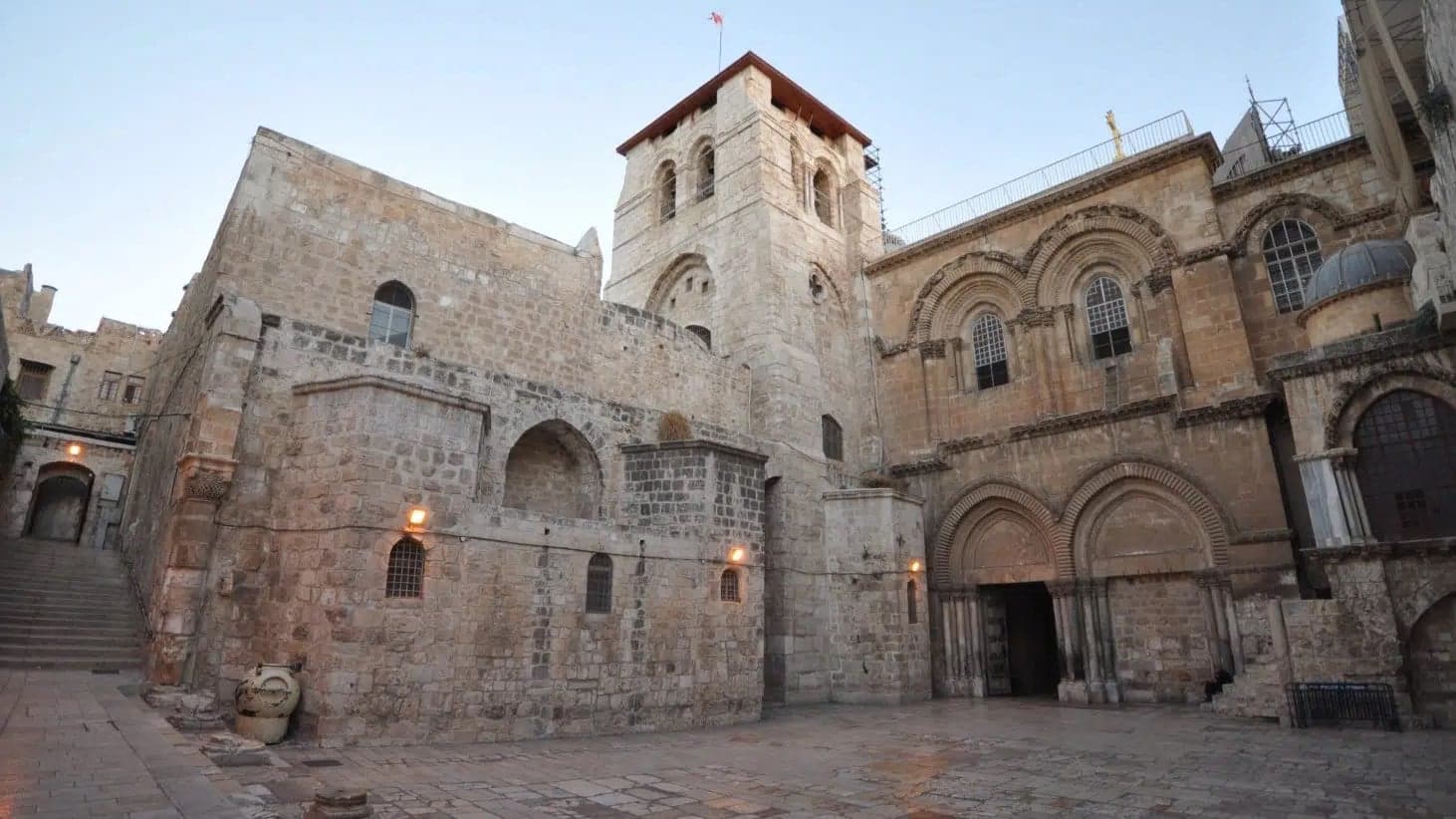
A team of archaeologists led by Sapienza University of Rome, Italy, has reconstructed the ancient landscape surrounding the Church of the Holy Sepulchre in Jerusalem.
The present church is built over part of an ancient quarry on Gareb Hill. After stone extraction ceased, some areas were adapted for agricultural use, while others were used for burials.
The research traced the area’s development across several historical periods. The findings contribute to an understanding of the site’s configuration before the Christian church was built in the fourth century.
Researchers identified evidence of plots enclosed by low walls, into which soil had been brought for cultivation. Analyses revealed remains of figs, grapes and cereals, as well as evidence of grapevines and olive trees.
According to the team of archaeologists from Sapienza University, the project represents “the first archaeobotanical investigation carried out in Jerusalem to cover such an extensive chronological sequence, from the Middle Iron Age to the modern period”.
Tombs in the former quarry
The research also highlighted the site’s funerary use. Tombs were cut into the rock exposed by quarrying at a time when the area lay outside Jerusalem’s urban centre.
This configuration is relevant to the account in the Gospel of John, which states that the place of the Crucifixion and the Tomb of the Lord Jesus Christ were near a garden.
The discoveries do not allow archaeologists to identify the traditional tomb as that of the Saviour. They do, however, show that the landscape features described in the Gospel — cultivated land and rock-cut tombs in an area outside the city — existed in this part of Jerusalem.
Research continues beneath the present basilica
The Sapienza University study covers a substantial area of the Church of the Holy Sepulchre.
“To date, almost half of the Basilica’s surface area has been investigated,” the researchers said.
In addition to plant remains, the team analysed wood and charcoal from the site, as well as pollen, to reconstruct changes in vegetation and how people used natural resources.
“This study, which is still ongoing, aims to reconstruct the diachronic evolution of Jerusalem’s vegetational landscape and the ways in which plant resources were exploited during successive historical periods.”
The area underwent a radical transformation in the fourth century, when St Constantine the Great initiated the construction of the Church of the Holy Sepulchre. Archaeologists identified a large circular marble structure associated with an early phase in the development of the Christian sanctuary.
The research has reconstructed the site’s history and the landscape in which Christian tradition has preserved the memory of the Tomb of Christ the Saviour.
Photo: Jerusalem Institute for Strategy and Security