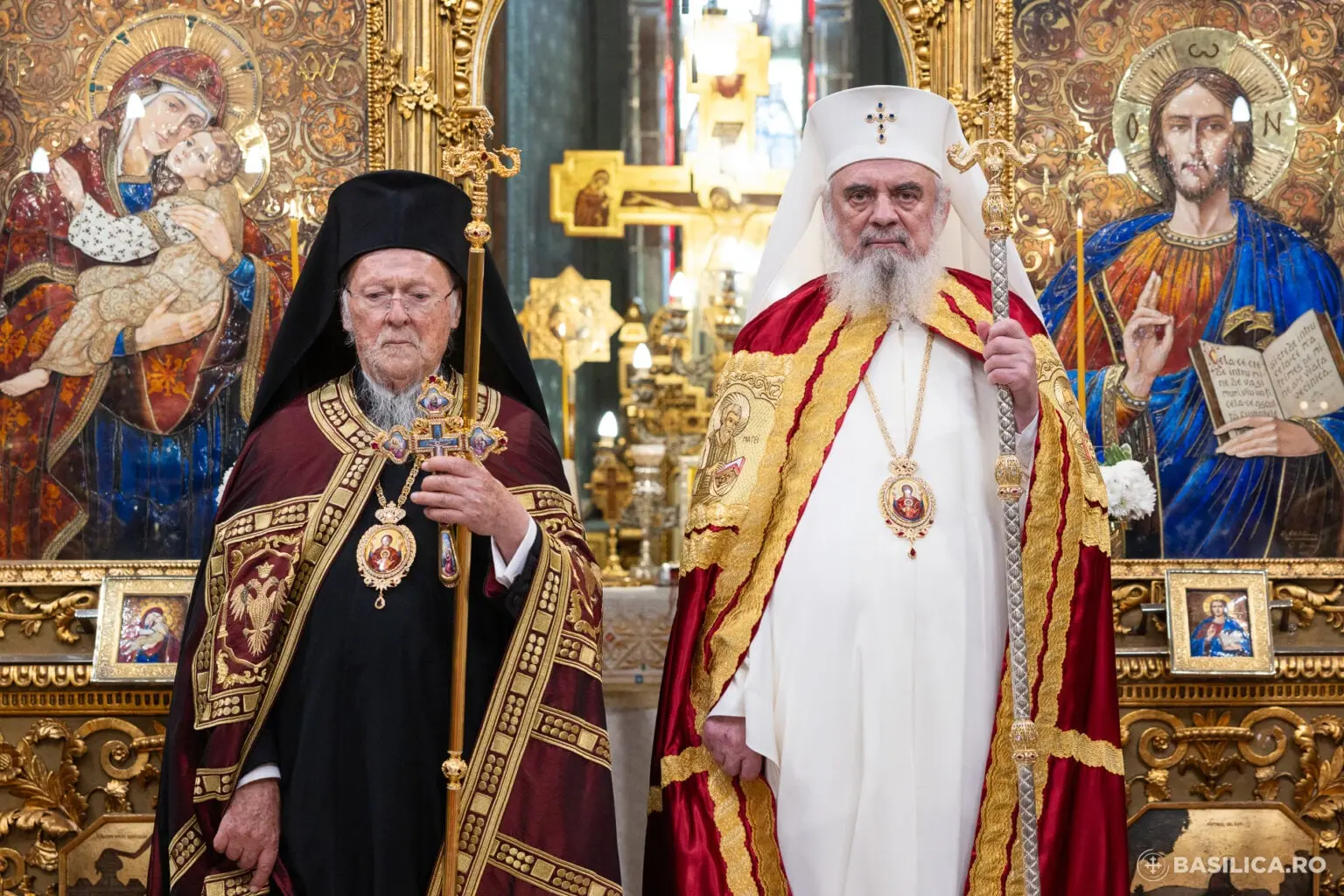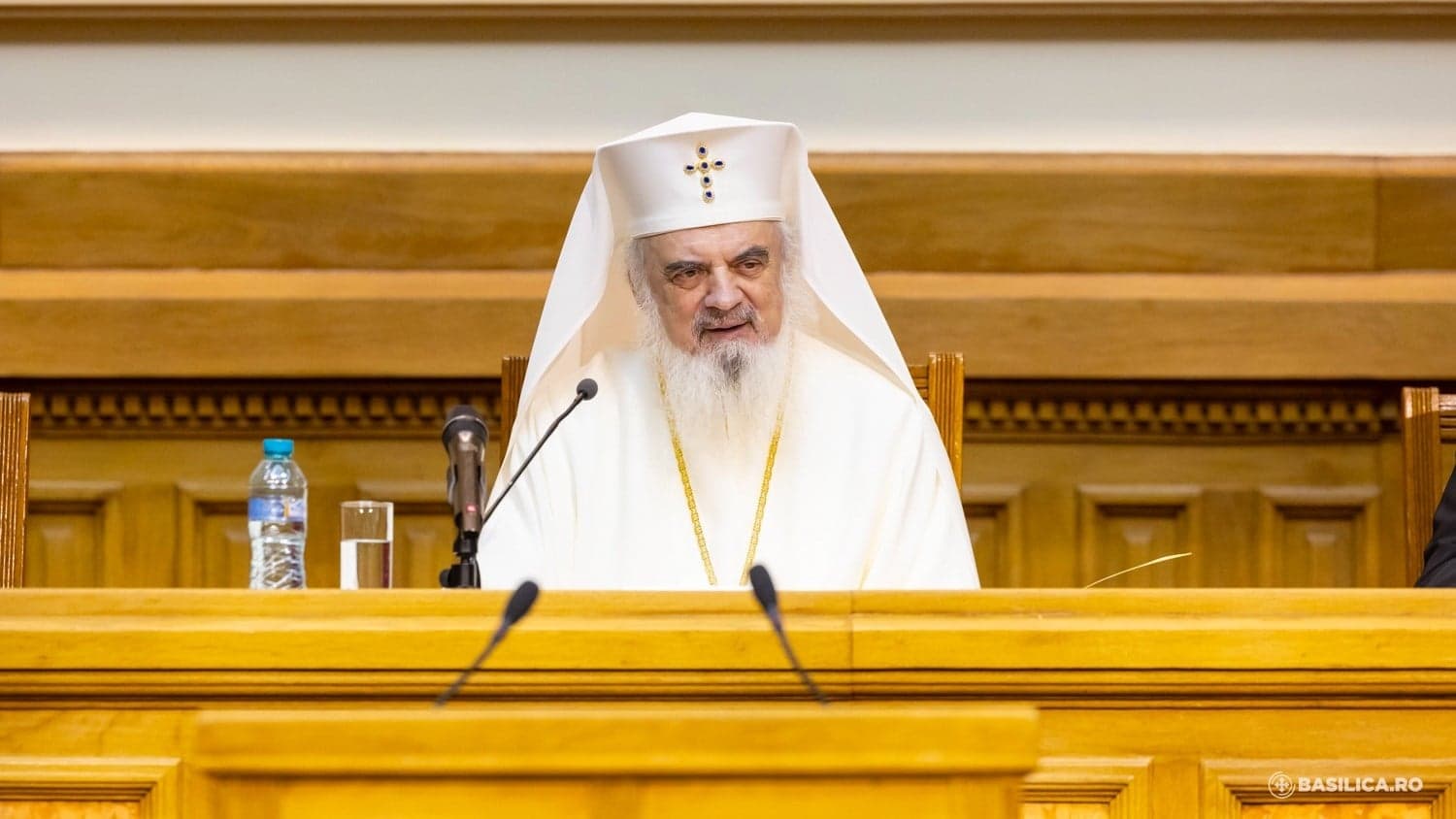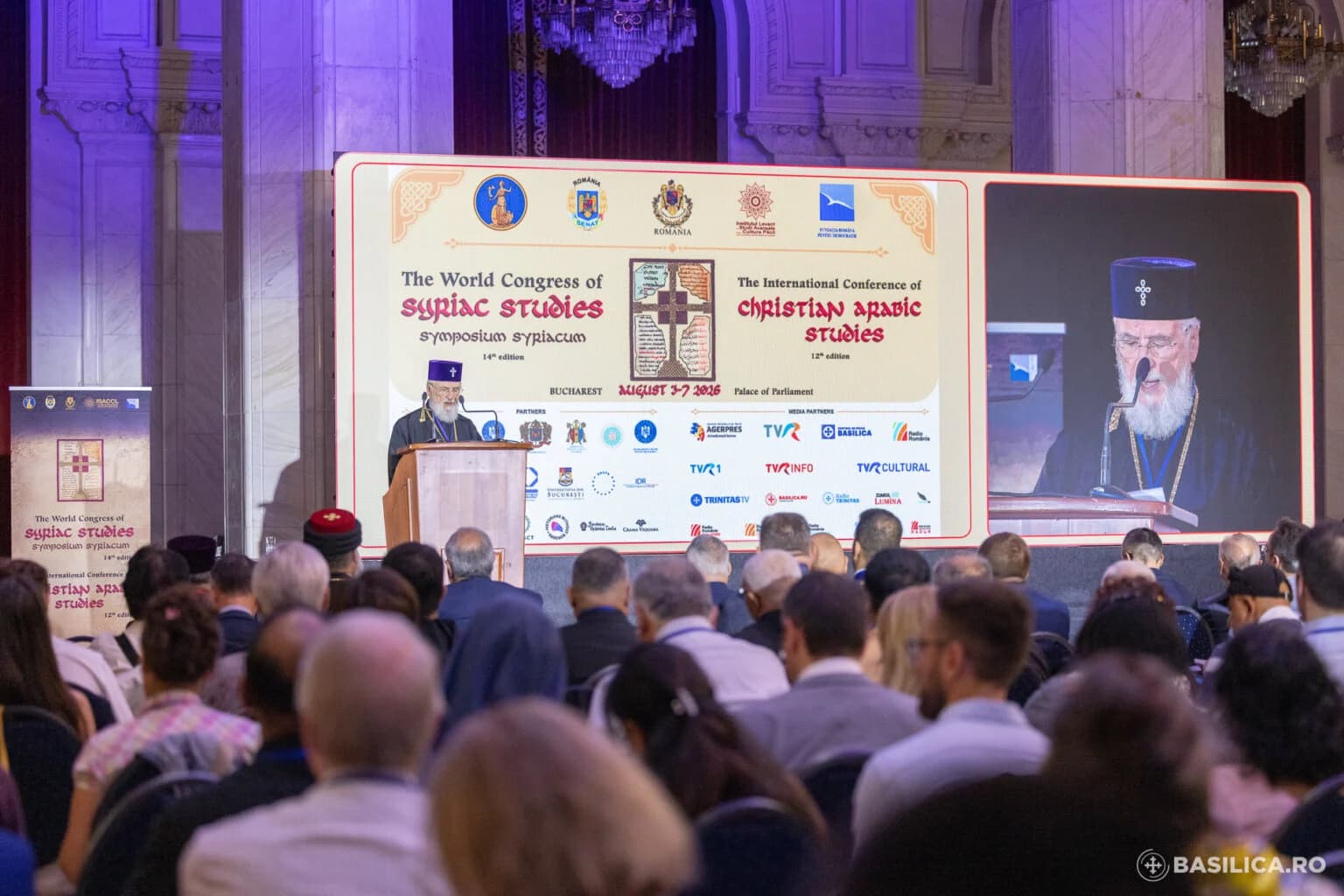
His Beatitude Daniel, Patriarch of the Romanian Orthodox Church sent on Monday an official message on the occasion of the opening session of the World Congress of Syriac Studies and the International Conference on Christian Arabic Studies that took place at the Romanian Palace of Parliament in Bucharest.
The message was read by His Eminence Nifon, Archbishop of Târgoviște, Honorary Metropolitan and Patriarchal Exarch. The Patriarch of Romania highlighted the historical ties between the Romanian Orthodox Church and the Patriarchate of Antioch, recalling the decisive contribution of the Romanian Principalities to the development of Orthodox printing in the Arabic language.
„The Arabic-language books printed with Romanian support opened a new path, with an unforeseen impact throughout the Levantine world. They contributed to the preservation of Byzantine Christianity in Arabic-speaking lands under Ottoman rule, fostered the development of the literary Arabic language, and enriched Christian Arabic literature”.
His Beatitude stated that „unity, cooperation, and communion in the spirit of the Gospel of love as lived and proclaimed by Christ our Lord, constitute a solid foundation and a sure path toward strengthening peace and inter-Christian and interreligious stability in the Middle East”.
Please find below Patriarch Daniel’s message at the opening session of the World Congress of Syriac Studies in English:
“Christian Mission and Evangelical Love in the Service of Peace” – Some Aspects with Regard to the Fraternal Relations between the Romanian Orthodox Church and the Orthodox Church of Antioch and All the East
The organization in Bucharest of this event of unparalleled significance in this part of Europe represents a joyful opportunity to highlight the fruitful cooperation between the Romanian Orthodox Church and the Orthodox Church of Antioch and All the East, with the aim of fostering a love that is ever ready for sacrifice, following the example and commandment of our Lord Jesus Christ.
The instability of political and social life in the Eastern Mediterranean region, part of the Ottoman Empire during the eighteenth century, profoundly affected the life of Christian communities, which were frequently subjected to unjust and discriminatory rule. These circumstances prompted the Eastern Patriarchs to seek support in distant lands, such as the small Danubian Principalities of Wallachia and Moldavia. Thus, having learned of the generosity of Prince Constantin Brâncoveanu of Wallachia, who extended his support to the entire Eastern Christian population of the Ottoman Empire, Patriarch Athanasius III Dabbas of Antioch and All the East arrived in Bucharest around the year 1700. The shortage of liturgical books in Arabic, keenly felt by the clergy and faithful of the Arabic-speaking Orthodox communities, seriously disrupted ecclesial life, which was also challenged by heterodox proselytizing activities.
In this context, in 1701, at the request of Patriarch Athanasius III Dabbas, and through the financial support of Prince Constantin Brâncoveanu and the technical expertise of the master printer Anthimus of Iberia, the Greek–Arabic Hieratikon was printed at Snagov Monastery, near Bucharest.
The following year, in 1702, the Greek–Arabic Horologion was published. These were the first books ever printed in Arabic in the Christian East for the Orthodox Christians of Syria. This publishing initiative, launched in Wallachia, inaugurated Orthodox Arabic printing in the Levant and made a concrete and decisive contribution to the establishment of the first printing press in Syria. Patriarch Athanasius III Dabbas returned to Aleppo not only with copies of the books printed in Wallachia but also with skilled printers and printing equipment, enabling the publication of nine works in Aleppo between 1706 and 1711.
The same situation was also faced by Patriarch Sylvester of Antioch (1724–1766), who succeeded Athanasius III Dabbas on the patriarchal throne. Given that, in 1724, a part of the Antiochian Church entered into communion with Rome, there arose a need to print books that would express the teaching and perspective of the Antiochene Church faithful to the Byzantine and Constantinopolitan tradition. Like his predecessor, Patriarch Sylvester sought assistance from the Romanian Principalities in order to establish a catechetical and apologetic publishing program.
Thus, between 1744 and 1747, with the financial support of Princes Ioan and Constantin Mavrocordat, the sons of another great patron of culture (Maecenas), Nicolae Mavrocordat, Patriarch Sylvester established two Arabic printing presses in Iași and Bucharest, which produced eight works. Princes Ioan and Constantin Mavrocordat also paid particular attention to the Christians of the Orthodox Church of Antioch by supporting Arabic-language schools both in the Levant and in Iași and Bucharest.
As part of the same program of assistance to Arabic-speaking Orthodox Christians, several monasteries were placed under the administration of the Patriarchate of Antioch, among them the Old Saint Spyridon Monastery in Bucharest and the Princely Monastery of Saint Nicholas–Popăuți in Botoșani (Moldavia).
Another printing press of significant, though short-lived, activity was established by Patriarch Sylvester of Antioch in Beirut, Lebanon, after he returned from Bucharest with the necessary printing equipment. Between 1751 and 1752, he printed several books there, of which two titles are known today: a Horologion and a Psalter.
The Arabic-language books printed with Romanian support opened a new path, with an unforeseen impact throughout the Levantine world. They contributed to the preservation of Byzantine Christianity in Arabic-speaking lands under Ottoman rule, fostered the development of the literary Arabic language, and enriched Christian Arabic literature. The wide circulation of these books throughout the Arabic-speaking world is attested today by the presence of the aforementioned volumes in libraries across the Middle East.
Following the path of inter-Orthodox cooperation and Christian love, the Romanian Orthodox Church continued, in the twentieth and twenty-first centuries, to receive with hospitality and joy the visits of the Patriarchs of Antioch: Alexander III in 1951 and 1954, Theodosius VI in 1959, Elias IV in 1974, and Ignatius IV in 1981 and 1996. On each occasion, the Primates of Antioch returned home carrying liturgical objects, books, and vestments produced in the Workshops of the Romanian Patriarchate, while the Faculty of Orthodox Theology in Bucharest has consistently granted scholarships to theologians from the Levant.
As an expression of evangelical love, in December 2014, during the fraternal visit to Bucharest of His Beatitude John X, Patriarch of Antioch and All the East, the Romanian Patriarchate granted financial assistance to the Patriarchate of Antioch in support of Christians in Syria and the Middle East who were being persecuted and were facing hardship. In 2016, at Our invitation, His Beatitude John X, Patriarch of Antioch, and His Eminence John, Metropolitan of Rustavi (Georgia), celebrated the service of the re-consecration of Antim Monastery in Bucharest, marking the 300th anniversary of the martyrdom of Saint Anthimus of Iberia, Metropolitan of Wallachia.
Examining several testimonies that attest to the fraternal bonds between the Romanian Orthodox Church and the Orthodox Church of Antioch and All the East, we observe that unity, cooperation, and communion in the spirit of the Gospel of love as lived and proclaimed by Christ our Lord, constitute a solid foundation and a sure path toward strengthening peace and inter-Christian and interreligious stability in the Middle East.
We congratulate the organizers of the 14th edition of the World Congress of Syriac Studies and the 12th edition of the International Conference on Christian Arabic Studies, as well as all the participants who have gathered in great numbers from all corners of the world. We express our hope that each of them, through their scholarly research, may become a messenger of peace and a promoter of mutual understanding, not only in the East but throughout the world.
† DANIEL
Patriarch of the Romanian Orthodox Church
Photo: Basilica.ro / Raluca-Emanuela Ene