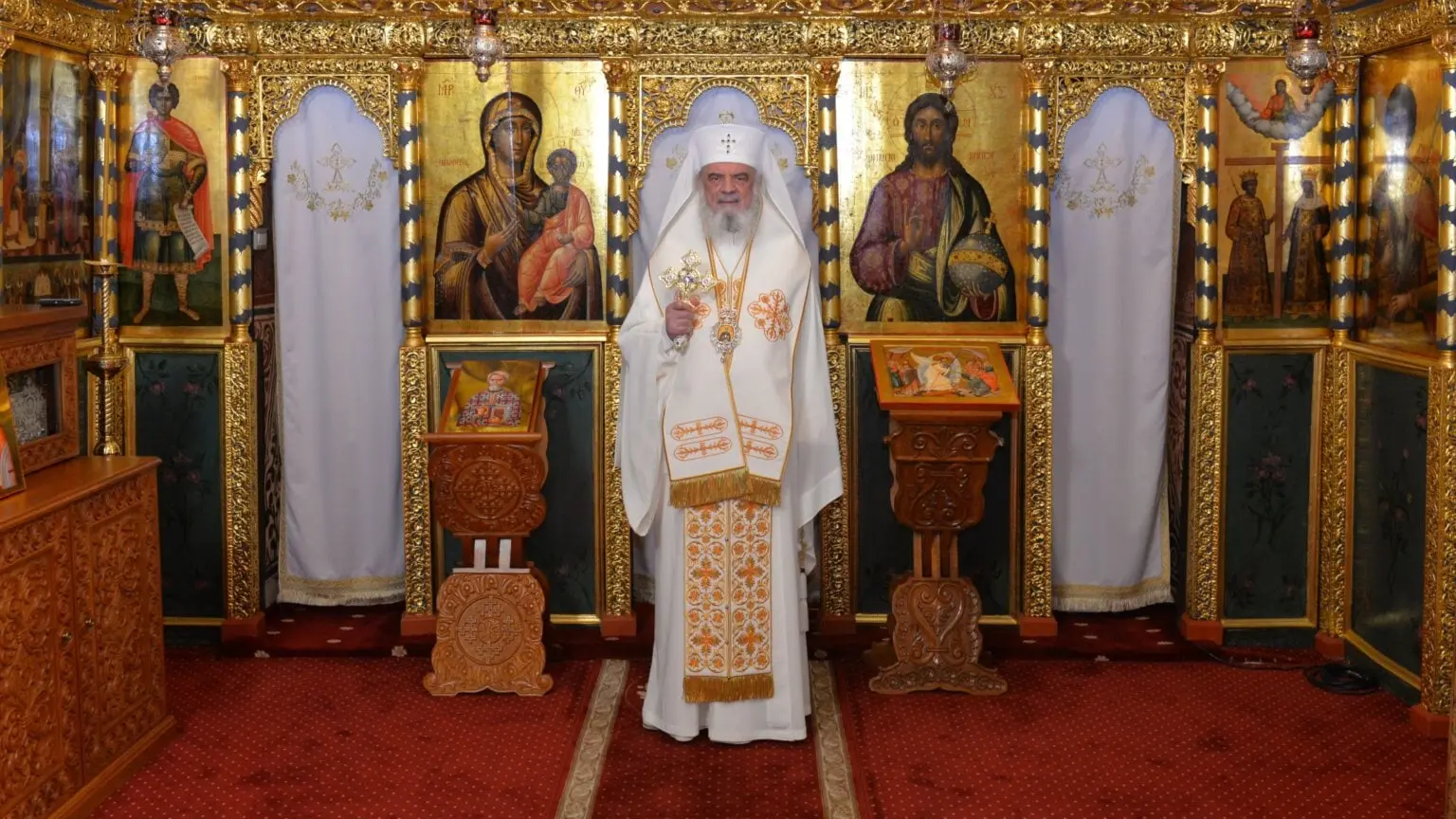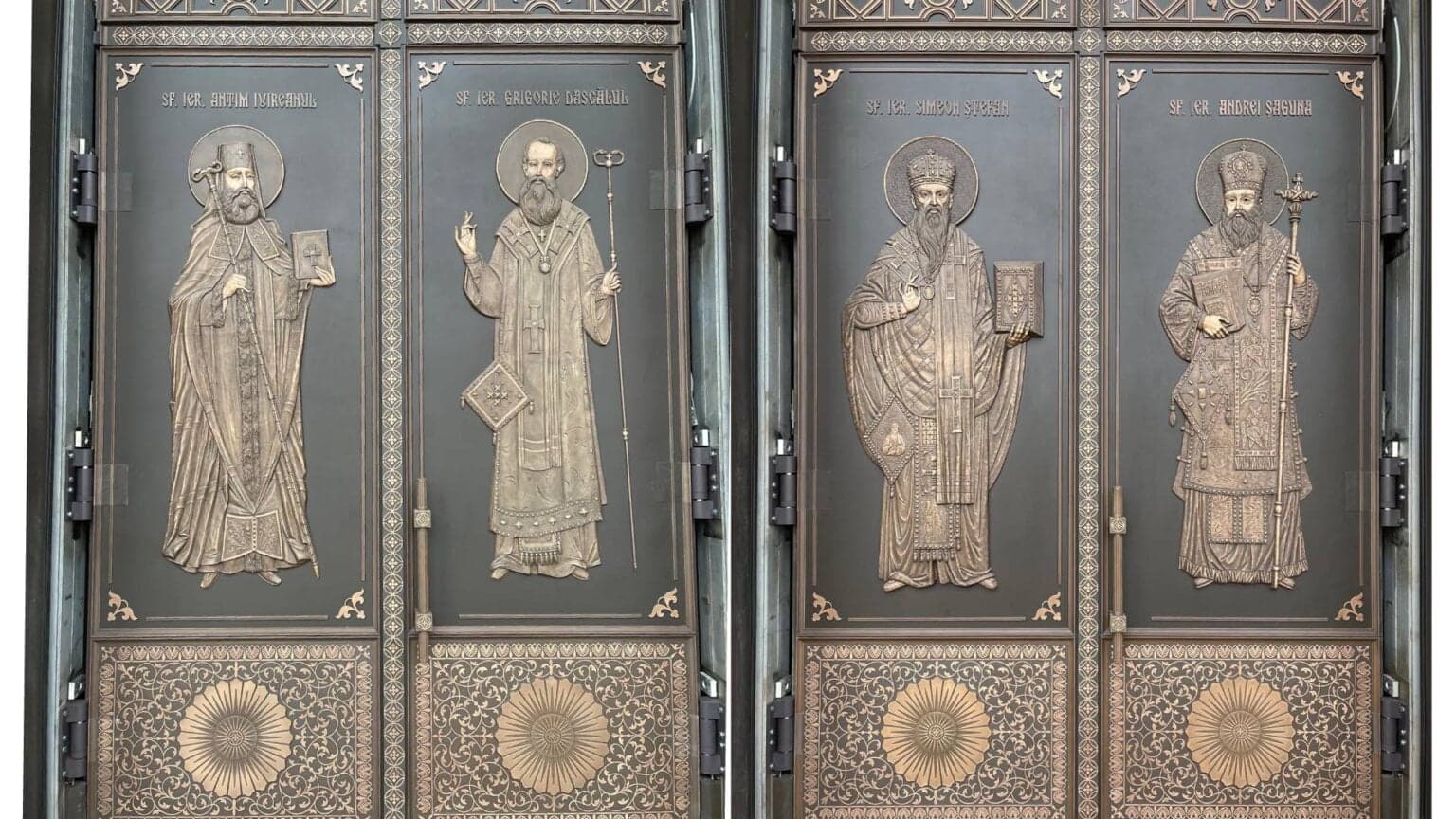
The entrance to the National Cathedral in Bucharest is made possible through 27 bronze doors depicting our Saviour Jesus Christ, the Mother of God, the Holy Apostles, as well as several Romanian saints.
The doors are a distinctive feature of the church; each weighs approximately 800 kilograms and is operated by an automatic opening and closing system.
For the solemn consecration on October 26, brochures have been prepared to help the faithful better understand the symbolism of the elements of the National Cathedral of Romania.
Please find below the French, Italian and Greek translations of the text.
The bronze doors of the National Cathedral
Entrance into the Romanian People’s Salvation Cathedral is made through a series of monumental gates that are not merely access points, but symbolically mark the crossing from the profane to the sacred, from earth to heaven.
Ascending the steps towards the entrance of the National Cathedral, we are greeted – upon the main doors – by the Mother of God and by our Saviour Jesus Christ. To the left and right of the main doors are three other doors, each depicting two of the Twelve Apostles of our Saviour Jesus Christ. Saint Andrew the Apostle is placed next to the Mother of God, as he is the Protector of Romania and the second patron saint of the National Cathedral (the principal patronal feast is the Ascension of the Lord).
The iconographic programme continues on all sides of the holy edifice, with over 20 Romanian Saints and 7 Daco-Roman Saints, including hierarchs, martyrs, and venerable monastics.
In this way is fulfilled the vision of His Beatitude Patriarch Daniel, who stated in 2017 that this Cathedral is truly “the Cathedral of the Romanian Saints of all times and from all regions of the country.”
The saints are arranged as follows:
Principal Entrance Doors
- Right: Our Lord Jesus Christ
- Left: The Mother of God
In the proximity of the main entrance (on the façade)
- Right: The Holy Apostles Peter and Paul, Philip and Matthew, Thomas and Bartholomew
- Left: The Holy Apostles Andrew and John, Simon and James, Jude Thaddeus and James the son of Alphaeus
Narthex
- Right: Saint John Jacob of Neamț and Saint George the Trophy-bearer; Saints Photios the Great and Niphon, Patriarchs of Constantinople; Saints Basil the Great and Gregory the Theologian, Saint John Chrysostom and Saint Nicholas; Saint Hyacinthus of Vicina and Saint Bretanion of Tomis
- Left: Saints Theodora of Sihla and Paraskeva of Iași; Saints Callinicus of Cernica and Joseph the New of Partoș; Saints Anthimos of Iberia and Gregory the Teacher; Saints Simeon Stephen and Andrew Șaguna; Saints Barlaam and Dositheus of Moldavia
Nave
- Right: The Holy Brâncoveanu Martyrs; Saints Montanus and Maxima, Martyrs; Saints Paisius of Neamț and Nicodemus of Tismana; Saints Germanus of Dobruja and John Cassian
- Left: Saints Theotimus and Ephrem of Tomis; Saints John the Wallachian and John the New of Suceava, Martyrs; Saints Parthenius and Raphael of Agapia; Saint Sophronius of Cioara, Martyr, and Saint Bessarion Sarai, Venerable Confessor
Altar
- Right: Saint Theoctistus and Saint Peter Mogila, Metropolitan of Kyiv
- Left: Saint Stephen the Great, Prince of Moldavia, and Saint Daniel the Hesychast
Beyond their spiritual beauty, the 27 bronze doors, crafted by the German company Strassacker, conceal a complex security system designed to safeguard the approximately 5,000 people that the Cathedral can accommodate.
The system is monitored from three distinct command rooms and is fully integrated into the Building Management System (BMS).
In the event of a fire, the system is programmed to simultaneously open all 54 door panels. This coordinated action ensures not only the rapid evacuation of people but also the expulsion of smoke.
Each door panel weighs around 800 kilograms. To prevent accidents, the opening is continuously monitored, and a magnetic braking system controls the uncontrolled acceleration of the doors.
The doors are connected both to the main electrical grid and to a backup generator. Should the main supply fail, the generator automatically starts, ensuring uninterrupted operation of the safety system.
The more than 50 saints, sculpted upon each bronze door, stand as steadfast guardians watching over the National Cathedral — silent, yet no less present witnesses to the holiness of this place, the Church of Christ, the dwelling place of the Most Holy Trinity.
Please see all leaflets in 4 languages here.
Download the leaflet in English in *pdf format here.
Les portes de bronze de la Cathédrale Nationale
L’entrée dans la Cathédrale Nationale se fait par une série de 27 portes monumentales qui ne sont pas de simples voies d’accès, mais elles marquent symboliquement aussi le seuil entre le mondain et le sacré, entre la terre et le ciel.
En gravissant les marches menant à l’entrée de la Cathédrale, les fidèles sont accueillis par la Mère de Dieu et par le Sauveur Jésus-Christ, dont les icônes figurent sur les portes principales d’accès. À gauche et à droite de ces portes centrales se trouvent six autres portes, chacune ornée de la représentation de deux des Douze Apôtres du Seigneur. L’Apôtre André se tient immédiatement auprès de la Mère de Dieu, en raison de son statut de Protecteur spirituel de la Roumanie et de second Patron spirituel de la Cathédrale (le premier étant l’Ascension du Seigneur).
Le programme iconographique des portes de bronze se poursuit sur toutes les faces de l’édifice, avec plus de 20 saints roumains et 7 saints daco-romains, incluant des hiérarques, des martyrs et des ascètes. Ainsi se confirme la parole de Sa Béatitude Daniel, Patriarche de Roumanie, qui déclarait en 2017 que cette Cathédrale est « celle des saints roumains de tous les temps et de toutes les régions du pays ».
La disposition de ces saints est la suivante :
Portes principales d’accès
Droite : le Sauveur Jésus-Christ
Gauche : la Mère de Dieu
À proximité des portes principales (la façade)
Droite : les saints apôtres Pierre et Paul, Philippe et Matthieu, Thomas et Bartholomé
Gauche : les saints apôtres André et Jean, Simon et Jacques, Jude Thaddée et Jacques d’Alphée
Pronaos
Droite : saint Jean Jacob de Neamț et saint martyr Georges ; les saints hiérarques Photius le Grand et Niphon de Constantinople ; les saints hiérarques Basile le Grand et Grégoire le Théologien, Jean Chrysostome et Nicolas ; Iachint de Vicina et Bretanion de Tomis
Gauche : les saintes moniales Théodora de Sihla et Parascève de Iași ; les saints hiérarques Callinique de Cernica et Joseph le Nouveau de Partoș, Anthime l’Ibère et Grégoire Dascălu, Siméon Ștefan et André Șaguna, Varlaam et Dosithée de Moldavie
Naos
Droite : les saints martyrs Brâncoveanu ; les saints martyrs Montanus et Maxima ; les saints moines Païssios de Neamț et Nicodème de Tismana, Germain de Dobroudja et Jean Cassien
Gauche : les saints hiérarques Théotim et Éphrem de Tomis ; les saints martyrs Jean le Valachien et Jean le Nouveau de Suceava ; les saints moines Parténios et Raphaël d’Agapia ; saint martyr Sophrone de Cioara et saint Visarion Sarai
L’Autel
Droite : saint moine Théoctiste et saint hiérarque Pierre Moghila
Gauche : saint voïvode Étienne le Grand et saint Daniel l’Ermite
Au-delà de leur beauté spirituelle, les 27 portes de bronze, réalisées par la firme allemande Strassacker, dissimulent un système de sécurité complexe, conçu pour protéger les quelque 5 000 personnes que peut accueillir la cathédrale.
Le système est surveillé depuis trois salles de commande distinctes et intégré au système de gestion centralisée du bâtiment (BMS). En cas d’incendie, il est programmé pour ouvrir simultanément l’ensemble des 54 vantaux des portes, action permettant non seulement l’évacuation rapide des personnes, mais aussi l’évacuation des fumées.
Chaque vantail pèse environ 800 kilogrammes. Afin de prévenir tout accident, leur ouverture est constamment monitorée et un système de freinage magnétique régule toute accélération incontrôlée des portes.
Les portes sont reliées à la fois au réseau électrique principal et à un générateur de secours. En cas de défaillance de l’alimentation principale, le générateur démarre automatiquement, assurant le fonctionnement ininterrompu du dispositif de sécurité.
Plus de 50 saints, représentés en relief sur chaque vantail de bronze, se tiennent tels des sentinelles célestes, veillant sur la Cathédrale Nationale, et tels des témoins silencieux, mais non moins présents, de la sainteté de ce lieu, église du Christ et maison de la Très Sainte Trinité.
Le Porte di Bronzo della Cattedrale Nazionale
L’ingresso nella Cattedrale della Salvezza della Nazione si fa attraverso una serie di porte monumentali che non sono semplici vie d’accesso, ma segnano simbolicamente il passaggio tra il profano e il sacro, tra la terra e il cielo.
Salendo i gradini che conducono all’ingresso della Cattedrale Nazionale, alle principali porte d’accesso ci accolgono la Madre di Dio e Il Salvatore Gesù Cristo. A sinistra e a destra delle porte principali si trovano altre tre porte, ciascuna delle quali rappresenta due dei 12 Apostoli del Salvatore Gesù Cristo. Il Santo Apostolo Andrea si trova in stretta prossimità della Madre di Dio, in quanto protettore della Romania e secondo santo patrono della Cattedrale Nazionale (il principale è l’Ascensione del Signore).
Il programma iconografico prosegue su tutti i lati del sito con oltre 20 santi romeni e 7 santi daco-romani, tra cui gerarchi, martiri e pii devoti.
Si realizza così la visione di Sua Beatitudine il Patriarca Daniel, che nel 2017 affermò che questa cattedrale è “dei santi romeni di tutti i tempi e di tutte le zone del Paese”.
Questi santi sono disposti come segue:
Porte d’accesso principali
- A destra: Il Salvatore Gesù Cristo
- A sinistra: La Madre di Dio
In prossimità delle porte principali (facciata)
- A destra: I Santi Apostoli Pietro e Paolo, Filippo e Matteo, Tommaso e Bartolomeo
- A sinistra: I Santi Apostoli Andrea e Giovanni, Simeone e Giacomo, Giuda Taddeo e Giacomo d’Alfeo
Pronao
- A destra: San Giovanni Giacomo di Neamț e San Marco Giorgio; I Santi Gerarchi Fozio il Grande e Nifone di Costantinopoli; I Santi Gerarchi Basilio il Grande e Gregorio il Teologo, Giovanni Crisostomo e Nicola, Giacinto di Vicina e Bretanione di Tomis
- A sinistra: Santa Pia Teodora di Sihla e Parascheva di Iași; I Santi Callinico di Cernica e Giuseppe il Nuovo di Partos, Antimo l’Iviriano e Gregorio il Maestro, Simeone Stefano e Andrea Saguna, Varlaam e Dosoftei di Moldavia
Navata
- A destra: I Santi Martiri Brancoveni; I Santi Martiri Montano e Massima; I Santi Venerabili Paisio di Neamț e Nicodemo di Tismana, Germano di Dobrugia e Giovanni Cassiano
- A sinistra: I Santi Gerarchi Teotimo ed Efrem di Tomis; I Santi Martiri Giovanni il Valacco e Giovanni il Nuovo di Suceava; I Santi Venerabili Partenio e Raffaele di Agapia; San Marco Sofronio di Cioara e il Santo Venerabile Visarion di Sarai
Altare
- A destra: il Santo Venerabile Teoctist e il Santo Gerarca Petru Movila
- A sinistra: il Santo Principe Stefano il Grande e San Daniele l’Eremita
Oltre alla loro bellezza spirituale, le 27 porte di bronzee, realizzate dall’azienda tedesca Strassacker, nascondono un complesso sistema di sicurezza, progettato per proteggere le circa 5.000 persone che la cattedrale può ospitare.
Il sistema è monitorato da tre sale di controllo separate ed è integrato nel sistema di gestione dell’edificio (BMS).
In caso di incendio, il sistema è programmato per aprire tutte le 54 porte (battenti delle porte) simultaneamente. Questa azione coordinata consente non solo la rapida evacuazione delle persone, ma anche del fumo.
Ogni battente pesa circa 800 chilogrammi. Per prevenire incidenti, l’apertura è costantemente monitorata e un sistema di frenatura magnetica controlla l’accelerazione incontrollata delle porte.
Le porte sono collegate alla rete elettrica principale, ma anche a un generatore di riserva. In caso di interruzione della rete elettrica principale, il generatore si avvia automaticamente, garantendo il funzionamento ininterrotto del sistema di sicurezza.
Gli oltre 50 santi, rappresentati in scultura su ogni porta bronzea, che, come sentinelle, vegliano sulla Cattedrale Nazionale, rimangono testimoni silenziosi, ma non per questo meno presenti, testimoni della santità di questo luogo chiesa di Cristo, dimora della Santissima Trinità.
ΟΙ ΧΑΛΚΙΝΕΣ ΘΥΡΕΣ
Η είσοδος στον Ιερό Καθεδρικό Ναό της Σωτηρίας του Έθνους γίνεται διά μίας σειράς μνημειωδών πυλών, οι οποίες δεν αποτελούν απλώς οδούς πρόσβασης, αλλά σημειώνουν συμβολικώς τη μετάβαση από το βέβηλο στο ιερό, από τη γη προς τον ουρανό.
Αναβαίνοντας τα σκαλοπάτια προς την είσοδο του Ιερού Εθνικού Καθεδρικού Ναού, στις κύριες θύρες πρόσβασης μας υποδέχονται η Υπεραγία Θεοτόκος και ο Σωτήρ ημών Ιησούς Χριστός. Αριστερά και δεξιά των κύριων θυρών υπάρχουν άλλες τρεις θύρες· επί εκάστης εξ αυτών απεικονίζονται δύο Απόστολοι εκ των δώδεκα του Κυρίου ημών Ιησού Χριστού.
Ο Άγιος Απόστολος Ανδρέας ευρίσκεται πλησίον της Θεοτόκου, κατόπιν του γεγονότος ότι είναι ο Προστάτης της Ρουμανίας, ενώ η τιμή του αποτελεί και τη δεύτερη πανηγυρική εορτή του Ιερού Εθνικού Καθεδρικού Ναού (η κύρια πανηγυρική εορτή είναι η Ανάληψη του Κυρίου).
Το εικονογραφικό πρόγραμμα συνεχίζεται, κατά μήκος όλων των πλευρών του Ιερού Ναού, με πλέον των είκοσι Ρουμάνων Αγίων και επτά Δακορωμαίων Αγίων, περιλαμβάνοντας αρχιερείς, μάρτυρες και οσίους.
Τοιουτοτρόπως, εκπληρούται η όραση του Μακαριωτάτου Πατρός ημών Πατριάρχου Δανιήλ, ο οποίος δήλωσε, το 2017, ότι αυτός ο Ιερός Καθεδρικός Ναός είναι «των Ρουμάνων Αγίων εξ απάντων των χρόνων και εκ πασών των περιοχών της χώρας».
Οι Άγιοι αυτοί είναι διατεταγμένοι ως εξής:
Επί των κύριων θυρών εισόδου: Δεξιά: Ο Σωτήρ ημών Ιησούς Χριστός· Αριστερά: Η Υπεραγία Θεοτόκος.
Πλησίον των κύριων θυρών (πρόσοψη): Δεξιά: Οι Άγιοι Απόστολοι Πέτρος και Παύλος, Φίλιππος και Ματθαίος, Θωμάς και Βαρθολομαίος· Αριστερά: Οι Άγιοι Απόστολοι Ανδρέας και Ιωάννης, Συμεών και Ιάκωβος, Ιούδας ο Θαδδαίος και Ιάκωβος του Αλφαίου.
Εν τω προνάω: Δεξιά: Ο Άγιος Ιωάννης Ιάκωβος ο εκ Νεάμτς και ο Άγιος Μεγαλομάρτυς Γεώργιος· οι Άγιοι Φώτιος ο Μέγας και Νήφων Κωνσταντινουπόλεως· οι Άγιοι Βασίλειος ο Μέγας και Γρηγόριος ο Θεολόγος, Ιωάννης ο Χρυσόστομος και Νικόλαος, Ιάκινθος Βικίνης και Βρετάνιος Τόμιδος· Αριστερά: Οι Όσιες Θεοδώρα της Σίχλας και Παρασκευή Επιβατηνή η εν Ιασίω· οι Άγιοι Καλλίνικος της Τσερνίκας και Ιωσήφ ο Νέος του Πάρτος, Άνθιμος ο Ιβηρίτης και Γρηγόριος ο Διδάσκαλος, Συμεών Στέφανος και Ανδρέας Σαγκούνα, Βαρλαάμ και Δοσίθεος Μολδαβίας.
Εν τω ναώ: Δεξιά: Οι Άγιοι Μάρτυρες Μπρανκοβένοι· οι Άγιοι Μάρτυρες Μοντανός και Μαξίμη· οι Όσιοι Παΐσιος ο εκ Νεάμτς και Νικόδημος ο εκ Τισμάνας, Γερμανός ο εκ Δοβρουτσάς και Ιωάννης ο Κασσιανός· Αριστερά: Οι Άγιοι Θεότιμος και Εφραίμ Τόμιδος· οι Άγιοι Μάρτυρες Ιωάννης ο Βλάχος και Ιωάννης ο Νέος εκ Σουτσεάβας· οι Όσιοι Παρθένιος και Ραφαήλ εκ Αγαπίας· ο Άγιος Μάρτυς Σωφρόνιος εκ Τσιοάρας και ο Όσιος Βησσαρίων Σαράι.
Εν τω Ιερώ Βήματι: Δεξιά: Ο Όσιος Θεόκτιστος και ο Άγιος Πέτρος Μογίλας· Αριστερά: Ο Άγιος Ηγεμών Στέφανος ο Μέγας και ο Όσιος Δανιήλ ο Ησυχαστής.
Πέρα από την πνευματική τους ομορφιά, οι 27 χάλκινες θύρες, που κατασκευάστηκαν από τη γερμανική εταιρεία Strassacker, κρύβουν ένα πολυσύνθετο σύστημα ασφαλείας, σχεδιασμένο για την προστασία των περίπου 5.000 χιλιάδων πιστών, που δύναται να φιλοξενεί ο Ιερός Καθεδρικός Ναός.
Το σύστημα παρακολουθείται από τρεις χωριστές κάμερες ελέγχου και είναι ενσωματωμένο στο σύστημα διαχείρισης του κτηρίου (BMS).
Σε περίπτωση πυρκαγιάς, το σύστημα είναι προγραμματισμένο να ανοίγει ταυτοχρόνως και τα 54 φύλλα των θυρών. Αυτή η συντονισμένη ενέργεια επιτρέπει όχι μόνο την ταχεία εκκένωση των παρισταμένων προσώπων, αλλά και την απομάκρυνση του καπνού.
Έκαστο φύλλο θύρας ζυγίζει περίπου 800 κιλά. Για να προληφθούν τυχόν ατυχήματα, η διαδικασία ανοίγματος παρακολουθείται συνεχώς, ενώ ένα μαγνητικό σύστημα φρεναρίσματος ελέγχει την ανεξέλεγκτη επιτάχυνση των θυρών.
Οι θύρες συνδέονται με το κεντρικό ηλεκτρικό δίκτυο, αλλά και με μία εφεδρική γεννήτρια. Εάν η κύρια πηγή ενέργειας παύσει να λειτουργεί, η γεννήτρια τίθεται αυτόματα σε λειτουργία, εξασφαλίζοντας την αδιάκοπη λειτουργία του συστήματος ασφαλείας.
Οι 50 και πλέον Άγιοι, που απεικονίζονται γλυπτικώς επάνω σε κάθε χάλκινη θύρα και, ως φύλακες, αγρυπνούν επάνω από τον Ιερό Εθνικό Καθεδρικό Ναό, μένουν σιωπηλοί μάρτυρες, αλλά όχι λιγότερο παρόντες, της αγιότητας του τόπου τούτου, δηλαδή της Εκκλησίας του Χριστού, οίκου της Παναγίας Τριάδος.
Photo: Basilica.ro