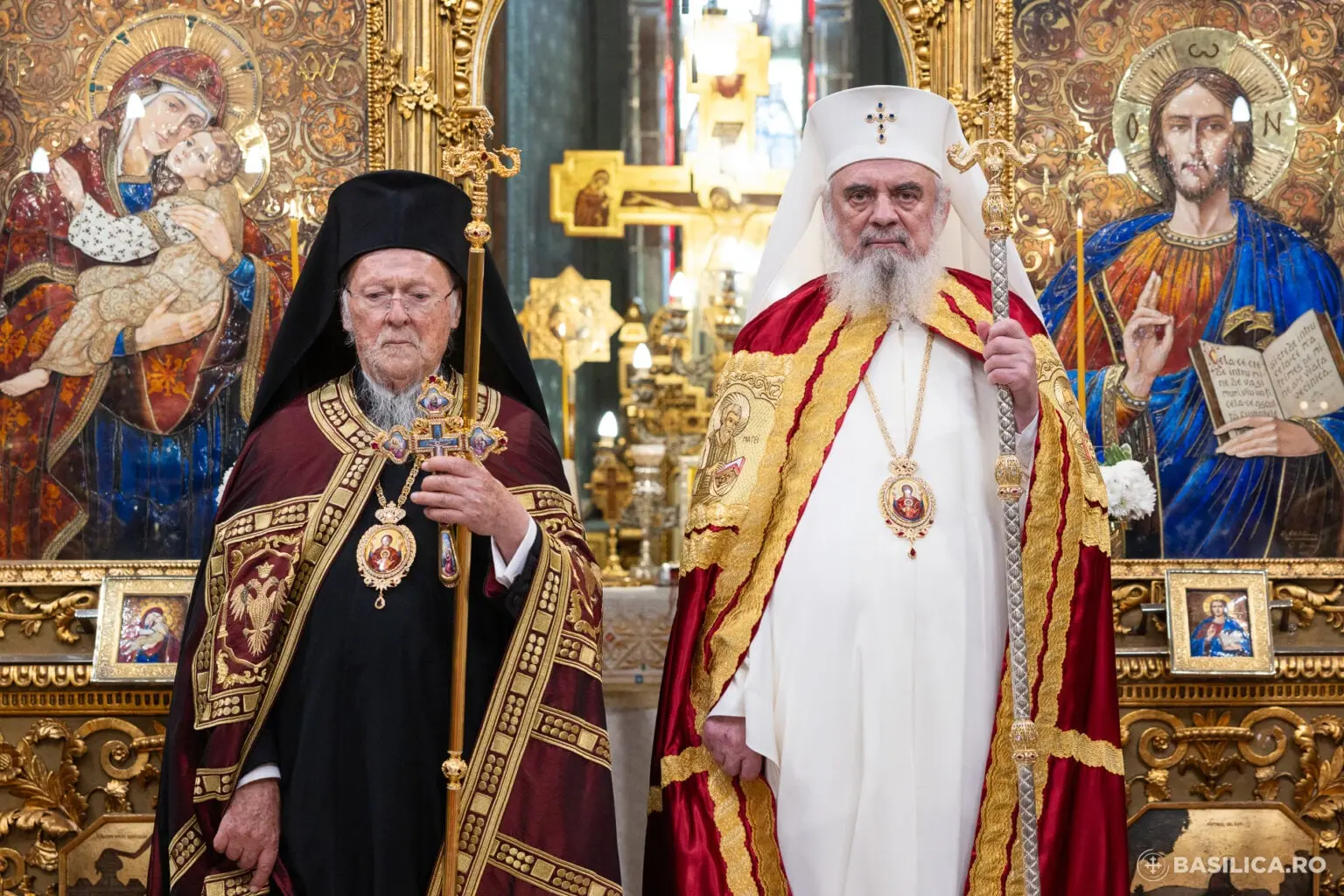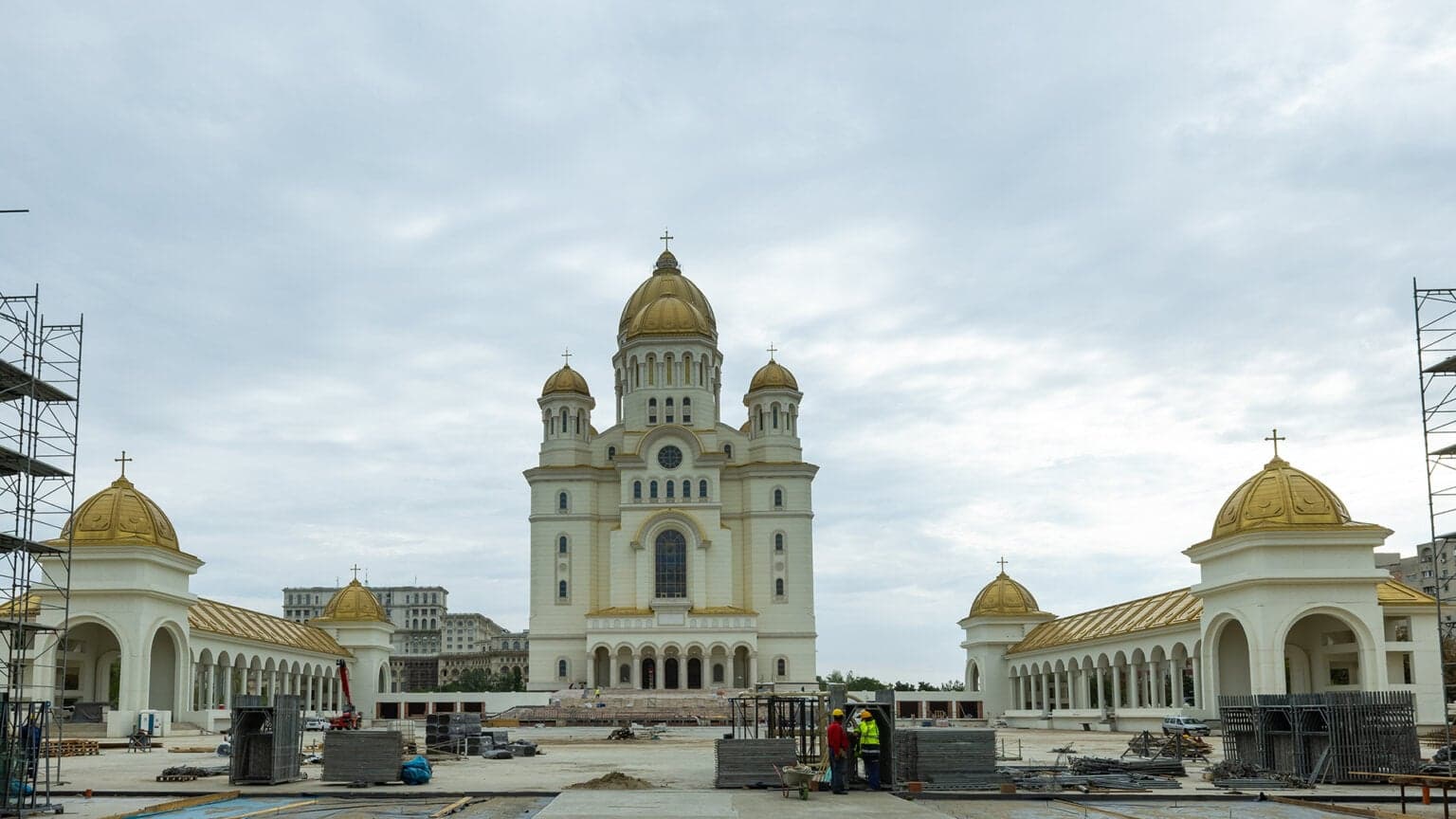
Major feast days gather thousands of faithful for the Divine Liturgy, as recently witnessed during the pilgrimage to Saint Paraskeva in Iași, where approximately 30,000 people attended the service celebrated at an outdoor altar.
On such occasions, the Divine Liturgy at the National Cathedral will be celebrated at an outdoor altar, making it possible for more people to take part in the service.
The summer altar will be set up, when needed, in front of the cathedral’s main porch, allowing the Divine Liturgy to be officiated in the open air. The square at the entrance of the cathedral can accommodate around 23,000 worshippers during religious services.
French, Italian and Greek translations available below.
The Porticos and Porches of the National Cathedral
The main access into the National Cathedral is made through a monumental porch with arches, located on the western side. Together with the lateral porticos and those outlining the esplanade, it forms a defining part of the architectural ensemble of the Cathedral.
The architecture of the Cathedral represents a synthesis between tradition and contemporaneity, harmonising architectural elements from various regions of Romania (Moldavian recessed niches, Brâncovenesque porches, and slender Transylvanian towers), along with monumental elements inspired by certain Western cathedrals, taking into account the fact that today a large part of the Romanian diaspora resides in the West. The ground plan of the ensemble expresses the liturgical and missionary character highlighted by the very theme of this work of architecture.
The porch at the main entrance, located on the western façade, impresses by its size and the elegance of its arches. It serves not only a functional role, protecting the entrance, but also a symbolic one, preparing and receiving the faithful for their entrance into the sacred space of the church.
The median exonarthex, vestibule or foyer, is conceived as an extension of the porch, in the form of an enclosed porch, symbolising liturgical communion and the hospitality characteristic of Romanian spirituality. Three additional open porches are situated on the eastern, southern, and northern sides of the National Cathedral.
The lateral porticos, to the north and south, are annexed structures extended in sequences of columns, designed to define the exterior liturgical space, with a built surface of 5,159.20 square meters and a volume of 28,712 cubic metres. These structures mark the outline of the Outdoor Altar of the National Cathedral. The curved porticos on the south-western and north-western sides, totaling 2,079.60 square metres and a built volume of 15,285.60 cubic metres, mark the principal entrance into the precincts of the Cathedral ensemble.
The typology of the columns in the porches of the National Cathedral pays homage to one of the most remarkable architectural creations of the national heritage: the style of Neo-Romanian architecture. This represents a re-interpretation of Brâncovenesque architecture, with vegetal ornaments carved at the bases of the columns, organic stylisation of stone folds draping the columns, and the delicate structure of volutes and acanthus leaves sculpted into the capitals.
The symbolic root of the acanthus leaf, chosen as a decorative motif, is connected with the symbol of eternal life. Over time, the plant has become a fundamental element in the representation of rebirth and Resurrection, and therefore is fittingly placed both at the base and at the top of the columns, as a sign of supporting the entire edifice.
The materials used in the construction of the porches and porticos — stone and reinforced concrete — ensure the durability and monumentality of the ensemble, designed to endure for centuries as a testimony of the Romanian people’s faith and national identity.
“This Cathedral must be an architectural symbol of the supreme liturgical moment, that of the Holy Eucharist — the communion with Christ, One of the Holy Trinity. For this reason, it is necessary to represent it through a configuration symbolising the CHALICE.
The cup of the Chalice will thus encompass the edifice of the Cathedral, wherein the Holy Sacraments will be celebrated. At the centre of the cup rises the church itself, which, as a sign of its missionary and uplifting vocation, will have the Pantocrator dome as its crown, surmounted by the Latin Cross.
The foot of the Chalice, which symbolises the infinite love of the Holy Trinity embracing the entire created universe, will be represented by rows of lampstands placed in elliptical form, a sign of the Church’s missionary work, its call to the faithful toward humility and repentance, and its invitation to eternal communion with God. These two luminous arms of the foot of the Chalice will define the precinct in which, on the major feast days, the faithful will be able to take part in the Divine Liturgy celebrated outside the Cathedral.”
† DANIEL
Patriarch of the Romanian Orthodox Church
Download the free PDF flyer
Please see all leaflets in 4 languages here.
Les portiques et les porches de la Cathédrale Nationale
L’accès principal à la Cathédrale Nationale se fait par un porche monumental à arcades, situé sur la façade ouest. Ce porche d’entrée, avec les portiques latéraux et ceux qui délimitent l’esplanade, constitue une partie essentielle de l’ensemble architectural de la Cathédrale.
L’architecture de l’édifice représente une synthèse entre tradition et contemporanéité, harmonisant des éléments issus de différentes régions de Roumanie (les niches moldaves, les porches brancovéniens, les tours élancées de Transylvanie), mais aussi des éléments de monumentalité inspirés de certaines cathédrales occidentales, en considération du fait qu’une grande partie de la diaspora roumaine vit aujourd’hui en Occident. La configuration spatiale traduit le caractère liturgique et missionnaire, inspiré par la thématique de cette œuvre architecturale.
Le porche de l’entrée principale, sur la façade ouest, impressionne par ses dimensions et par l’élégance de ses arcades. Outre sa fonction pratique de protection de l’accès, il revêt une valeur symbolique d’accueil et de préparation des fidèles avant leur entrée dans l’espace sacré de l’église. L’exonarthex médian, vestibule ou foyer, conçu comme une extension close du porche, exprime le lien entre la communion liturgique et l’hospitalité qui éclaire la spiritualité roumaine. Trois autres porches ouverts se trouvent à l’est, au sud et au nord de la Cathédrale Nationale.
Les portiques latéraux nord et sud sont des structures annexes, formées de suites de colonnes, qui délimitent l’espace liturgique extérieur. Ils couvrent une surface construite de 5 159,20 m² et un volume de 28 712 m³, marquant le contour du Sanctuaire d’été de la Cathédrale. Les portiques curvilignes sud-ouest et nord-ouest, d’une surface totale de 2 079,60 m² et d’un volume de 15 285,60 m³, marquent l’entrée principale dans l’enceinte du complexe cathédral.
La typologie des colonnes des porches rend hommage à l’une des créations les plus remarquables de l’art architectural national : le style néo-roumain. Ce dernier réinterprète l’architecture brancovénienne, par l’ornementation végétale des bases des colonnes, la stylisation organique des plis de pierre qui les drapent et la finesse sculpturale des volutes et des feuilles d’acanthe des chapiteaux. La racine symbolique des feuilles d’acanthe, choisies comme motif décoratif, est liée au symbole de la vie éternelle. Cette plante, devenue au fil du temps un élément fondamental dans la représentation de la renaissance et de la Résurrection, n’est pas placée au hasard à la base et dans la partie supérieure des colonnes : elle symbolise le soutien structurel de l’édifice tout entier.
Les matériaux employés dans la construction des porches et des portiques, tels que la pierre et le béton armé, garantissent la durabilité et la monumentalité de l’ensemble, conçu pour traverser les siècles comme témoignage de la foi et de l’identité nationale roumaine.
Selon le patriarche Daniel,
« Cette Cathédrale doit être un symbole architectural du moment liturgique suprême, celui de l’Eucharistie, de la communion avec le Christ, Un de la Sainte Trinité. D’où l’exigence d’une configuration symbolisant le “Calice”. La coupe de ce calice symbolique englobera ainsi l’édifice cathédral, voué à la célébration des Saints Mystères. En son centre s’élèvera l’église, dont la tour du Pantocrator – couronnée d’une croix latine – manifestera sa vocation missionnaire et d’élévation spirituelle.
Le pied du calice, symbole de l’amour infini de la Sainte Trinité embrassant l’univers créé, sera représenté par des lampadaires disposés en forme d’ellipse, signe de l’œuvre missionnaire de l’Église, de son appel aux fidèles à l’humilité et à la repentance, mais aussi de l’invitation des hommes à la communion éternelle avec Dieu. Ces deux bras lumineux du pied du calice délimiteront l’espace où, lors des grandes fêtes, les fidèles pourront suivre la célébration de la Divine Liturgie à l’extérieur de la Cathédrale ».
I Portici e le verande della Cattedrale Nazionale
L’accesso principale alla Cattedrale Nazionale si fa attraverso un portico monumentale, con arcate, situato sul lato ovest, che, insieme ai portici laterali e a quelli che delineano la spianata, costituisce una parte caratterizzante del complesso architettonico della Cattedrale.
L’architettura della Cattedrale rappresenta una sintesi tra tradizione e contemporaneità, armonizzando elementi architettonici provenienti da diverse aree della Romania (i chiostri moldavi, i portici in stile Brâncoveanu e le snelle torri della Transilvania), nonché elementi monumentali di alcune cattedrali occidentali, tenendo conto che, oggi, gran parte della diaspora romena si trova in Occidente. La conformazione planimetrica del complesso rispecchia il carattere liturgico-missionario enfatizzato dal tema di quest’opera architettonica.
Il portico dell’ingresso principale, situato sul lato ovest, colpisce per le sue dimensioni e l’eleganza degli archi. Svolge non solo un ruolo funzionale, proteggendo l’ingresso, ma anche simbolico, accogliendo e preparando i fedeli all’ingresso nello spazio sacro della chiesa. L’esonartece mediano, vestibolo o foyer, è concepito come un’estensione del portico sotto forma di un portico chiuso, a simboleggiare la comunione liturgica e l’ospitalità caratteristica della spiritualità romena. Altri tre portici aperti si trovano nelle parti orientale, meridionale e settentrionale della Cattedrale Nazionale.
I portici laterali, settentrionale e meridionale sono strutture annesse, estese in sequenze di colonne, destinate a delimitare lo spazio liturgico esterno, per una superficie edificata di 5.159,20 metri quadrati e un volume di 28.712 metri cubi. Questi edifici delineano il contorno del Santo Altare Estivo della Cattedrale Nazionale. I portici curvi da sud-ovest e nord-ovest, che totalizzano 2.079,60 metri quadrati e un volume di costruzione di 15.285,60 metri cubi, segnano l’ingresso principale al complesso della Cattedrale.
La tipologia delle colonne nei portici della Cattedrale Nazionale rende omaggio a una delle creazioni architettoniche più notevoli dell’arte nazionale: lo stile architettonico neo-romeno. Rappresenta una reinterpretazione dell’architettura in stile Brâncoveanu, attraverso la lavorazione delle basi delle colonne con ornamenti vegetali, la stilizzazione organica delle pieghe in pietra che drappeggiano le colonne e la delicata struttura della scultura delle volute e delle foglie d’acanto del capitello. La radice simbolica delle foglie d’acanto, scelta come motivo decorativo, è legata al simbolo della vita eterna, la pianta divenuta nel tempo un elemento fondamentale nella rappresentazione della rinascita e della Resurrezione, non a caso è situata alla base e alla sommità delle colonne, come simbolo di sostegno dell’intero edificio.
I materiali utilizzati nella costruzione dei portici e delle verande, come la pietra e il cemento armato, garantiscono la durevolezza e la monumentalità dell’insieme, progettato per durare nei secoli, testimonianza della fede romena e dell’identità nazionale.
“Questa Cattedrale deve essere un simbolo architettonico del momento liturgico supremo, quello dell’Eucaristia, della comunione con Cristo, Uno della Santissima Trinità. Per questo è necessario rappresentarla attraverso una configurazione che simbolizzi il «CALICE». La coppa del calice racchiuderà quindi l’edificio della Cattedrale in cui saranno celebrati i Santi Misteri. Al centro della coppa, la chiesa che si eleva, avrà come segno della sua vocazione missionaria ed esaltante, la guglia del Pantocratore, coronata dalla croce latina.
Il piede del calice, che simboleggia l’amore infinito della Santissima Trinità che abbraccia l’intero universo creato, sarà rappresentato da candelabri disposti a forma di ellisse, segno dell’opera missionaria della Chiesa, della sua esortazione ai fedeli all’umiltà e al pentimento, ma anche della chiamata degli uomini alla comunione eterna con Dio. Questi due bracci luminosi della base del calice delimiteranno il recinto in cui, nelle grandi feste, i fedeli potranno seguire la celebrazione della Santa Liturgia fuori dalla Cattedrale”.
† DANIEL
Patriarca della Chiesa Ortodossa Romena
ΟΙ ΣΤΟΕΣ ΚΑΙ ΤΑ ΠΡΟΠΥΛΑΙΑ
Ἡ κύρια εἴσοδος στὸν Ἱερὸ Ἐθνικὸ Καθεδρικὸ Ναὸ γίνεται διὰ ἑνὸς μνημειώδους προπυλαίου, μὲ ἀψίδες, ποὺ βρίσκεται στὴ δυτική του πλευρά. Τὸ προπύλαιο αὐτό, μαζὶ μὲ τὶς πλάγιες στοὲς καὶ ἐκεῖνες ποὺ περιβάλλουν τὴν ἐσπλανάδα, ἀποτελοῦν ἕνα καθοριστικὸ μέρος τοῦ ἀρχιτεκτονικοῦ συνόλου τοῦ Ἱεροῦ Καθεδρικοῦ Ναοῦ.
Ἡ ἀρχιτεκτονικὴ τοῦ Ἱεροῦ Ἐθνικοῦ Καθεδρικοῦ Ναοῦ ἀποτελεῖ σύνθεση μεταξὺ παραδόσεως καὶ συγχρονικότητας, ἐναρμονίζοντας ἀρχιτεκτονικὰ στοιχεῖα ἀπὸ διάφορες περιοχὲς τῆς Ρουμανίας (μολδαβικὲς ὀξυκόρυφες μοῦδες, μπρανκοβενικὰ προπύλαια καὶ τρανσυλβανικὰ λεπτὰ πύργια), καθὼς καὶ στοιχεῖα μνημειακότητας ἀπὸ ὀρισμένους δυτικοὺς καθεδρικοὺς ναούς, λαμβάνοντας ὑπ’ ὄψιν ὅτι, στὶς ἡμέρες μας, ἕνα μεγάλο μέρος τῆς ρουμανικῆς Διασπορᾶς ζεῖ στὴ Δύση. Ἡ διάταξη τοῦ συνόλου στὸ σχέδιο ἐκφράζει τὸ λειτουργικὸ καὶ ἱεραποστολικὸ ἦθος, ποὺ ἀναδεικνύεται ἀπὸ τὴ θεματολογία αὐτοῦ τοῦ ἀρχιτεκτονικοῦ ἔργου.
Τὸ προπύλαιο τῆς κυρίας εἰσόδου, ποὺ βρίσκεται στὴ δυτικὴ πλευρά, ἐντυπωσιάζει μὲ τὶς διαστάσεις του καὶ μὲ τὴν κομψότητα τῶν ἀψίδων. Δὲν ἔχει μόνον λειτουργικὸ ρόλο, δηλαδὴ νὰ προστατεύει τὴν εἴσοδο, ἀλλὰ καὶ συμβολικό, ὡς τόπο ὑποδοχῆς καὶ προετοιμασίας τῶν πιστῶν γιὰ τὴν εἴσοδό τους στὸν ἱερὸ χῶρο τοῦ ναοῦ. Ὁ κεντρικὸς ἐξωνάρθηκας, προθάλαμος ἢ φουαγιέ, ἔχει σχεδιαστεῖ ὡς ἕνα ἔκταμα τοῦ προπυλαίου, μὲ τὴ μορφὴ ἐνὸς κλειστοῦ προπυλαίου, συμβολίζοντας τὴ λειτουργικὴ κοινωνία καὶ τὴ χαρακτηριστικὴ φιλοξενία τῆς ρουμανικῆς πνευματικότητας. Τρία ἄλλα ἀνοικτὰ προπύλαια ὑπάρχουν στὶς ἀνατολικές, νότιες καὶ βόρειες πλευρὲς τοῦ Ἱεροῦ Ἐθνικοῦ Καθεδρικοῦ Ναοῦ.
Οἱ πλάγιες στοές, βορείως καὶ νοτίως, ἀποτελοῦν βοηθητικὲς δομές, ἐκτεταμένες σὲ διαδοχικὲς κιονοστοιχίες, μὲ σκοπὸ νὰ ὁριοθετοῦν τὸν ἐξωτερικὸ λειτουργικὸ χῶρο, καταλαμβάνοντας ἐμβαδὸν 5.159,20 τετραγωνικῶν μέτρων καὶ ὄγκο 28.712 κυβικῶν μέτρων. Αὐτὰ τὰ κτίσματα ὁριοθετοῦν τὸ περίγραμμα τοῦ Ἱεροῦ Θερινοῦ Βήματος τοῦ Ἱεροῦ Ἐθνικοῦ Καθεδρικοῦ Ναοῦ. Οἱ καμπύλες στοὲς πρὸς τὸ νοτιοδυτικὸ καὶ τὸ βορειοδυτικὸ μέρος, ποὺ ἔχουν συνολικὴ ἐπιφάνεια 2.079,60 τετραγωνικῶν μέτρων καὶ ὄγκο κατασκευῆς 15.285,60 κυβικῶν μέτρων, σηματοδοτοῦν τὴν κύρια εἴσοδο στὸν περιβάλλοντα χῶρο τοῦ συγκροτήματος τοῦ Ἱεροῦ Ἐθνικοῦ Καθεδρικοῦ Ναοῦ.
Ἡ τυπολογία τῶν κιόνων τῶν προπυλαίων τοῦ Ἱεροῦ Ἐθνικοῦ Καθεδρικοῦ Ναοῦ ἀποτίνει φόρο τιμῆς σὲ μία ἀπὸ τὶς πιὸ ἐξαίσιες ἀρχιτεκτονικὲς δημιουργίες τῆς ἐθνικῆς τέχνης: τὸ ὕφος τῆς νεορουμανικῆς ἀρχιτεκτονικῆς. Αὐτὸ ἀποτελεῖ ἐπανερμηνεία τῆς μπρανκοβενικῆς ἀρχιτεκτονικῆς, μὲ διακόσμηση φυτικῶν μοτίβων στὶς βάσεις τῶν κιόνων, ὀργανικὴ στιλιζάριση τῶν πτυχώσεων τῆς πέτρας ποὺ περιβάλλουν τοὺς κίονες, καὶ λεπτομερῆ δομὴ τῆς γλυπτῆς διακοσμήσεως τῶν ἐλίκων καὶ τῶν φύλλων ἀκάνθου τῶν κιονοκεφαλαίων. Ἡ συμβολικὴ ρίζα τῶν φύλλων ἀκάνθου, ποὺ ἐπελέγησαν ὡς διακοσμητικὸ μοτίβο, συνδέεται μὲ τὸ σύμβολο τῆς αἰώνιας ζωῆς, ἐνῶ τὸ συγκεκριμένο φυτὸ ἀνεδείχθη, μὲ τὴν παρόδο τοῦ χρόνου, σὲ θεμελιώδες στοιχεῖο τῆς ἀπεικονίσεως τῆς ἀναγεννήσεως καὶ τῆς Ἀναστάσεως, καί, γι’ αὐτὸν τὸν λόγο, δὲν εἶναι τυχαῖο ὅτι ἐκοσμήθη ἐπὶ τῆς βάσεως καὶ ἐπὶ τοῦ ἄνω μέρους τῶν κιόνων, ὡς σύμβολο στηρίξεως ὁλόκληρου τοῦ οἰκοδήματος.
Τὰ ὑλικὰ ποὺ χρησιμοποιήθηκαν γιὰ τὴν κατασκευή τῶν προπυλαίων καὶ τῶν στοῶν, ὅπως ἡ πέτρα καὶ τὸ ὁπλισμένο σκυρόδεμα, ἐξασφαλίζουν τὴν ἀνθεκτικότητα καὶ τὴ μνημειακότητα τοῦ συνόλου, ποὺ σχεδιάστηκε νὰ διατηρηθεῖ γιὰ αἰῶνες, ὡς μαρτυρία πίστεως καὶ ἐθνικῆς ταυτότητας τοῦ ρουμανικοῦ λαοῦ.
«Αὐτὸς ὁ Ἱερὸς Καθεδρικὸς Ναὸς ὀφείλει νὰ εἶναι ἕνα ἀρχιτεκτονικὸ σύμβολο τοῦ ὑπέρτατου λειτουργικοῦ γεγονότος, ἐκεῖνου τῆς Θείας Εὐχαριστίας, τῆς μεταλήψεως τοῦ Χριστοῦ, τοῦ Ἑνὸς ἐκ τῆς Ἁγίας Τριάδος. Γι’ αὐτό, ἐπιβάλλεται ἡ ἀπεικόνιση μὲ ἕνα σχῆμα ποὺ συμβολίζει τὸ ‘ΠΟΤΗΡΙΟΝ’. Ἡ κούπα τοῦ ποτηρίου θὰ περικλείει, λοιπόν, τὸ οἰκοδόμημα τoῦ Ἱεροῦ Καθεδρικοῦ Ναοῦ, μέσα στὸν ὁποῖο θὰ τελοῦνται τὰ Ἱερὰ Μυστήρια. Στὸ κέντρο τῆς κούπας, ὅπου ὑψώνεται ὁ ναός, θὰ δεσπόζει, ὡς σημεῖο τῆς ἱεραποστολικῆς καὶ ἀναβατικῆς του κλήσεως, ὁ τρούλλος τοῦ Παντοκράτορος, στεφανωμένος μὲ τὸν λατινικὸ σταυρό.
Ὁ πόδας τοῦ ποτηρίου, ποὺ συμβολίζει τὴν ἄπειρη ἀγάπη τῆς Ἁγίας Τριάδος, ἡ ὁποία ἐμπεριέχει ὅλο τὸν κτιστὸ κόσμο, θὰ ἀπεικονίζεται μὲ λυχνίες διατεταγμένες σὲ ἐλλειπτικὴ μορφή, ὡς σημεῖα τοῦ ἱεραποστολικοῦ ἔργου τῆς Ἐκκλησίας, τῆς προτροπῆς της πρὸς τοὺς πιστοὺς γιὰ ταπεινοφροσύνη καὶ μετάνοια, ἀλλὰ καὶ τῆς κλήσεως τῶν ἀνθρώπων στὴν αἰώνια κοινωνία μὲ τὸν Θεό. Αὐτοὶ οἱ δύο φωτεινοὶ βραχίονες τοῦ πόδα τοῦ ποτηρίου θὰ ὁριοθετοῦν τὸν περίβολο, μέσα στὸν ὁποῖο, κατὰ τὶς μεγάλες ἑορτές, οἱ πιστοὶ θὰ δύνανται νὰ παρακολουθοῦν τὴν τέλεση τῆς Θείας Λειτουργίας ἐκτός τοῦ Ἱεροῦ Καθεδρικοῦ Ναοῦ».
† ΔΑΝΙΗΛ
Πατριάρχης τῆς Ρουμανικῆς Ὀρθοδόξου Ἐκκλησίας
Photo: Basilica.ro / Mircea Florescu