The foundations of a Roman bridge built across the Danube nearly 1,700 years ago have emerged as exceptionally low water levels exposed parts of the ancient structure, Reuters reported.
The Bridge of Constantine was built in the early fourth century and inaugurated in 328 by the Holy Emperor Constantine the Great. It linked the ancient city of Ulpia Oescus, near the present-day village of Gigen in Bulgaria, with Sucidava, in what is now Romania.
More than two kilometres long, the bridge is regarded as one of the longest of antiquity. Its lifespan was relatively short, however, and it is believed to have been largely destroyed around 367.
A rare opportunity for archaeologists
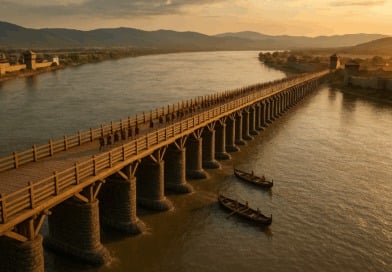
The unusually low level of the Danube allowed specialists from the Pleven Regional History Museum in Bulgaria to observe and document sections of the foundations that are normally submerged.
“For archaeologists, these moments are extremely valuable because nature briefly reveals an object that remains hidden beneath the Danube for most of the time,” Pavel Popov, a representative of the Pleven Regional History Museum, told Reuters.
“It gives us a rare opportunity to observe, document and study it in its actual setting,” the archaeologist added.
“Nature gave us this opportunity”
The museum team examined the visible remains near Gigen on 4 August. Specialists used drones for aerial photography and to map the exposed foundations, while also assessing their route and state of preservation.
“Nature gave us this opportunity—to photograph and document this historical and cultural heritage,” representatives of the Pleven Regional History Museum said in a post on the institution’s official Facebook page.
Several record-breaking heatwaves across Europe this summer have caused severe drought in parts of the continent, affecting major rivers such as the Danube and Rhine.
Photo: Facebook / Regional History Museum in Pleven