Orthodox Calendar, September 4
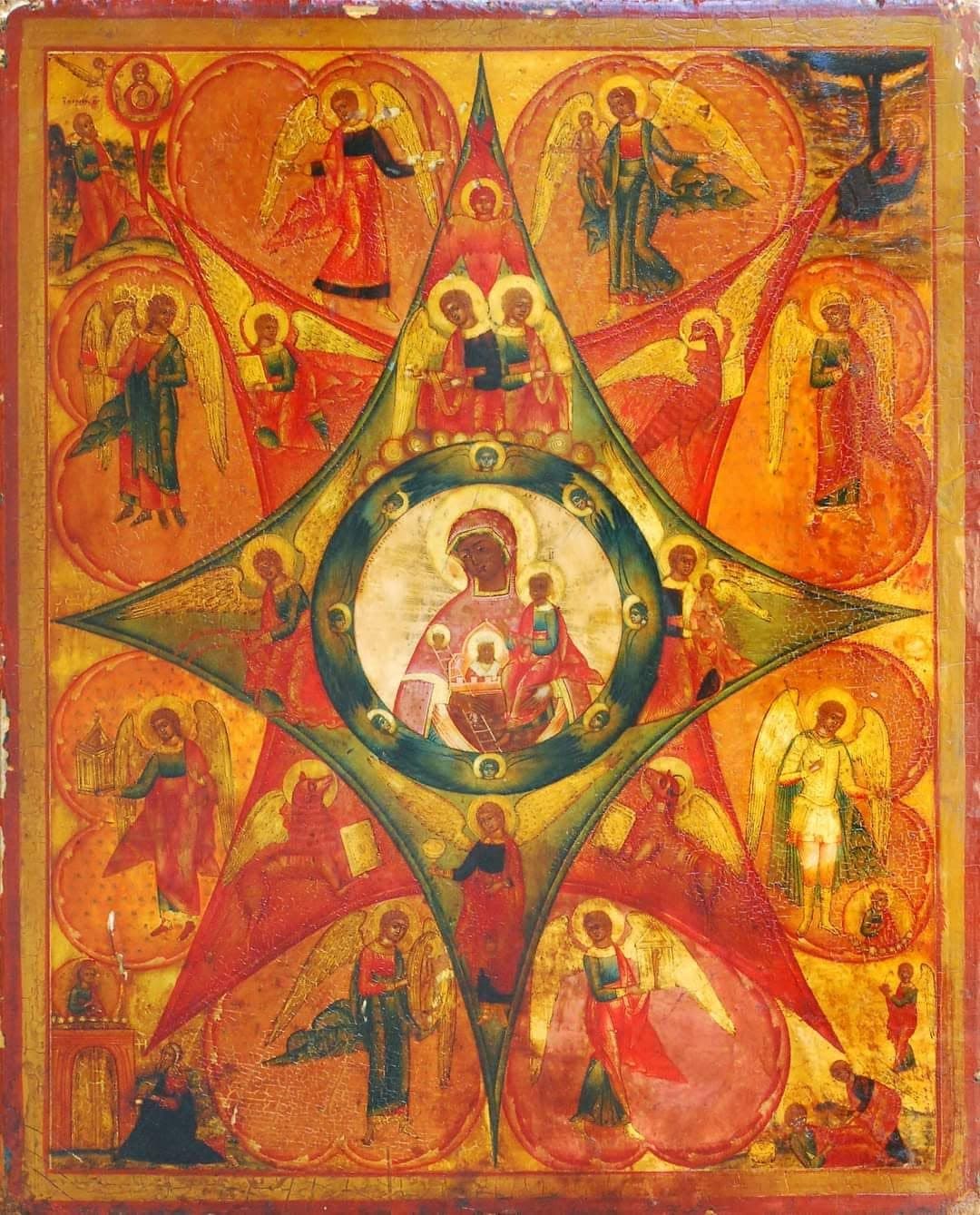
The Icon of the Mother of God “The Unburnt Bush”
The icon of the Mother of God known as “The Unburnt Bush” depicts the biblical event from the Old Testament in which the Holy Prophet Moses, while at the foot of Mount Sinai (Horeb), saw a bush that was burning but was not consumed by the flames (Exodus, chapter 3).
Hearing the voice of God from the bush, he was called to lead the Jews out of Egyptian bondage. The Holy Fathers saw in the unburnt bush a foreshadowing of the Mother of God, who, although she received the fire of the Godhead within her womb, was not consumed by it.
The earliest icons depicting the Unburnt Bush were painted at the Monastery of Saint Catherine on Mount Sinai. From the 13th century onwards, the icon of the Bush was often accompanied by the depiction of the Mother of God with the Christ Child. In the 16th century, Russian iconographers created a new type of the Unburnt Bush icon, rich in symbolism. At its centre is the icon of the Holy Virgin Mary with the Christ Child, set against a background formed by two overlapping quadrilaterals, one red and the other green, representing both the leaves of the bush and the fire that enveloped them. Together, they form an eight-pointed star surrounded by the figures of angels and archangels.
In the four corners of the icon are depicted four Old Testament prefigurations of the Mother of God: the burning bush, Jacob’s ladder, the closed gate seen by the Prophet Ezekiel, and the Tree of Jesse. In Romania, the Unburnt Bush is depicted in the ancient frescoes of the Sucevița and Hurezi Monasteries, as well as in other places.
This icon was often painted in churches because, according to tradition, through it the Mother of God protects the faithful from fires. A miracle is known to have taken place in Russia when an entire village was engulfed in flames, yet a single house was spared because a woman came out in front of it praying and holding the icon of the Unburnt Bush in her hands.
One of the best-known icons of the Unburnt Bush in Romania is the icon at Antim Monastery in Bucharest, brought from Mount Athos in 1929 by the hieroschemamonk and martyr Daniil Sandu Tudor. At the time, while still a layman, he had made a pilgrimage to the Holy Mountain, from which he returned with a special desire to learn the Jesus Prayer.
Indeed, he gave a new interpretation to the icon of the Unburnt Bush, linking it to the prayer of the heart, which must burn in the soul of the one who prays, setting it aflame with love for God. Beginning in 1945, the hesychast movement known as the Unburnt Bush was formed around the icon and Father Daniil. It brought together the fathers of Antim Monastery, as well as many lay theologians, intellectuals and students from Bucharest, who desired to know more deeply the mysteries of the faith and to learn the practice of ceaseless prayer.
The Mother of God worked a miracle for Father Daniil Sandu Tudor through her icon. In 1941, while working as a tutor at a technical school in Vălenii de Munte, he incurred the wrath of some criminals who plotted to shoot him and knew the room where he lived.
One evening, after praying before the Unburnt Bush icon in his room, Sandu Tudor felt inspired to move his bed to another side of the room. Three men fired 16 bullets through the window towards the place where they knew the bed to be, but he escaped unharmed through the help of the Mother of God.
Years later, in gratitude, he composed a beautiful Akathist Hymn to the Mother of God, calling the Virgin “the weaver of unceasing prayer”, in thanksgiving for all her gifts and especially for her help in acquiring the prayer of the heart. The Venerable Father Daniil, persecuted for his faith, died in Aiud Prison in 1962.
The icon came into the possession of the Venerable Archimandrite Benedict Ghiuș, who left it by testament to the Venerable Sofian Boghiu. He, in turn, placed it in the church of Antim Monastery, where it remains to this day. Another icon of the Unburnt Bush belonged to Professor Alexandru Mironescu. As a sign of the Mother of God’s blessing, on several occasions the icon moved on the wall, producing pleasant sounds resembling those of a harp. This also happened during a gathering of the Unburnt Bush movement attended by the Venerable Cleopa of Sihăstria.
For this reason, the icon of the Unburnt Bush at Antim Monastery is a symbol of the preservation and confession of the faith in times of persecution. Through her holy icon, the Most Holy Mother of God delivers those who pray to her not only from material fires, but also from the kindling of temptations and conflicts among people, helping those who desire to be cleansed of their passions and to persevere in the sanctifying work of ceaselessly invoking the name of the Lord Jesus.
In many Orthodox Churches, the feast of the Unburnt Bush icon is observed on September 4, when the Holy Prophet Moses, the God-seer, is also commemorated.
Troparion, tone 3:
We know you as the Unconsumed Burning Bush, O Virgin, for you gave birth to Christ our God, the Son of the Heavenly Father, clothed in flesh. Therefore, we venerate your holy icon with reverence and humbly beseech you: protect your holy dwelling from fire, and kindle within us the pure fire of love for God.
Hieromartyr Babylas, bishop of Antioch
Bishop Babylas and with him the three youths Urban, Prilidian, Epolonius and their mother Christodoula died as martyrs under the emperor Decius (249-251). During his stay in their city of Antioch, the emperor arranged for a large festival in honour of the pagan gods.
At the same time, Babylas, the holy and God-fearing Bishop of Antioch, was serving the Divine Liturgy in church. He prayed for his flock and taught them to endure all tribulations for Christ with courage. The idolater Decius, curious to witness the Divine Mysteries, decided to enter the church.
News of this reached the bishop, so he went out to meet Decius and blocked the path to the church, for he was unwilling to permit impiety in the temple of God. When the emperor approached the church doors, Saint Babylas refused to let him enter, so the emperor had to abandon his intention. He wanted to take revenge on the saint right away, but when he saw the large throng of Christians, he feared they might riot.
The next day the angry emperor ordered that the church be set on fire, and for Bishop Babylas to be brought before him. When asked why he had insulted the imperial dignity by not allowing the emperor to enter the church, the holy bishop answered, “Anyone who would rise up against God and want to desecrate His sanctuary, is not worthy of respect, but has become the enemy of the Lord.”
Decius declared that the holy bishop must worship the idols to make up for his lack of respect for the emperor, or else face execution. After convincing himself that the martyr would remain steadfast in his faith, he commanded the military commander Victorinus to put him in heavy chains and lead him through the city in disgrace.
The holy martyr replied, “Emperor, these chains are as venerable for me as your imperial crown is for you. For me, suffering for Christ is as desirable as the imperial power is for you. Death for the Immortal King is as precious to me as your life is to you.”
At the trial with Bishop Babylas were three young brothers, who did not forsake him even in this most difficult moment. Seeing them, the emperor asked, “Who are these children? “
“These are my spiritual children,” the saint replied, “and I have raised them in piety, I have educated them, cultivated them with guidance, and here before you in a small body are these great young men and perfect Christians. Test them and see.”
The emperor tried in all sorts of ways to entice the youths and their mother Christodoula to renounce Christ, but in vain. Then, in a rage, he ordered each of them to be whipped with a number of blows corresponding to their age. The first received twelve blows, the second, ten, and the third, seven. Dismissing the mother and children, the torturer again summoned the bishop, telling him that the children had renounced Christ. He did not believe the lie, however.
Then he commanded all the martyrs be tied to a tree and burned with fire. Seeing the stoic bravery of the saints, the emperor finally condemned them to be beheaded with the sword.
Troparion, tone 4:
Your holy martyrs O Lord, through their sufferings have received incorruptible crowns from You, our God. For having Your strength, they laid low their adversaries, and shattered the powerless boldness of demons. Through their intercessions, save our souls!

Holy Prophet and God-Seer Moses
He was of the tribe of Levi, the son of Abram and Jochabed (Exodus 6:20). His life is described in the Bible (Exodus 2 through Deuteronomy 34:12).
Moses was born in Egypt around 1689 B.C. When Pharaoh ordered all male children of the Hebrew slaves to be killed (Exodus 1:22), Moses’ mother placed him in a basket of papyrus coated with pitch, and set him adrift on the Nile. Pharaoh’s daughter found him and raised him as her own son.
At the age of eighty, Moses fled to Midian, where he spoke to God in the Burning Bush on Mt. Horeb (Exodus 3:2). God chose Moses to lead His people from the slavery of Egypt. They crossed the Red Sea as if it were dry land, and for forty years they wandered in the desert.
Arriving in the land of Moab, Moses went to the top of Mt. Nabau, or Nebo (Deuteronomy 32:49), which is called Phasga (Deut. 34:1). There, according to the will of God, he died in 1569 B.C. at the age of 120 without entering the Promised Land.
The first two Biblical Odes are attributed to Moses: “Let us sing to the Lord…” (Exodus 15:1-9), which was sung on the shores of the Red Sea after the Hebrews had crossed it. “Attend, O heaven…” (Deut. 32:1-43) was sung in the land of Moab, a few days before Moses’ death. He is also regarded as the author of the Pentateuch (the first five books of the Old Testament).
The holy Prophet Moses performed many miracles during his lifetime, and also after his death. He appeared on Tabor with the Prophet Elias at the Transfiguration of the Lord (August 6).
On the day that Saint John of the Ladder (March 30) was installed as abbot of Mt. Sinai, the Prophet Moses was seen going around and giving orders to the cooks, stewards, and servants. When the guests had gone and the monks were sitting at table, they wondered what had become of the stranger who had been giving orders. Saint John said, “Our Lord Moses does nothing strange by serving in the place which belongs to him.”
Troparion, tone 2:
You ascended to the heights of the virtues, Prophet Moses; therefore, you were deemed worthy to see the glory of God. Having received the grace-filled tablets of the Law, and bearing the grace of the writing within yourself, you were the honorable praise of prophets, and a great mystery of piety.