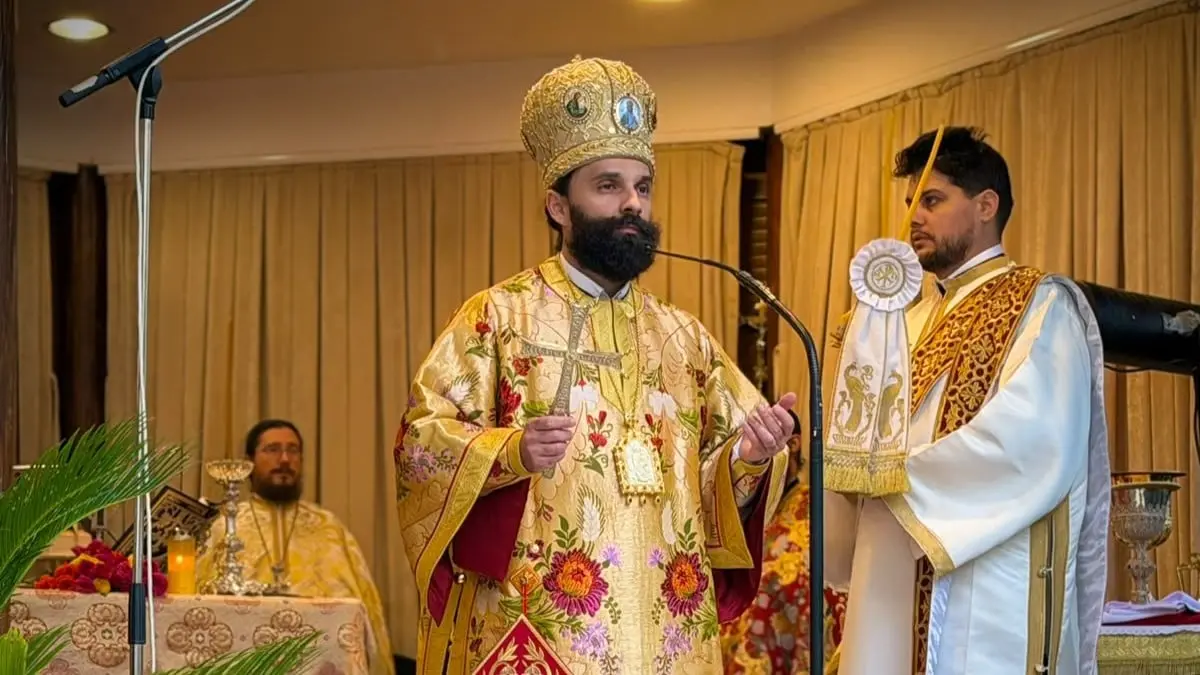
His Eminence Metropolitan Chariton of Kananga, of the Patriarchate of Alexandria, recounted in a special edition of Trinitas TV how Orthodox communities emerged in the Democratic Republic of the Congo following unexpected encounters with local people.
The metropolitan explained that early Orthodox missionary work in certain regions of Congo faced numerous difficulties, from vast distances and barely accessible roads to the absence of churches and established Orthodox communities.
Metropolitan Chariton particularly recalled the period when he was sent to undertake missionary work in the city of Goma, where he knew nobody and had neither a church nor a place to live.
“I myself did not know how this work was going to begin,” Metropolitan Chariton admitted, emphasising that trust in God and obedience to the instructions he had received helped him overcome the uncertainty of those early days.
An unexpected encounter
On his first day in Goma, two men came looking for him at the hotel where he was staying, after some people had noticed him at the airport wearing clerical clothing.
They had a calendar featuring images of Orthodox clergy and wanted to learn more about the Church he belonged to.
One of the men was a Protestant pastor who invited the future metropolitan to speak about Orthodoxy to his congregation.
More than 30 people attended the meeting. Before the discussion began, Metropolitan Chariton said a prayer and made the sign of the Cross, a gesture that aroused the participants’ curiosity.
They then discussed the meaning of the sign of the Cross and the Orthodox faith, and held further meetings.
According to the African hierarch’s account, the Protestant pastor subsequently received Orthodox baptism together with his family and became the first Orthodox priest in Goma.
“I did not know what to do. But God worked through obedience,” Metropolitan Chariton explained.
How parishes are established by the roadside
The Metropolitan of Kananga also spoke about the difficulties of travelling to remote villages, where poor infrastructure can mean a 100-kilometre journey sometimes takes as long as 12 hours.
Unexpectedly, vehicle breakdowns repeatedly became opportunities to meet people who had never previously heard of Orthodoxy.
“Wherever the car breaks down, a parish is established,” His Eminence said, describing how such unplanned stops led to the formation of communities.
Children are usually the first to approach. The missionaries offer them water or sweets and begin talking to them.
Later, their parents learn who the visitors are and why they treat the children with such kindness.
After these initial encounters, the missionaries remain in contact with local people and send priests to continue their catechetical instruction.
In this way, new Orthodox parishes have been established in some communities.
Faith is transmitted through personal example
Drawing on these experiences, His Eminence emphasised that missionary work aims not to increase the number of believers at any cost, but to cultivate an authentic life in Christ.
“We are not in a hurry to make everyone Orthodox. Rather, our words, actions and lives must be Orthodox.”
“We transmit Orthodoxy through our lives,” Metropolitan Chariton stressed.
Metropolitan Chariton was born in 1974. He graduated from the Faculty of Law in Kasai and the Faculty of Orthodox Theology in Athens, and completed a master’s programme in Biblical Theology at the Faculty of Orthodox Theology in Thessaloniki.
He was ordained a deacon in 2003 and, two years later, a priest by Metropolitan Ignatios Madenlidis of Central Africa.
In 2015, he was elevated to archimandrite, and in 2022 the Holy Synod of the Patriarchate of Alexandria elected him Metropolitan of Kananga.