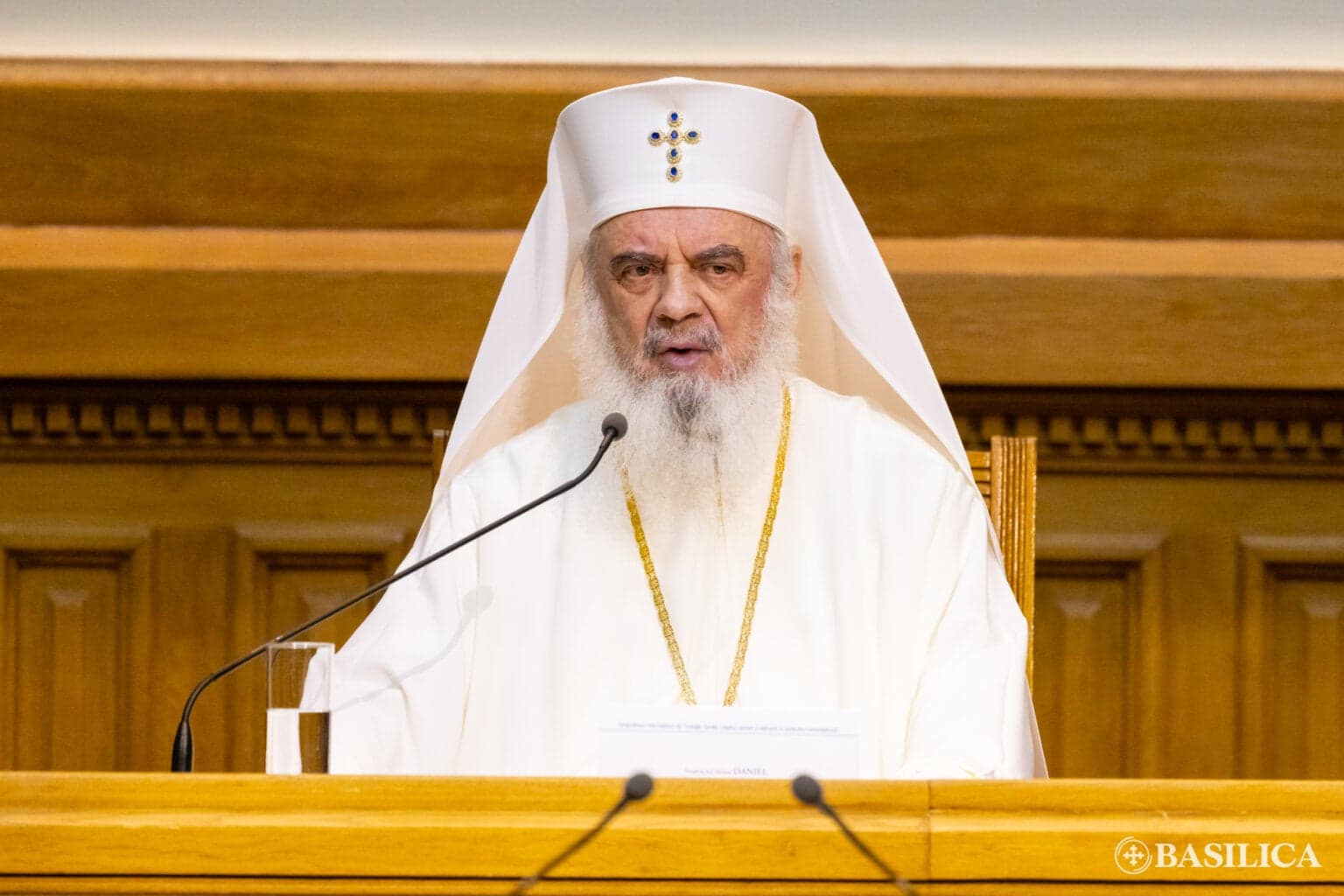
This February instalment of Digital Matericon: Women Saints of February is published in the context of the decision of the Holy Synod of the Romanian Orthodox Church to proclaim 2026 as the Commemorative Year of the Holy Women in the life and calendar of the Church. The series seeks to bring before contemporary readers the living witness of Orthodox women who, in different historical and cultural settings, bore faithful and courageous testimony to Christ through martyrdom, ascetic struggle, prayer and self-giving love.
The saints commemorated this month come from remarkably diverse worlds: the early Christian communities of North Africa and the Middle East, the monastic and missionary landscape of Ireland, and the spiritual life of modern Russia. From the martyrs Perpetua and Felicity, Agatha, Dorothea, Apollonia and Valentina, to the righteous Prophetess Anna, the missionary abbess Brigid of Kildare and the blessed fool-for-Christ Liubov of Ryazan, their lives reveal the same inner freedom and unwavering fidelity to Christ, lived out under persecution, social pressure, suffering and personal trial.
What unites these holy women is not a common historical background, but a shared spiritual vision: a life centred on prayer, repentance, sacrificial love and courageous confession of faith. Whether standing before Roman tribunals, serving in the Temple, founding monastic communities, guiding others through spiritual discernment, or bearing prophetic witness in times of upheaval, each of these saints embodies a deeply personal and profoundly ecclesial response to God’s call.
Through this Digital Matericon, we invite readers to rediscover the place of holy women within the living memory of the Church and to encounter, in their stories, enduring models of spiritual strength, motherhood of the heart, faithfulness to the Church and joyful perseverance. In the spirit of the Church’s Commemorative Year of the Holy Women, these lives speak not only of the past, but of a living vocation offered to women and men alike in the Church today.
Saints Perpetua and Felicity – February 1

Saints Perpetua and Felicity were two women who were martyred in Carthage, North Africa, in 203, during the reign of the Roman emperor Septimius Severus. Historical accounts record that Perpetua was a young noblewoman, aged twenty-two, and well educated, while Felicity was her servant. They were arrested by the Roman authorities together with three young men. All five were catechumens, preparing to receive Baptism.
Saint Perpetua had a small child, whom she breastfed in prison, despite the opposition of her pagan family. Saint Felicity longed to receive the crown of martyrdom together with the others, but she was pregnant and, according to Roman law, could not be executed. Following her prayers, she gave birth prematurely to a baby girl, who was taken and raised by Christians.
While in prison, Saint Perpetua received several visions, which confirmed to her that she was called to struggle and to renounce the joys of this world for the sake of the Kingdom of Heaven.
The three male catechumens – Saturninus, Secundulus and Revocatus – were thrown to wild beasts during a public spectacle, while the two women, Perpetua and Felicity, were beheaded.
The legacy of the two saints has endured throughout the centuries. They remain examples of steadfast faith (Perpetua) and joy in suffering (Felicity), as well as loving mothers.
According to tradition, the two martyrs were buried in Carthage, in what is now Tunisia, and the relics of Saint Perpetua were later translated to France. In 903, they were brought to the town of Vierzon. Today, they are kept in the Church of Notre-Dame in Vierzon, where they are brought out for public veneration once a year.
Saint Brigid of Kildare – February 1

Saint Brigid came from an Irish noble family and was converted to Christianity by Saint Patrick, the Enlightener of Ireland. From her youth, she desired to dedicate her life to Christ, and when the time for marriage came, she prayed that the Lord would take away her beauty, so that no one would wish to take her as a wife.
Her prayer was answered: the young woman lost an eye and entered a monastery. On the day of her monastic profession, she was miraculously healed and regained her beauty.
Many young women and men wished to place themselves under her spiritual guidance, and thus two monastic communities were formed around her – one for women and one for men. The place, situated a few kilometres from Dublin, was called Kildare, or Cell-Dara, meaning “the church of the oak”, because the monastic settlement developed around an oak tree.
Her monastery gradually came to be recognised as an important centre of education, hospitality and the spread of Christianity. The disciples of Saint Brigid founded monasteries throughout Ireland, which led her to travel extensively. Wherever she went, through her prayers, demons were driven away, people and animals were healed, and pagans were converted.
She reposed in the Lord in the year 524 or 528 and left behind, as her legacy, a Rule for monastic life. In Kildare, where the saint was buried, a fire was kept burning in her honour until 1220, when the local bishop forbade it because of popular superstitions.
She is greatly venerated in Ireland and is one of the country’s patron saints, along with Saint Patrick and Saint Columba.
Righteous Anna the Prophetess – February 3

Information about Saint Anna the Prophetess is found in the Gospel of Luke, which recounts the presentation of the Christ Child in the Temple forty days after His birth (Luke 2:22–39).
Saint Anna was “the daughter of Phanuel, of the tribe of Asher” and was eighty-four years old. She had been married, but after seven years she was left a widow. From that time on, she remained in the Temple, serving God, and was among those who awaited the coming of the Messiah in fasting and prayer.
After meeting the infant Jesus Christ, she, too, began to give glory to God and spoke to everyone about the salvation of the people of Israel (Luke 2:38).
Saint Agatha of Sicily – February 5

Saint Agatha was a third-century martyr who confessed Christ at the age of fifteen, during the persecution of Christians under the Roman emperor Decius.
The young Agatha came from a respected family in Sicily, either Palermo or Catania, according to different sources. Having heard of her beauty and wealth, the city prefect ordered that she be brought before him. After she refused to become his wife and chose to remain faithful to Christ the Bridegroom, the saint was subjected to torture, including the cutting off of her breasts. For this reason, she is today regarded as a patron and helper of women suffering from breast cancer.
The holy Apostle Peter appeared to her in the prison cell where she was being held and healed her. She was then tortured again until she gave her soul into the hands of the Lord.
The saint is also invoked as a helper in cases involving fire, on account of a miracle that occurred one year after her death. During an eruption of Mount Etna, when lava threatened the city of Catania, both Christians and pagans ran to the tomb of Saint Agatha and took the veil that covered her. They held it as a shield before the river of fire that was approaching the city, and the lava stopped in its tracks. For this reason, Saint Agatha is honoured to this day as the protector of the city of Catania.
Saint Dorothea of Caesarea – February 6

Saint Dorothea was a virgin from a noble family, originally from Caesarea in Cappadocia. During the persecutions of the Roman emperor Diocletian, she was arrested for being a Christian. She was tortured, yet did not renounce Christ. For this reason, she was handed over to two sisters, Christina of Caesarea and Callista of Caesarea, who had once been Christians but, out of fear of suffering, had denied Christ.
However, it was Saint Dorothea who persuaded the two women to return to the true faith and called them to repentance. They suffered martyrdom and are commemorated in the synaxarion on the same day as Saint Dorothea.
The young virgin was sentenced to death by beheading. While she was being led to the place of execution, a pagan named Theophilus of Caesarea mockingly cried out to her: “Bride of Christ, send me some roses or apples from the garden of your Bridegroom!”
The saint agreed, and after she prayed, an angel appeared before her carrying three apples and three roses. Dorothea sent them to Theophilus, and afterwards she gave her soul into the hands of the Lord. Because of this miracle, Theophilus believed in Christ and became a Christian, and he too later suffered martyrdom.
Blessed Liubov of Ryazan – February 8

Saint Liubov was born in the city of Ryazan, in central Russia, in 1852, and lived before the first years of the persecution of the Orthodox Church by the communist regime.
She was one of four children in a simple family, and for fifteen years, she was bedridden and disabled. The saint to whom she was most devoted was Saint Nicholas, who appeared to her, healed her, and told her to become a fool for Christ. With her spiritual father’s blessing, she accepted this cross. She prayed in all the churches of the city, travelled to the convent in Kazan, and after some time returned to Ryazan. She then withdrew to her home, devoting herself to intense prayer for three years.
Afterwards, she returned to the city, where she became known for her kindness and generosity, and for anticipating what each person needed. She wore colourful clothes and sometimes a pink headscarf – her favourite colour. Before her death, she instructed a young woman to line her coffin with pink fabric. The young woman later testified that, on the very day of the saint’s death, she unexpectedly found pink veil material in a local shop and was thus able to fulfil her final wish.
Saint Liubov also had the gift of prophecy. Accounts of her life relate many occasions on which she foretold a person’s entrance into monastic life, their repose in the Lord, or their marriage. At the beginning of 1917, she prophesied the outbreak of the Revolution, crying out in the city’s streets: “The walls of Jericho will fall, the walls of Jericho will fall!”
Another well-known prophecy concerned the closure of the convent in Kazan.
At the beginning of 1920, the saint fell ill with pneumonia and was confined to bed. On 8 February 1921, she reposed in the Lord. She was glorified among the saints in 1987, and from 1988 her holy relics have been placed for veneration in a church in the city dedicated to Saint Nicholas. A small pink chapel was later built on the site of her grave, and the saint continues to intercede for all the faithful who seek her help.
Saint Apollonia of Alexandria – February 9

Saint Apollonia was a virgin martyr and deaconess who lived in Alexandria in the third century, during the reign of the Roman emperor Decius.
The martyrdom of Saint Apollonia is described in a letter written by Dionysius of Alexandria to the bishop of Antioch. In this account, she is portrayed as an admirable virgin of advanced age, who was arrested by pagans and struck repeatedly in the face until all her teeth were knocked out. For this reason, she is sometimes depicted in icons with a small medallion showing a tooth.
An enraged pagan crowd lit a fire outside the city and threatened to burn her alive if she refused to worship the idols. Saint Apollonia asked them to allow her a few moments to pray and then, of her own will, threw herself into the fire, where she received the crown of martyrdom.
Because of the nature of the suffering she endured, Saint Apollonia is invoked by those with toothaches and is also regarded as the patron saint of dentists.
Virginmartyr Valentina of Palestine – February 10

Saint Valentina was a fourth-century martyr, honoured for her unwavering faith and remarkable courage. She was originally from Gaza, in Palestine, and during the persecution under the Roman emperor Diocletian, she was arrested and brought to Caesarea Maritima together with several other Christians.
Alongside Saint Valentina stood Saint Ennatha of Gaza, known in the Greek synaxaria as Theia. She was scourged and then tied to a wooden frame, her sides being torn apart.
Saint Valentina came to the defence of her companion, was taken before the tribunal, and was then led to a pagan altar. Instead of offering sacrifice to the idols, the saint openly defied her persecutors and kicked the altar over.
She was subjected to further torture and was then burned in the fire together with Saint Enatha.
Read more: