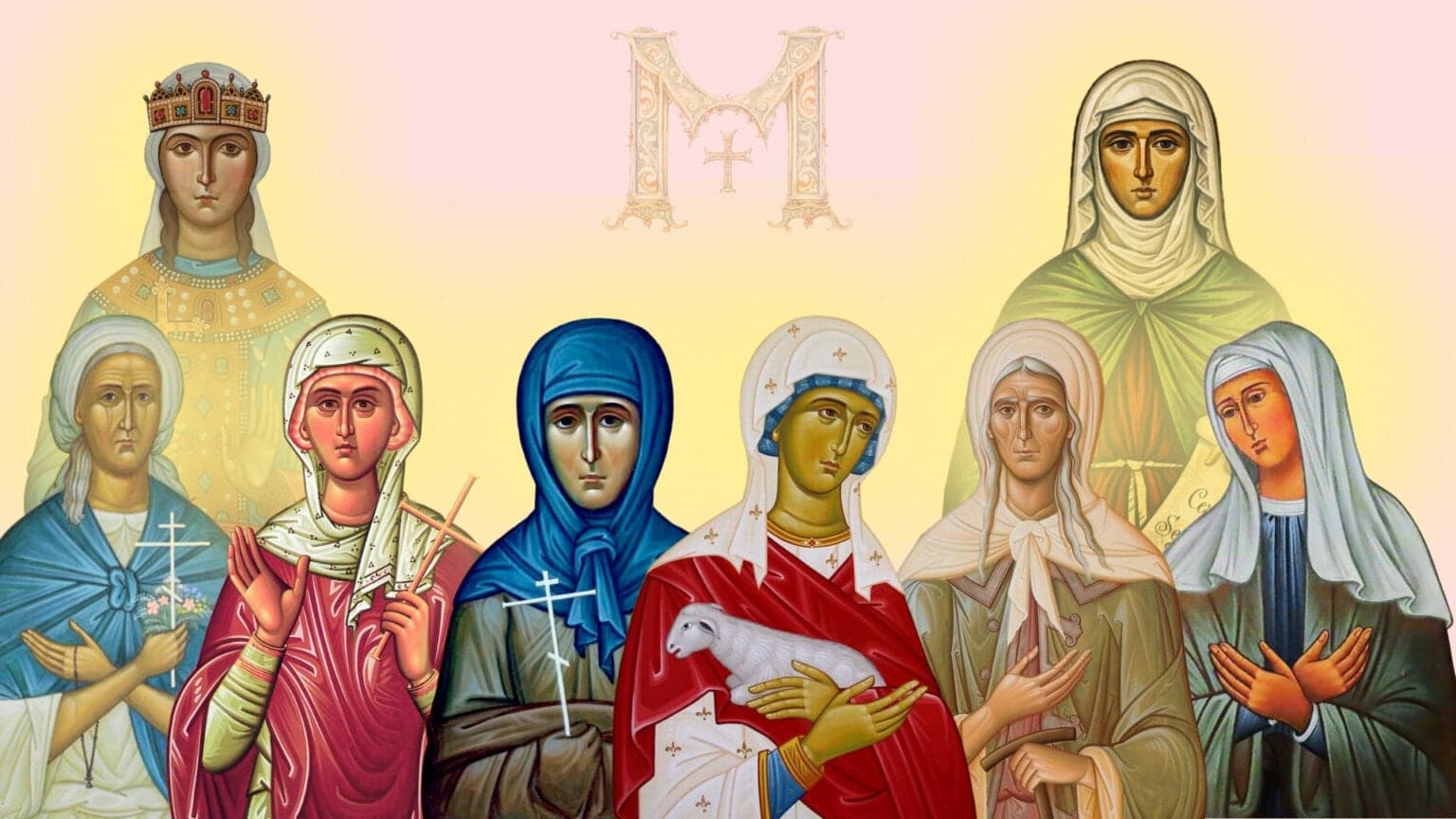
This second January instalment of Digital Matericon continues our monthly series dedicated to the women saints commemorated in the Orthodox calendar. Because January contains an especially rich number of holy women—martyrs, monastics, ascetics, mothers, confessors, and “fools for Christ”—the month is presented in two parts, allowing each figure to be remembered with due attention.
In the following brief biographies, we encounter a striking range of spiritual witness: youthful martyrdom and fearless confession of Christ, quiet endurance in illness and persecution, radical renunciation of worldly comfort, and steadfast service expressed through prayer, mercy, and hidden sacrifice. Though separated by centuries and cultures—from ancient Rome to imperial Constantinople and from the deserts of early Christianity to the cities of modern Russia—these women share the same inner strength: a life shaped by faithfulness, humility, and love.
Together, their lives form a living “matericon” for the digital age: a spiritual record of feminine holiness that offers both inspiration and guidance for Christians seeking courage, purity of heart, and perseverance in today’s world.
St Agnes of Rome – 21 January

Saint Agnes was born in the 3rd century in Rome to a Christian family. She chose to live a life of chastity, reflected in her name, which means “clean, pure” in Greek. Her name has also been associated with the Latin term agnus (“lamb”), a symbol of purity often depicted in her icons.
Saint Agnes confessed Christ at the young age of 12 or 13, after refusing to renounce Him before the Prefect of Rome. In retaliation, she was stripped and taken to a brothel, but God protected her: her hair miraculously grew to cover her body, and the men who sought to approach her were prevented in a wondrous way.
One of them—according to some sources, even the prefect’s son—died on the spot, struck by the power of an angel. Yet through Saint Agnes’ prayers, the young man was raised from the dead. Witnessing this miracle, about 160 pagans became Christians.
However, other idol-worshippers demanded her death, and after enduring further tortures, the saint received the crown of martyrdom. Her parents buried her body on the Via Nomentana, where later Constantia, the daughter of Saint Constantine the Great, built a church after being healed. The church still exists today and is known as Sant’Agnese fuori le mura (“Saint Agnes Outside the Walls”), where her relics are preserved. Her head is kept in the church of Sant’Agnese in Agone in Piazza Navona, Rome, believed to stand on the site of her martyrdom.
Saint Agnes’ friend, Saint Emerentiana, was also martyred at her tomb—stoned to death—and is commemorated on 23 January.
Saint Ambrose of Milan composed a hymn in honour of Saint Agnes, which also serves as a historical source for her life.
Saint Xenia of St Petersburg – 24 January

Saint Xenia lived in the 17th century as a “fool for Christ”. After the death of her husband, she renounced all worldly comfort and chose to wander barefoot through the streets of St Petersburg’s poorer districts, dressed in worn-out clothes in both summer and winter, with no shelter over her head—like the Saviour.
Yet God accompanied her everywhere, and through her He worked many miracles. When the saint entered a shop, the day’s earnings would increase; when she kissed a sick child, the child would recover.
Today, Saint Xenia is beloved by many faithful for her swift help in resolving people’s everyday struggles and for healing bodily suffering. Pilgrims come to seek her intercession at her grave in the Smolensk Cemetery (St Petersburg), where they take earth or oil from the vigil lamp.
Saint Xenia is especially known as a quick helper in finding employment and in establishing a family.
Saint Paula of Rome – 26 January

A descendant of a distinguished family in Rome, Saint Paula was born in 347. She married at a young age and had five children, among them Saint Blesilla, commemorated on 22 January.
At the age of 32, she was widowed and decided to follow the example of Saint Marcella, another widow in Rome who had transformed her palace into a monastery. She also formed a spiritual bond with Blessed Jerome and Saint Epiphanius of Salamis, whose accounts of the monks of Egypt and Palestine kindled in her heart a longing for the ascetic life.
After the unexpected death of Saint Blesilla, Paula set out on a journey to the Holy Land, hoping to fulfil her calling. Together with her daughter Eustochium and other virgins, she first went on pilgrimage through Cyprus, Antioch, Syria and Palestine, under the guidance of Blessed Jerome.
In the Holy Land, she visited hermits for a long time, and then settled in Bethlehem, where she founded three monastic communities for women and one for men, inspired by the example of Saint Melania on the Mount of Olives.
She established a rule of life for the sisterhoods, learned Hebrew, and continued studying Scripture under the guidance of Blessed Jerome, who lived in the men’s monastery she had founded. Saint Paula became known for her almsgiving and for the care she showed to the sick and the poor.
She also endured a daily martyrdom through illness and other trials, including the loss of two more of her children.
After more than 20 years spent in ascetic struggle in the Holy Land, she fell asleep in the Lord in 404, at the age of 56. Her final words were: “The time of harvest has come. I believe I shall see the goodness of the Lord in the land of the living.” (Psalm 26:13)
Blessed Jerome wrote Saint Paula’s life shortly after her repose, addressing it to her daughter Eustochium and to the monastic communities she had established in Bethlehem.
Saint Maria of Gatchina – 26 January

Saint Maria was born into the family of a merchant in Saint Petersburg at the end of the 19th century and was baptised Lydia. Suffering began at an early age. When she was three, she lost her father, and while still a pupil, she fell ill with encephalitis, followed by Parkinson’s disease, rheumatism and gout, to the point that she had to sit her exams in a wheelchair.
Her younger sister, Yulia, and her brother, Vladimir, stood by her through the years of hardship that followed. To make her care easier, they moved out of the city to a smaller town, Gatchina. In 1922, at the Gatchina metochion of a monastery, Lydia was tonsured a nun with the blessing of Metropolitan Veniamin of Petrograd, who himself later became a saint after being martyred by the Bolsheviks.
Her body was completely immobilised, and even the slightest touch caused her pain, yet she never complained. Illness made her gentler, more humble and obedient. It led her to withdraw inwardly and to pray more.
The only thing she could still do was speak—though with difficulty. In this way, the Lord granted her the gift of consoling others, especially those suffering from depression.
One professor testified that people struggling with depression would leave their meetings with the saint bright and cheerful; he himself was healed of a terrible depression, as though a “spiritual tumour” had been removed from his soul.

Every day, crowds came to seek her help, patiently waiting their turn. Many brought her money and food, which the saint would distribute to the poor.
On 19 February 1932, Saint Maria and her brother were arrested by the political police of the Bolshevik regime, accused of counter-revolutionary activity. Although she was paralysed, her arms were twisted behind her back, and she was dragged from her bed to the police van. Her brother was sent to a labour camp in Siberia for five years, and the saint fell asleep in the Lord shortly after her arrest.
Those who brought parcels to her in prison were told one day that the nun “had died in hospital”, though it is known that vulnerable prisoners were more often exterminated.
She was buried in the Smolensk Cemetery in Saint Petersburg, in a location initially unknown. Her relics were discovered only in March 2007 and were transferred to Saint Paul’s Cathedral in Gatchina.
Saint Marciana the Empress – 27 January

Little is known about the life of Saint Marciana, and even details about her origins remain uncertain. According to an account attributed to a Roman consul, she may have come from a modest background and originally borne a different name.
She married the future Emperor Justin I, and this alliance reportedly required her to adopt the name Euphemia. Both spouses supported the decisions of the Ecumenical Council of Chalcedon, where the Holy Martyr Euphemia had worked a miracle.
When Justin I ascended the throne in Constantinople in 518, both he and his wife were already advanced in age. As empress, she received the title Flavia Aelia Marcia, from which the name by which she is known in the synaxaria—Marciana—derives.
Her correspondence with the bishops of Rome reveals another defining trait: her piety, strengthened by her founding of a church dedicated to Saint Euphemia, where she was also buried. Some synaxaria also describe her as “the wife of Justin the First, who gave much alms”.
Hagiographical sources state that she had no children and, for this reason, Saint Marciana supported her nephew, the future Emperor Justinian I, as heir to the throne.
It is believed that Saint Marciana fell asleep in the Lord in 523 or 524, and that her husband, who died in 527, was followed shortly afterwards.
Saint Pelagia the Fool for Christ of Diveevo – 30 January

In childhood, she suffered from an illness that kept her bedridden for a long time. After recovering, she began to behave strangely, as though she were a different person. Later, her mother understood that this was already the early manifestation of her “folly for Christ”.
At the age of 19, she was forced into marriage. Wanting to help her with what appeared to be a psychological condition, Pelagia’s husband took her to Saint Seraphim of Sarov. The venerable elder held a long private conversation with her and, at the end, urged her to go to the convent of Diveevo to care for his “orphans”.
Saint Pelagia continued to live as before: she prayed at the closed doors of the church, gave all the money she had to the poor, spent her nights in prayer, wandered the streets, and was often mocked.
In 1837, after the repose of Saint Seraphim, she was received into the community at Diveevo, where she continued her ascetic struggle as a fool for Christ. She would break the windows of the sisters’ cells, strike her head against walls, go barefoot, live only on bread and water, and never take part in the common meals. Some of the nuns recognised the mystery of her life and honoured her, calling her “little mother”, while the abbess often sought her counsel.

Saint Pelagia was granted many gifts through which she helped others: she healed the sick, foretold future events, extinguished a fire from afar, and—according to Saint Seraphim of Sarov—“many souls were saved through her intercession”.
After 20 years of ascetic labour, following the counsel of Saint Seraphim of Sarov, who appeared to her, she withdrew into a cell for silence and the prayer of the heart. She fell asleep in the Lord on 30 January 1884, after being found worthy to receive Holy Communion from an angel.
In time, she became known as “a second Seraphim” or “Seraphim’s Seraphim”.
St Marcella of Rome – 30 January

Saint Marcella was born into a noble family in Rome around the year 325. She married, but was widowed after only seven months.
After hearing from Saint Athanasius the Great—who was living in exile in Rome—about the monastic life of the Eastern fathers such as Saint Anthony and Saint Pachomius, she resolved to live an ascetic life in the heart of the city.
She turned her palace into a monastery and lived there together with other widows and virgins, who regarded her as their spiritual mother. Through her example, several other houses and palaces in Rome were transformed into similar places dedicated to asceticism and the acquisition of virtues, to the point that some synaxaria say Rome “became a second Jerusalem”.
Another significant aspect of her life was her meeting with Blessed Jerome, who interpreted passages of Holy Scripture for her and became her guide and friend. Hagiographical sources note that at times their roles were reversed, as the venerable Marcella herself possessed considerable knowledge. They maintained a correspondence, and nineteen letters from Blessed Jerome to Saint Marcella have been preserved.
Saint Marcella was also among the victims of the Gothic invasion, during which she was tortured despite her advanced age. She endured these trials with peace, fearing only for her young disciple, Saint Principia, in whose arms she is said to have fallen asleep in the Lord at about 85 years of age.
A letter from Blessed Jerome to Saint Principia, dated 412, has also been preserved, in which he praises the virtues of Saint Marcella.
Virginmartyr Chryse of Rome – 30 January

Very little is known about the life of Saint Aura, also called Chryse in the Greek synaxaria. Aura, which in Latin means “breeze” or “radiance”, and Chryse, which in Greek means “the golden one”, convey the same idea of light and splendour.
Saint Aura is believed to have come from a noble family and lived in the third century during the reign of Emperor Claudius II.
She was a secret Christian and cared for persecuted believers. She was eventually arrested, and Greek synaxaria record that she endured a series of horrific tortures: her jaws were smashed with stones, her back was pierced with lead balls, and her wounds were burned with lit candles.
Saint Aura was martyred alongside other Christians, including Saint Hippolytus, Pope of Rome. Their hands and feet were bound, and they were cast into the depths of the sea.