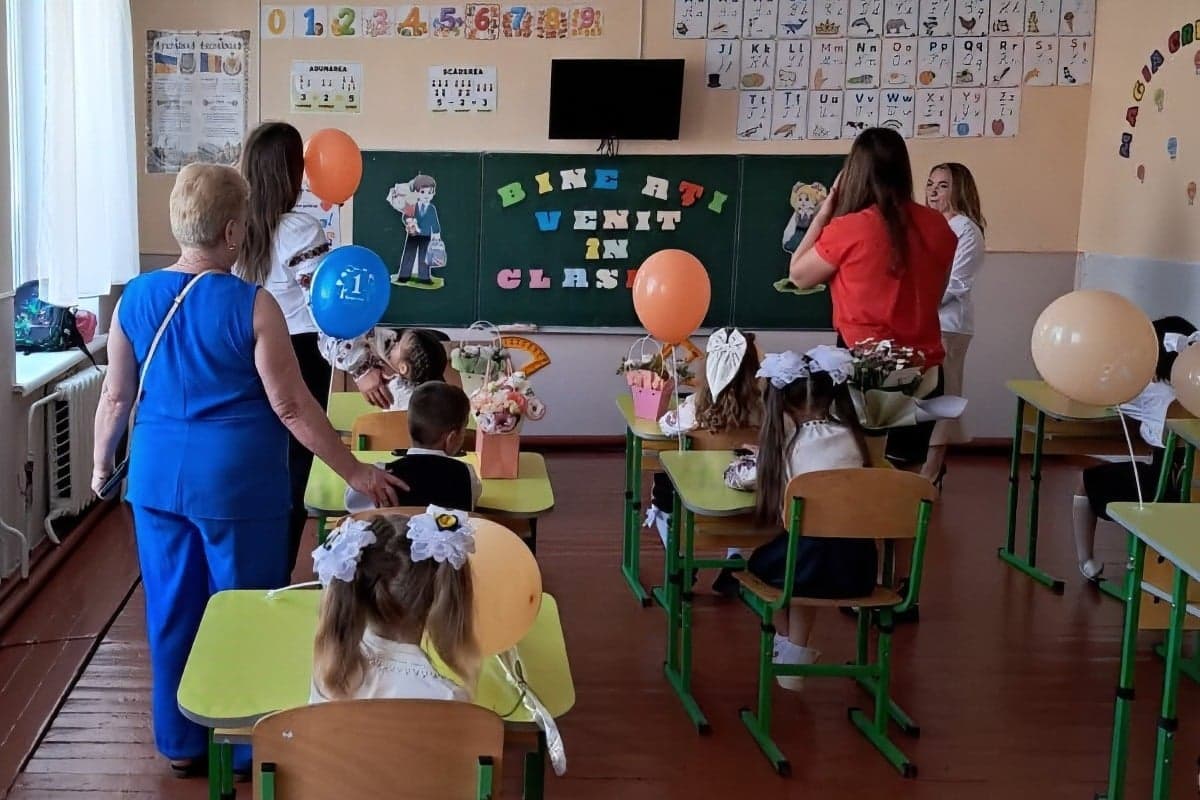
Romanian public broadcaster TVR reported from Cartal, in Ukraine’s Odesa region, where Romanian children were able to return to a Romanian-language school class that local Ukrainian authorities had closed just four days after the school year began.
Following intervention by Romanian authorities at the highest level, the decision was reversed, and the children were able to return to school and exercise their right to education in their mother tongue.
“We intervened in time in a crisis situation that arose unexpectedly, just a few days before the beginning of the school year. I promised the parents that I would be there with them, and I kept my promise. I would like to emphasise that we had the full support of the leadership of the Ministry of Foreign Affairs in this matter,” Claudiu Tătaru, Romania’s acting consul in the Odesa region, told TVR.
Presidential statement
The situation arose as Romanian President Nicușor Dan and Ukrainian President Volodymyr Zelensky attended a summit in Ukraine.
Responding to a question from TVR’s correspondent at the event, President Volodymyr Zelensky said: “Under martial law, no one can close anything. This means there are certain challenges. There are matters at the local level that we cannot fully control at the level of the prime minister or the education minister.”
Romanian-language education, a right of ethnic Romanians
The mother of a Romanian child enrolled at the Romanian-language school in Cartal, also known as Orlivka, told TVR about her joy at the reversal of the decision, but also the distress and concern the closure caused her family.
“For me, it was a very difficult period. Emotionally, there were many obstacles, and there were many nights when I could not even sleep. When I told my daughter on Friday evening that she would have to move from one class to another, she burst into tears and said, ‘How, Mum? How? How can I move from one to another?’” Elena Cloșca said.
The children returned to school on the International Day of Peace, with a positive-thinking theme centred on the word “PEACE”.
“I was invited especially for this class. I came back from maternity leave specifically for them. If the air-raid alarms begin, we are ready to take our little bags and go down to the basement,” teacher Olga Varsa said.
“For me, Romanian is my first language, because everyone in my family speaks purely Romanian. I come from an ethnic Romanian family. The children know Ukrainian as well; they know their mother tongue, and they have a very bright future. We hope it will also be a peaceful one, because we hope to enter the European Union, where many more doors will open than in a small village like Orlivka,” the teacher added.
The Ukrainian name of the Romanian village of Cartal in the Odesa region, where the overwhelming majority of residents are ethnic Romanians, is Orlivka.
European path
Protecting minority rights, including linguistic and educational rights, is part of Ukraine’s commitments in its European Union accession process.
The Romanian community in Cartal/Orlivka has struggled to secure Romanian-language education. Parents had to submit repeated requests for their children to be taught in Romanian.
Local sources have also cited administrative obstacles as limiting, in practice, ethnic Romanians’ access to education in their mother tongue.