Orthodox Calendar, October 11
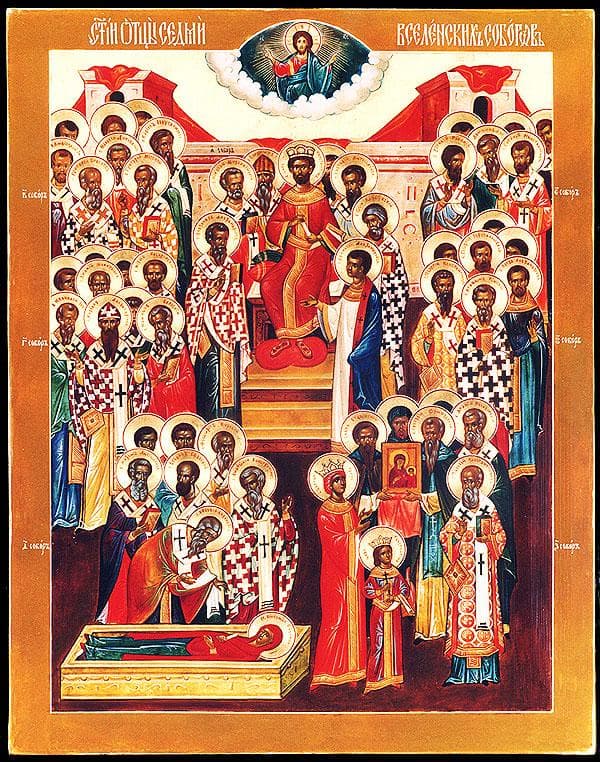
Sunday of the Holy Fathers of the 7th Ecumenical Council
Today the Church remembers the 350 holy Fathers of the Seventh Ecumenical Council under the holy Patriarch Tarasius (February 25).
The Synod of 787, the second to meet at Nicea, refuted the Iconoclast heresy during the reign of Empress Irene and her son Constantine VI.
The Council decreed that the veneration of icons was not idolatry (Exodus 20:4-5), because the honor shown to them is not directed to the wood or paint, but passes to the prototype (the person depicted). It also upheld the possibility of depicting Christ, Who became man and took flesh at His Incarnation. The Father, on the other hand, cannot be represented in His eternal nature, because “no man has seen God at any time” (John 1:18).
In Greek practice, the holy God-bearing Fathers of the Seventh Ecumenical Council are commemorated on October 11 (if it is a Sunday), or on the Sunday which follows October 11. According to the Slavic menaion, however, if the eleventh falls on Monday, Tuesday, or Wednesday, the service is moved to the preceding Sunday.
Troparion — Tone 8
Most glorious art Thou, O Christ our God, / Who hast established the Holy Fathers as luminaries on the earth. / By them Thou hast guided us on the path of the True Faith. / O Most Merciful One, glory to Thee!

Apostle Philip, one of the 7 deacons
He is not to be confused with St Philip one of the Twelve Apostles (November 14). This Philip was born in Palestine, was married and had children.
After the Descent of the Holy Spirit, the Twelve Apostles made Philip a deacon in the Church of Jerusalem. Along with the other six deacons, they appointed him to deal with the offerings of the faithful and attend to the concerns of the widowed, the orphaned and the needy.
The eldest among the seven deacons was the holy Archdeacon Stephen. When the persecution of Christians began, the Jews stoned the Protomartyr Stephen. The Apostle Philip left Jerusalem and settled in Samaria. There he successfully preached Christianity. Among the disciple’s converts was the noted magician Simon, who “after being baptized, continued with Philip.” (Acts 8:9-13).
At the command of an angel of the Lord, St Philip set out upon the road connecting Jerusalem with Gaza. There he met an official of the empress of Ethiopia, whom also he converted to Christianity (Acts 8:26-39).
The holy disciple Philip tirelessly preached the Word of God in many of the lands of the Near East adjoining Palestine. At Jerusalem, the Apostles made him a bishop and sent him to Tralles in Asia Minor, where he also baptized many. St Philip died in old age.
Troparion — Tone 3
Filled with divine grace, / you served God the Word as a deacon of the Church, O Apostle Philip. / By the working of miracles and by signs from God / you enlightened the multitudes of Samaria. / O blessed one, entreat Christ our God to grant us His great mercy.

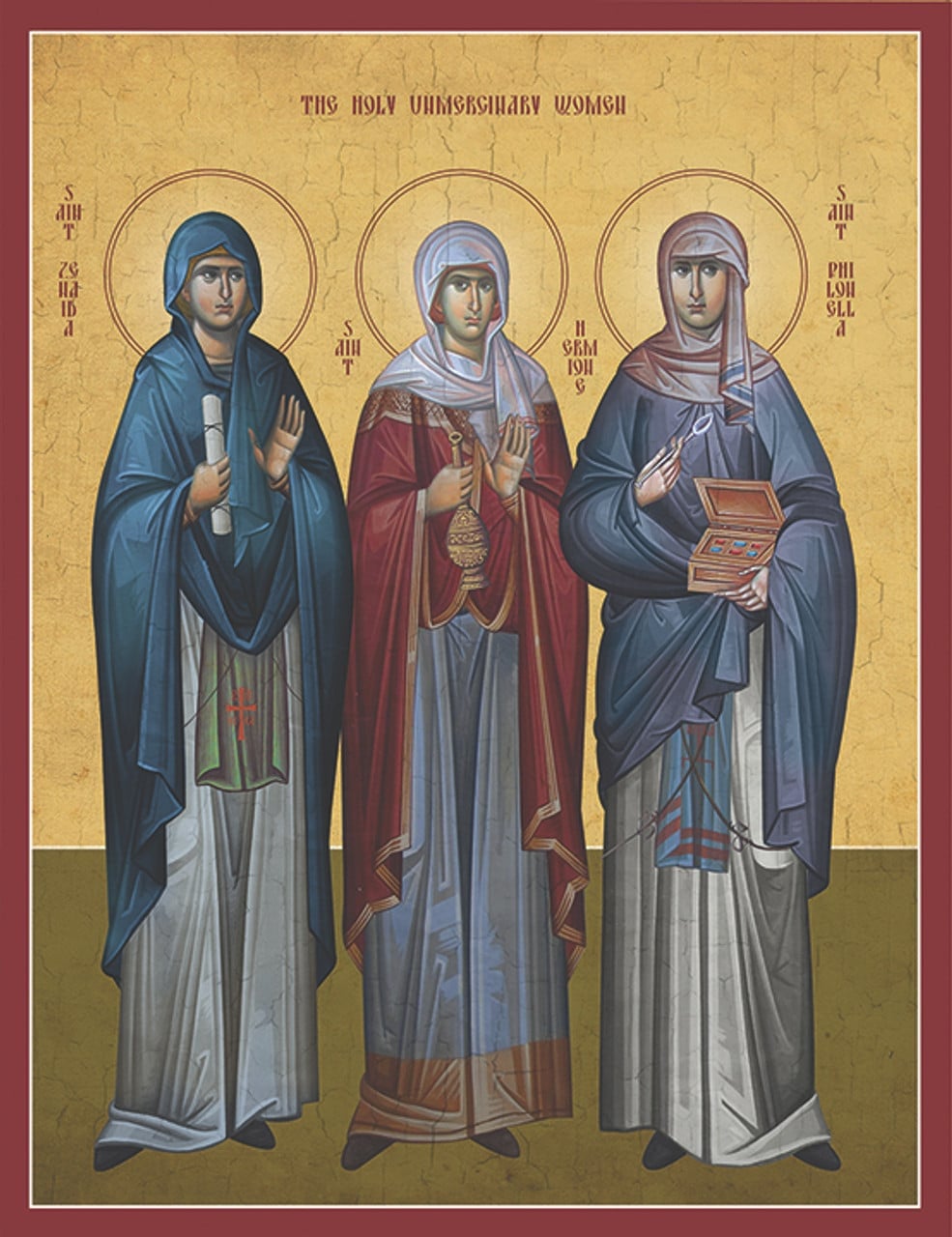
Saints Martyrs Zinaida and Philonilla
These two sisters are counted among the first unmercenary physicians in the history of the Church, and some sources even regard them, alongside Saint Hermione, as founders of this tradition.
Originally from Tarsus in Cilicia, Saints Zinaida and Philonilla lived in the 1st century and were sisters of Saint Jason, the first Bishop of Tarsus, who baptized them. They were also relatives of Saint Paul the Apostle.
They studied philosophy at an important school in the city, as well as medicine, which particularly attracted their interest.
They began their mission as Christian physicians at a hospital in Tarsus, but eventually travelled to other regions as well. During their journeys, they healed many people without accepting payment, converted many to Christianity, and established a care centre for the sick.
The two sisters’ preaching of the Gospel aroused the envy of the pagans, who stoned them to death.
Saint Theophanes, Confessor and Hymnographer, Bishop of Nicea
He was the younger brother of St Theodore the Branded (December 27). The brothers received an excellent education and were particularly involved in philosophy. Striving towards the knowledge of God, they settled in the Lavra of St Sava. Here St Theophanes was tonsured and later became a hieromonk.
The holy brothers were famed as advocates of icon veneration. They boldly fulfilled the mission entrusted to them by the Patriarch of Jerusalem and went to Constantinople to denounce the iconoclast emperor Leo the Armenian (813-820). Afterwards, they also denounced the iconoclast emperors Michael Balbos (820-829) and Theophilus (829-842).
The saints had to endure imprisonment, hunger, and even torture. The emperor Theophilus gave orders to inscribe a phrase insulting to the glorious confessors upon their faces with red-hot needles.
Therefore, they are called “Branded”. “Write whatever you wish, but at the Last Judgment you shall read your own writing,” said the agonized brothers to the emperor. They sent Theodore to prison, where also he died (+ 833), but Theophanes was sent into exile.
With the restoration of Icon veneration, St Theophanes was returned from exile and consecrated Bishop of Nicea. The saint wrote about 150 canons, among which is a beautiful canon in defence of holy icons. He died peacefully around the year 850.
Troparion — Tone 5
Having attained an angelic state, / you sounded forth as a golden trumpet of revelation / and nourished the chosen people with your words. / The singing of your hymns gladdens the Church, / for which you struggled, O Theophanes.