Orthodox Calendar November 28
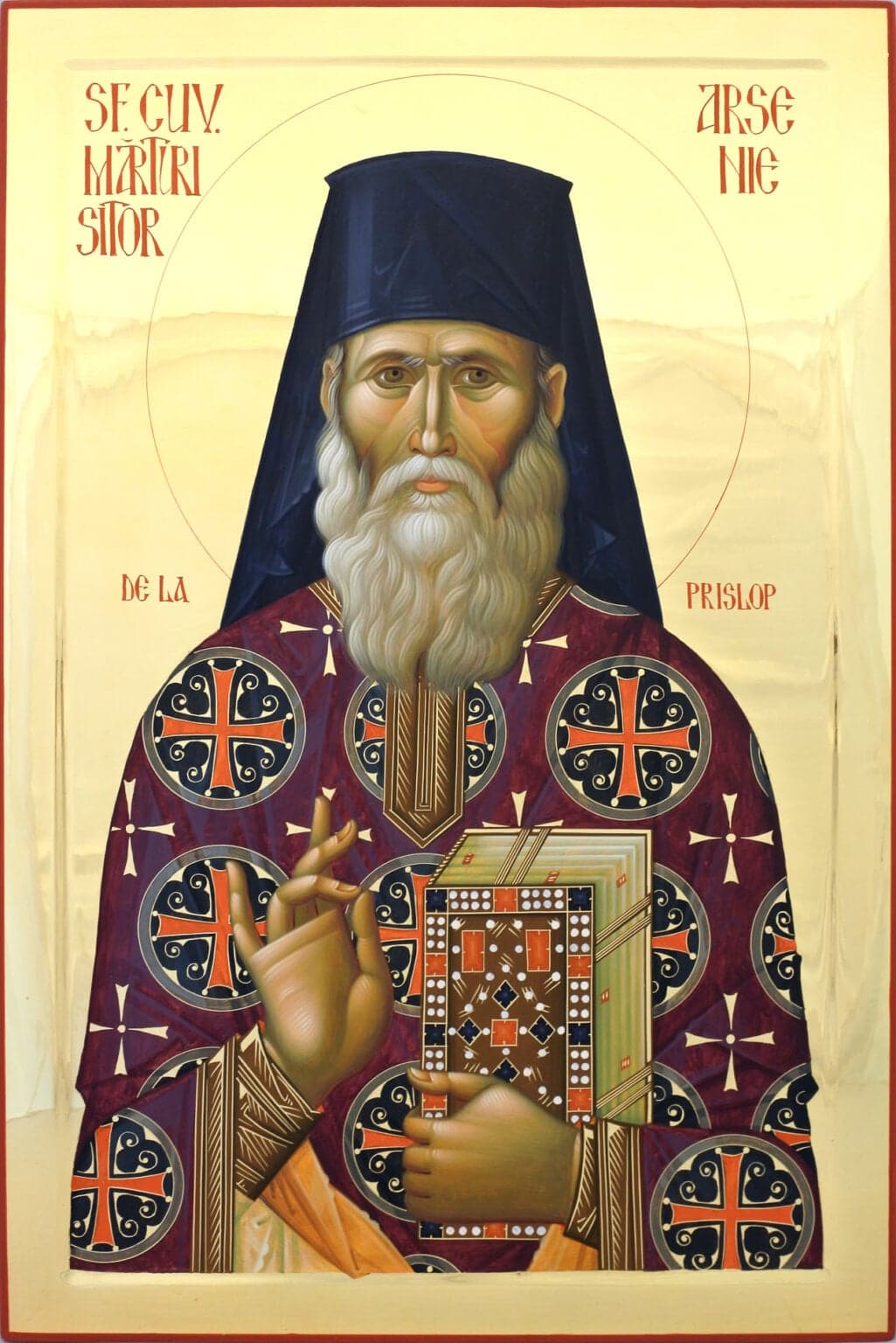
Confessor Saint Arsenius of Prislop
Venerable Father Arsenius was born on September 29, 1910, in the village of Vața de Sus in Hunedoara County, receiving at baptism the name Zian-Vălean. In the home of his parents, Iosif-Petru and Creștina Boca, simple and hardworking people, he grew up in the fear of God, so much so that he later said, “I found myself faithful even as a child.”
He remembered that his father, wishing to set a strong foundation for him, once rebuked him so that he would stop wasting time. He promised that he would keep this advice to his last hour. From then on he never grew idle and advanced so much in learning that all were amazed at his bright mind. And together with his thirst for knowledge, his soul began to thirst for the Lord, so from his youth he chose a “more austere discipline.”
In the autumn of 1929, after completing his secondary studies in Brad, he enrolled at the Theological Academy in Sibiu, where from the start he proved to be a student of good conduct. Modest and poor, he impressed not only through his learning, but also through the strength he showed in patience, silence, self-restraint, and fasting. With such a way of life, he said, “the beauty of the monastic life became clear to me and I wished to train myself, as well as I could, more firmly, especially in the mystical side of life.”
At the completion of his theological studies, Metropolitan Nicolae Bălan of Transylvania, seeing the gifts that were waiting to be multiplied, encouraged him to study at the Academy of Fine Arts in Bucharest, where he learned painting from the most renowned teachers of the time. In September 1936 he was ordained deacon, and in the spring of 1939 he was sent to the Holy Mountain of Athos to learn “the entire spiritual order and the craft of Byzantine art.” Together with Saint Seraphim of Sâmbăta, he stayed at the Cell of Saint Hypatius, where the elder was the hieroschemamonk Teodosie Domnariu of Săliștea Sibiului.
His pilgrimage to the Holy Mountain was short but full of blessing. Like a bee gathering nectar, he collected much spiritual profit. Because of his great love for God, the Mother of God granted him an encounter with two Romanian ascetics on Athos, Dometie Trihenea and Antipa Dinescu. From them he received guidance and also a manuscript of the Philokalia, which he copied and brought back to Romania.
Upon returning home, he was sent to Chișinău to learn the technique of gilding icons with gold leaf. There he experienced a wondrous event that marked his entire life. On August 31, 1939, one day before the beginning of the Second World War, in the train station, “looking out over the turmoil of the world,” he saw the Savior “with eyes of divine beauty and infinite sorrow.” This moved him to follow Christ, saying to himself, “Shall I not lighten, even a little, His immense cross that He carries among people until the end of the world, by taking up my part?” Thus he entered the monastery founded by Saint Prince Martyr Constantin Brâncoveanu at Sâmbăta de Sus, where at his tonsure he received the name of Abba Arsenius. On April 10, 1942, he was also deemed worthy to receive the grace of the priesthood.
Because of his chosen life, adorned with the fruits of the Holy Spirit, both his fellow strugglers and the faithful around him saw him as a living icon of virtue. His sermons touched the hearts of believers, and his wisdom became a source of repentance and right confession for all who heard him. Yet he was convinced that “the mission of a servant of God among people is very hard, because in order to do and to speak the will of God to others, you must put to death your own will.”
During these years, Father Arsenius gave decisive help to Saint Dumitru Stăniloae in translating the first volumes of the Philokalia, writing under the professor’s dictation and managing the lists of subscribers whose contributions supported the publication of these works.
After he had “revived, through his life and preaching, the spirit of the Philokalia in the religious life of the people,” Father Arsenius was sent in the autumn of 1948 to restore Prislop Monastery near Hațeg, the place of Saint John of Prislop’s ascetic struggle, which had been completely abandoned. Loving stillness, he rejoiced in the quiet of that place. Less than a year after arriving, in the presence of a large crowd of believers, he tonsured Saint Dometie of Râmeț, whose sponsor was Saint Seraphim of Sâmbăta.
News of Father Arsenius’ deeds spread throughout the country. In 1950, Saint Cleopa of Sihăstria, then abbot of Slatina Monastery, sent him a letter in which he confessed, “I too, thirsty as I am, longed much to drink from this spring of your words full of wisdom,” and thanked him for bringing to light “the mystical and ascetic treasure of the Holy Fathers, from which those who seek perfection may drink.”
Because he was sought without cease by faithful from all over the country for guidance, Father Arsenius began to be followed by the communist authorities. Under false charges he was arrested several times, though his only “crime” was confessing Christ. This is why Patriarch Justinian Marina said, “I do not know what is with this man, for he is taken again and again, and always released, and each time he comes out more full of light.”
Yet in 1959, with the harsh Decree 410, Father Arsenius was expelled from the monastery, forbidden to serve, and forced to give up the monastic habit. Although he had to live in the world, from which he had long withdrawn, he never broke his monastic vows. Instead, with greater zeal, he prayed to God and to the Most Pure Mother to strengthen him in patience.
He went to church dressed as a layman, but during the Divine Liturgy he shed many tears. In his home he kept the monastic rule of prayer and wrote spiritual teachings and theological reflections. He never complained and never spoke a bitter word about anyone, even when he would have been justified. Through the care of Patriarch Justinian Marina, he worked as a painter at Saint Elefterie Church in Bucharest, at Saint Parascheva Church in Bogata-Olteană in Brașov County, at the Painting Workshop of the Maicilor Skete in Bucharest, and for seventeen years at Saint Nicholas Church in Drăgănescu, which he painted entirely.
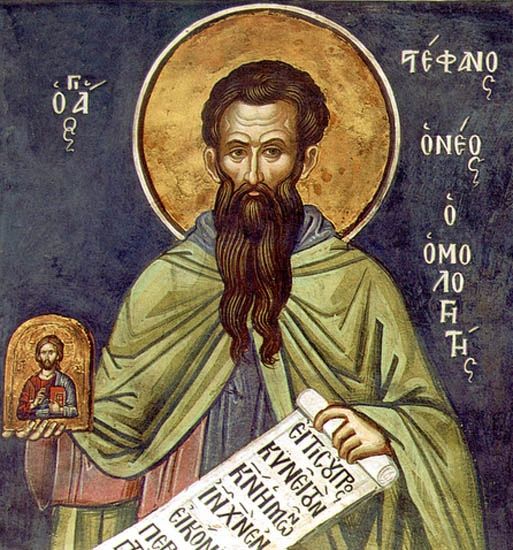
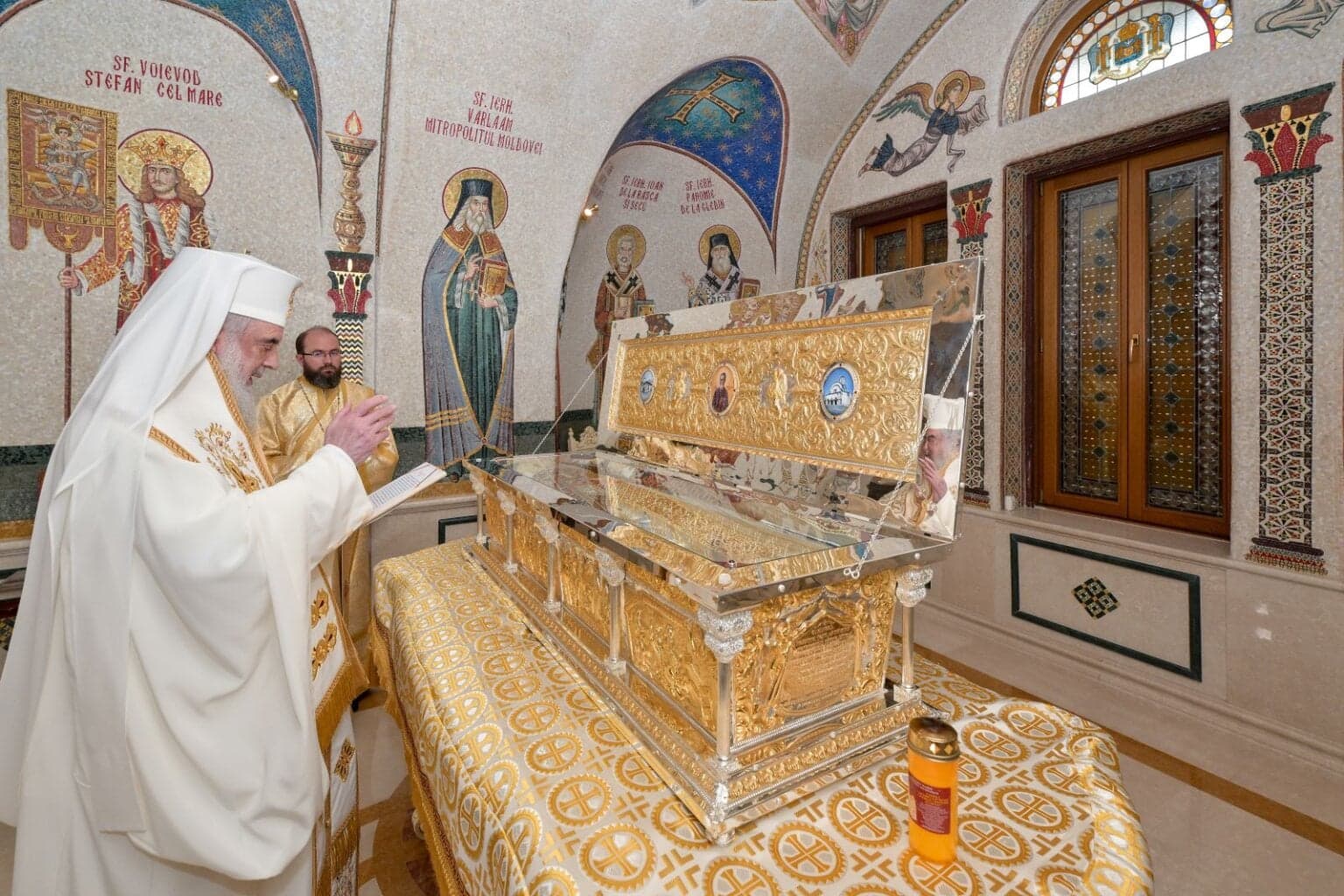
In the last years of his life he withdrew to Sinaia, where he labored constantly in prayer. He passed to the Lord on November 28, 1989, on the feast of Saint Stephen the New, whose life he had painted, in a prophetic way, in the altar of the church at Drăgănescu. He was buried as a hieromonk at Prislop Monastery, where countless miracles are worked even today for those who come with faith to his grave.
Through his holy prayers, Lord Jesus Christ our God, have mercy on us. Amen.

Martyr Stephen the New of Mt St Auxentius
The Monk Martyr and Confessor Stephen the New was born in 715 at Constantinople into a pious Christian family. His parents, having two daughters, prayed the Lord for a son. The mother of the new-born Stephen took him to the Blachernae church of the Most Holy Theotokos and dedicated him to God.
During the reign of the emperor Leo the Isaurian (716-741) there was a persecution against the holy icons and against those venerating them. With the support of the emperor, the adherents of the Iconoclast heresy seized control of the supreme positions of authority in the Empire and in the Church. Persecuted by the powers of this world, Orthodoxy was preserved in monasteries far from the capital, in solitary cells, and in the brave and faithful hearts of its followers.
The Orthodox parents of Saint Stephen, grieved by the prevailing impiety, fled from Constantinople to Bithynia, and they gave over their sixteen-year-old son in obedience to the monk John, who labored in asceticism in a solitary place on the Mount of Saint Auxentius. Saint Stephen dwelt with the venerable monk John for more than fifteen years, devoting himself totally to this spirit-bearing Elder, and learning monastic activity from him. Here Stephen received the news that his father was dead, and his mother and sisters had been tonsured as nuns.
After a certain time his teacher John also died. With deep sorrow Saint Stephen buried his venerable body, and continued with monastic effort in his cave by himself. Soon monks began to come to the ascetic, desiring to learn from him the virtuous and salvific life, and a monastery was established, with Saint Stephen as the igumen. At forty-two years of age Stephen left the monastery he founded, and he went to another mountain, on whose summit he dwelt in deep seclusion in a solitary cell. But here also a community of monks soon gathered, seeking the spiritual guidance of Saint Stephen.
Leo the Isaurian was succeeded by Constantine Copronymos (741-775), a fiercer persecutor of the Orthodox, and an even more zealous iconoclast. The emperor convened an Iconoclast Council, attended by 358 bishops from the Eastern provinces. However, except for Constantine, the Archbishop of Constantinople, illegitimately raised to the patriarchal throne by the power of Copronymos, not one of the other patriarchs participated in the wicked doings of this Council, thus making it less likely to style itself as “ecumenical.”
This council of heretics, at the instigation of the emperor and the archbishop, described icons as idols, and pronounced an anathema on all who venerated icons in the Orthodox manner, and it described icon veneration as heresy.
Meanwhile, the monastery of Mount Auxentius and its igumen became known in the capital. They told the emperor about the ascetic life of the monks, about their Orthodox piety, about the igumen Stephen’s gift of wonderworking, and of how Saint Stephen’s fame had spread far beyond the region of the monastery, and that the name of its head was accorded universal respect and love.
The saint’s open encouragement of icon veneration and the implied rebuff to the persecutors of Orthodoxy within the monastery of Mount Auxentius especially angered the emperor. Archbishop Constantine realized that in the person of Saint Stephen he had a strong and implacable opponent of his iconoclastic intentions, and he plotted how he might draw him over to his side or else destroy him.
They tried to lure Saint Stephen into the Iconoclast camp, at first with flattery and bribery, then by threats, but in vain. Then they slandered the saint, accusing him of falling into sin with the nun Anna. But his guilt was not proven, since the nun courageously denied any guilt and died under torture and beatings.
Finally, the emperor gave orders to lock up the saint in prison, and to destroy his monastery. Iconoclast bishops were sent to Saint Stephen in prison, trying to persuade him of the dogmatic correctness of the Iconoclast position. But the saint easily refuted all the arguments of the heretics and he remained true to Orthodoxy.
Then the emperor ordered that the saint be exiled on one of the islands in the Sea of Marmora. Saint Stephen settled into a cave, and there also his disciples soon gathered. After a certain while the saint left the brethren and took upon himself the exploit of living atop a pillar. News of the stylite Stephen, and the miracles worked by his prayers, spread throughout all the Empire and strengthened the faith and spirit of Orthodoxy in the people.
The emperor gave orders to transfer Saint Stephen to prison on the island of Pharos, and then to bring him to trial. At the trial, the saint refuted the arguments of the heretics sitting in judgment upon him. He explained the dogmatic essence of icon veneration, and he denounced the Iconoclasts because in blaspheming icons, they blasphemed Christ and the Mother of God. As proof, the saint pointed to a golden coin inscribed with the image of the emperor.
He asked the judges what would happen to a man who threw the coin to the ground , and then trampled the emperor’s image under his feet. They replied that such a man would certainly be punished for dishonoring the image of the emperor. The saint said that an even greater punishment awaited anyone who would dishonor the image of the King of Heaven and His Saints, and with that he spat on the coin, threw it to the ground, and began to trample it underfoot.
The emperor gave orders to take the saint to prison, where already there were languishing 342 Elders, condemned for the veneration of icons. In this prison Saint Stephen spent eleven months, consoling the imprisoned. The prison became like a monastery, where the usual prayers and hymns were chanted according to the Typikon. The people came to the prison in crowds and asked Saint Stephen to pray for them.
When the emperor learned that the saint had organized a monastery in prison, where they prayed and venerated holy icons, he sent two of his own servants, twin-brothers, to beat the saint to death. When these brothers went to the prison and beheld the face of the monk shining with a divine light, they fell down on their knees before him, asking his forgiveness and prayers, then they told the emperor that his command had been carried out.
But the emperor learned the truth and he resorted to yet another lie. Informing his soldiers that the saint was plotting to remove him from the throne, he sent them to the prison. The holy confessor himself came out to the furious soldiers, who seized him and dragged him through the streets of the city. They then threw the lacerated body of the martyr into a pit, where they were wont to bury criminals.
On the following morning a fiery cloud appeared over Mount Auxentius, and then a heavy darkness descended upon the capital, accompanied by hail, which killed many people.
Troparion, tone 4:
Trained in asceticism on the mountain, with the weapon of the Cross you destroyed the spiritual assaults of the hostile powers, all-blessed one; Again you bravely prepared for combat and slew Copronymus with the sword of faith; for both struggles you have been crowned by God, monk-martyr Stephen of eternal memory.

Martyr Hirenarchus at Sebaste
The Holy Martyr Hirenarchus was from Sebaste, Armenia, and lived during the reign of Diocletian (284-305). When he was young, he would minister to the martyrs in prison after they were tortured.
He once saw seven women being tortured for Christ, who bravely endured their torments. Saint Irenarchus marveled at this because they showed great courage in standing up to the tyrant, even though they were weak by nature.
Illumined by divine grace, Saint Hirenarchus confessed Christ. First he endured trials by fire and water, then he was beheaded with the seven holy women in the year 303.
Troparion, tone 4:
Your holy martyrs O Lord, through their sufferings have received incorruptible crowns from You, our God. For having Your strength, they laid low their adversaries, and shattered the powerless boldness of demons. Through their intercessions, save our souls!