Orthodox Calendar, May 1
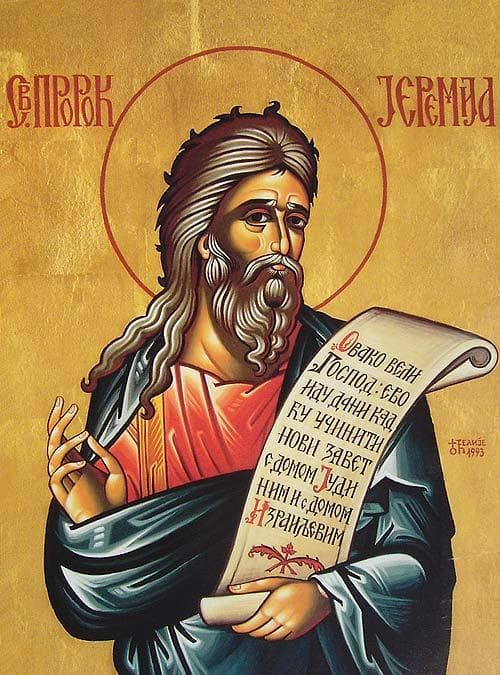
Prophet Jeremiah
One of the four great Old Testament prophets, he was son of the priest Helkiah from the city of Anathoth near Jerusalem, and he lived 600 years before the Birth of Christ, under the Israelite king Josiah and four of his successors.
He was called to prophetic service at the age of fifteen, when the Lord revealed to him that even before his birth the Lord had chosen him to be a prophet. Jeremiah refused, citing his youth and lack of skill at speaking, but the Lord promised to be always with him and to watch over him.
He touched the mouth of the chosen one and said, “Behold, I have put My words into your mouth. Behold, I have appointed you this day over nations and kingdoms, to root out and to pull down, to destroy and to rebuild, and to plant” (Jer. 1:9-10).
From that time Jeremiah prophesied for twenty-three years, denouncing the Jews for abandoning the true God and worshipping idols, predicting sorrows and devastating wars. He stood by the gates of the city, and at the entrance to the Temple, everywhere where the people gathered, and he exhorted them with imprecations and often with tears. The people, however, mocked and abused him, and they even tried to kill him.
Depicting for the Jews their impending enslavement to the king of Babylon, Jeremiah first placed on his own neck a wooden, and then an iron yoke, and thus he went about among the people. Enraged at the dire predictions of the prophet, the Jewish elders
threw the Prophet Jeremiah into a pit filled with horrid, slimy creatures, where he almost died. Through the intercession of the God-fearing royal official Habdemelek, the prophet was pulled out of the pit, but he did not cease his prophecies, and for this he was carted off to prison. Under the Jewish king Zedekiah his prophecy was fulfilled.
Nebuchadnezzar came, slaughtered many people, carried off a remnant into captivity, and Jerusalem was pillaged and destroyed. Nebuchadnezzar released the prophet from prison and permitted him to live where he wanted. The prophet remained at the ruins of Jerusalem and bewailed his nation’s misfortune.
According to Tradition, the Prophet Jeremiah took the Ark of the Covenant with the Tablets of the Law and hid it in one of the caves of Mount Nabath (Nebo), so that the Jews could no longer find it (2 Mac. 2). Afterwards, a new Ark of the Covenant was fashioned, but it lacked the glory of the first.
Among the Jews remaining in their fatherland there soon arose internecine clashes: Hodoliah, Nebuchadnezzar’s viceroy, was murdered. The Jews, fearing the wrath of Babylon, decided to flee into Egypt. The Prophet Jeremiah disagreed with their intention, predicting that the punishment which they feared would befall them in Egypt.
The Jews would not listen to the prophet, however, and taking him along by force, they went into Egypt and settled in the city of Tathnis. There the prophet lived for four years and was respected by the Egyptians, because by his prayers he killed crocodiles and other creatures infesting these parts.
When Jeremiah prophesied that the King of Babylon would invade Egypt and annihilate the Jews living there, the Jews murdered him. In that very same year the saint’s prophecy was fulfilled. There is a tradition that 250 years later, Alexander the Great transported the relics of the holy Prophet Jeremiah to Alexandria.
The Prophet Jeremiah wrote his Book of Prophecies and also the Book of Lamentations about the desolation of Jerusalem and the Exile. The times in which he lived and prophesied are described in 4/2 Kings (Ch. 23-25) and in the Second Book of Chronicles (36:12) and in 2 Maccabbees (Ch. 2).
In the Gospel of Matthew it is said that the betrayal of Judas was foretold by the Prophet Jeremiah, “And they took thirty pieces of silver, the price of him on whom the sons of Israel had set a price, and they gave them for the potter’s field, as the Lord directed me” (Mt. 27:9-10). Perhaps Jeremiah 32:6-15 is meant.
Even after his death, the Prophet Jeremiah was regarded as a wonderworker. Dust from his tomb was believed to cure snake-bite, and many Christians pray to him for this purpose.
Troparion — Tone 2
Celebrating the memory / of Your Prophet Jeremiah, O Lord, / for his sake, we entreat You to save our souls.

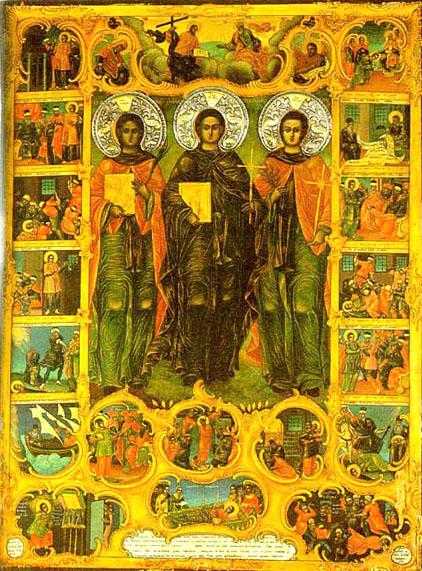
Martyrs Ignatius, Acacius and Euthymius
Martyr Euthymius
This holy New Martyr of Christ was born in Demitsana in the Peloponnesos. His parents were Panagiotes and Maria, and he was given the name Eleutherius in Baptism. Eleutherius was the youngest of five children (the others were George, Christos, John, and Katerina).
After attending school in Demetsana, Eleutherius and John traveled to Constantinople to enroll in the Patriarchal Academy. Later, they went to Jassy, Romania where their father and brothers were in business. Some time afterwards, Eleutherius decided to go to Mt. Athos to become a monk. Because of a war between Russia and Turkey, he was able to travel only as far as Bucharest. There he stayed with the French consul, then with an employee of the Russian consul.
Eleutherius began to pursue a life of pleasure, putting aside his thoughts of monasticism. When hostilities ceased, Eleutherius made his way to Constantinople in the company of some Moslems. On the way, he turned from Orthodoxy and embraced Islam.
Soon his conscience began to torment him for his denial of Christ. The other Moslems began to notice a change in his attitude, so they restricted his movements and kept a close watch on him.
Eleutherius, however, prayed that God would permit him to escape.
With some assistance from the Russian embassy, Eleutherius boarded a ship and sailed to Mt. Athos. At the Great Lavra Eleutherius was chrismated and received back into the Orthodox Church, and also became a monk with the name Euthymius.
Euthymius read the New Martyrologion of Saint Νikόdēmos (July 14), and was inspired by the example of the New Martyrs. He then became consumed with a desire to wipe out his apostasy with the blood of martyrdom.
Saint Euthymius went to Constantinople with a monk named Gregory, arriving on March 19, 1814. A few days later, on Palm Sunday, he received Holy Communion. Removing his monastic garb, he dressed himself as a Moslem and went to the palace of the Grand Vizier, Rusud Pasha. Saint Euthymius, holding palms in his hand, confessed that he was an Orthodox Christian, and wished to die for Christ.
Saint Euthymius was killed about noon on March 22, 1814 in Constantinople, thereby earning a place in the heavenly Kingdom. The head of Saint Euthymius is in the Monastery of Saint Panteleimon on Mt. Athos.
Martyr Ignatius
The holy New Martyr Ignatius was born in the village of Eski Zagora in the Trnovo region of Bulgaria, and was named John in Baptism. While he was still a young child, his parents George and Maria moved to the city of Philippopolis and enrolled him in a school there.
Although he did well at school, he had a strong desire for the monastic life. Upon reaching adulthood, he entered the Rila monastery in western Bulgaria. There he was assigned to an Elder, with whom he lived in obedience for six years. When the Elder’s strictness became unbearable, John returned home.
About that time the Serbs rose in revolt against the Moslem government. John’s father was asked to take command of an Ottoman brigade, but he refused to fight against other Orthodox Christians.
The Moslems attacked George with furious anger. He was stabbed and then beheaded. John’s mother and sisters were also taken by the Hagarenes, and they ultimately agreed to convert to Islam.
John fled and hid in the home of an elderly Orthodox woman. His mother and sisters learned where he was hiding, and they told the Moslems. Those sent to capture him did not know what he looked like, so the old woman told them she did not know him. The woman helped him escape to Bucharest, Romania, where he became acquainted with Saint Euthymius, who would also endure martyrdom.
John did not wish to stay in Bucharest, however, and so he left for Mt. Athos. On the way he visited the village of Soumla, where he ran into his friend Father Euthymius again. Learning that Euthymius had denied Christ and become a Moslem, John became very sad and left the village.
He had not gotten very far when Turkish soldiers stopped him and took all his possessions. They demanded that he convert to Islam, and in his fright he told them that he would do so. Satisfied with this reply, they let him go.
John reached the village of Eski Zagora, where he met an Athonite monk from the monastery of Grigoriou. They journeyed to the Holy Mountain together, and John settled in the Skete of Saint Anna.
In time, John was found worthy of monastic tonsure, and was given the new name Ignatius. The Elder Acacius blessed him to travel to Constantinople with the monk Gregory in order to bear witness to Christ. After receiving the Holy Mysteries in Constantinople, Ignatius felt he was ready for his ordeal.
Dressed in Moslem garb, Ignatius went before the kadi and proclaimed his faith in Christ.
The holy New Martyr Acacius was born at Neochorion, Macedonia near Thessalonica in the eighteenth century. The oldest son of Bulgarian peasants, he was named Athanasius at his baptism. When he was nine years old, his family moved to the city of Serres. Athanasius was apprenticed to a cobbler, who frequently beat him. On the night of Holy Friday, after a particularly severe beating, he wandered onto the street and two Moslem women comforted him, brought him home and fed him. Pretending sympathy, they urged him to deny Christ.
They took the boy to Yusuf Bey, who adopted him, gave him a Moslem name, and had him circumcised. He lived in that home for nine years.
At first, the wife of Yusuf Bey treated Athanasius with maternal love, but this later turned into a lustful passion. Just as the righteous Joseph (March 31) rejected the advances of Potiphar’s wife (Genesis 39:8-10), so did Athanasius spurn the advances of the Moslem woman. So she told her husband that Athanasius had tried to force himself on her. His Turkish father threw him out of the house, and the young man returned to Thessalonica to find his real parents. His mother told him it was too dangerous for him to stay with them, and so he went to Mt Athos.
At first he lived at the Hilandar Monastery for a while, but he spent time in other monasteries as well. He confessed his apostasy to Father Nicholas at the Xenophontos Monastery, who read the prescribed prayers and received him back into the Church through Chrismation. Athanasius returned to Hilandar for about a year, then went to Ivḗron.
While at the skete at Ivḗron he heard of Saints Euthymius and Ignatius, and desired to imitate their feat of martyrdom.
he left for Constantinople with the Elder Gregory, who had also accompanied Saints Ignatius and Euthymius on their way to martyrdom. They left Mt Athos on a ship, arriving in Constantinople thirteen days later. On April 22, Saint Acacius received Holy Communion at a church in Galata, then returned to the ship. He changed into Moslem clothing and went with Father Gregory to the Porte, where a doorkeeper asked them what they wanted.
Saint Acacius related his story, saying that he had been deceived into renouncing Christianity and accepting Islam, but now he had come to his senses. Denouncing Mohammed as a false prophet, he loudly proclaimed that he was a Christian.
Saint Acacius gave his life for Christ on May 1, 1816 at six o’clock in the evening. Some pious Christians ransomed the saint’s body from the Turks, and Father Gregory brought it back to Mt Athos. The holy relics were brought to Ivḗron and buried in a church dedicated to Saints Ignatius and Euthymius.
Although some sources give the year of the saint’s martyrdom as 1815, there is a letter from Saint Acacius to a certain spiritual Father on Mt Athos dated April 27, 1816 which states that he is on his way to martyrdom. Thus, the year is 1816.
The heads of Saints Acacius, Euthymius, and Ignatius are in the Russian monastery of Saint Panteleimon on the Holy Mountain.
St. Tamara, the Queen of Georgia
In 1166 a daughter, Tamar, was born to King George III (1155-1184) and Queen Burdukhan of Georgia. The king proclaimed that he would share the throne with his daughter from the day she turned twelve years of age.
The royal court unanimously vowed its allegiance and service to Tamar, and father and daughter ruled the country together for five years. After King George’s death in 1184, the nobility recognized the young Tamar as the sole ruler of all Georgia. Queen Tamar was enthroned as ruler of all Georgia at the age of eighteen. She is called “King” in the Georgian language because her father had no male heir and so she ruled as a monarch and not as a consort.
At the beginning of her reign, Tamar convened a Church council and addressed the clergy with wisdom and humility: “Judge according to righteousness, affirming good and condemning evil,” she advised. “Begin with me—if I sin I should be censured, for the royal crown is sent down from above as a sign of divine service. Allow neither the wealth of the nobles nor the poverty of the masses to hinder your work. You by word and I by deed, you by preaching and I by the law, you by upbringing and I by education will care for those souls whom God has entrusted to us, and together we will abide by the law of God, in order to escape eternal condemnation…. You as priests and I as ruler, you as stewards of good and I as the watchman of that good.”
The Church and the royal court chose a suitor for Tamar: Yuri, the son of Prince Andrei Bogoliubsky of Vladimir-Suzdal (in Georgia Yuri was known as “George the Russian”). The handsome George Rusi was a valiant soldier, and under his command the Georgians returned victorious from many battles. His marriage to Tamar, however, exposed many of the coarser sides of his character. He was often drunk and inclined toward immoral deeds. In the end, Tamar’s court sent him away from Georgia to Constantinople, armed with a generous recompense. Many Middle Eastern rulers were drawn to Queen Tamar’s beauty and desired to marry her, but she rejected them all. Finally at the insistence of her court, she agreed to wed a second time to ensure the preservation of the dynasty. This time, however, she asked her aunt and nurse Rusudan (the sister of King George III) to find her a suitor. The man she chose, Davit-Soslan Bagrationi, was the son of the Ossetian ruler and a descendant of King George I (1014-1027).
In 1195 a joint Muslim military campaign against Georgia was planned under the leadership of Atabeg (a military commander) Abu Bakr of Persian Azerbaijan. At Queen Tamar’s command, a call to arms was issued. The faithful were instructed by Metropolitan Anton of Chqondidi to celebrate All-night Vigils and Liturgies and to generously distribute alms so that the poor could rest from their labors in order to pray. In ten days the army was prepared, and Queen Tamar addressed the Georgian soldiers for the last time before the battle began: “My brothers! Do not allow your hearts to tremble before the multitude of enemies, for God is with us…. Trust God alone, turn your hearts to Him in righteousness, and place your every hope in the Cross of Christ and in the Most Holy Theotokos!”
Having taken off her shoes, Queen Tamar climbed the hill to the Metekhi Church of the Theotokos (in Tbilisi) and knelt before the icon of the Most Holy Theotokos. She prayed without ceasing until the good news arrived: the battle near Shamkori had ended in the unquestionable victory of the Orthodox Georgian army.
After this initial victory the Georgian army launched into a series of triumphs over the Turks, and neighboring countries began to regard Georgia as the protector of the entire Transcaucasus. By the beginning the 13th century, Georgia was a commanding political authority recognized by both the Christian West and the Muslim East.
Georgia’s military successes alarmed the Islamic world. Sultan Rukn al-Din was certain that a united Muslim force could definitively decide the issue of power in the region, and he marched on Georgia around the year 1203, commanding an enormous army.
Having encamped near Basiani, Rukn al-Din sent a messenger to Queen Tamar with an audacious demand: to surrender without a fight. In reward for her obedience, the sultan promised to marry her on the condition that she embrace Islam; if Tamar were to cleave to Christianity, he would number her among the other unfortunate concubines in his harem. When the messenger relayed the sultan’s demand, a certain nobleman, Zakaria Mkhargrdzelidze, was so outraged that he slapped him on the face, knocking him unconscious.
At Queen Tamar’s command, the court generously bestowed gifts upon the ambassador and sent him away with a Georgian envoy and a letter of reply. “Your proposal takes into consideration your wealth and the vastness of your armies, but fails to account for divine judgment,” Tamar wrote, “while I place my trust not in any army or worldly thing but in the right hand of the Almighty God and the infinite aid of the Cross, which you curse. The will of God—and not your own—shall be fulfilled, and the judgment of God—and not your judgment—shall reign!”
The Georgian soldiers were summoned without delay. Queen Tamar prayed for victory before the Vardzia Icon of the Theotokos, then, barefoot, led her army to the gates of the city.
Hoping in the Lord and the fervent prayers of Queen Tamar, the Georgian army marched toward Basiani. The enemy was routed. The victory at Basiani was an enormous event not only for Georgia, but for the entire Christian world.
The military victories increased Queen Tamar’s faith. In the daytime she shone in all her royal finery and wisely administered the affairs of the government; during the night, on bended knees, she beseeched the Lord tearfully to strengthen the Georgian Church. She busied herself with needlework and distributed her embroidery to the poor.
Once, exhausted from her prayers and needlework, Tamar dozed off and saw a vision. Entering a luxuriously furnished home, she saw a gold throne studded with jewels, and she turned to approach it, but was suddenly stopped by an old man crowned with a halo. “Who is more worthy than I to receive such a glorious throne?” Queen Tamar asked him.
He answered her, saying, “This throne is intended for your maidservant, who sewed vestments for twelve priests with her own hands. You are already the possessor of great treasure in this world.” And he pointed her in a different direction.
Having awakened, Holy Queen Tamar immediately took to her work and with her own hands sewed vestments for twelve priests.
History has preserved another poignant episode from Queen Tamar’s life: Once she was preparing to attend a festal Liturgy in Gelati, and she fastened precious rubies to the belt around her waist. Soon after she was told that a beggar outside the monastery tower was asking for alms, and she ordered her entourage to wait. Having finished dressing, she went out to the tower but found no one there. Terribly distressed, she reproached herself for having denied the poor and thus denying Christ Himself. Immediately she removed her belt, the cause of her temptation, and presented it as an offering to the Gelati Icon of the Theotokos.
During Queen Tamar’s reign a veritable monastic city was carved in the rocks of Vardzia, and the God-fearing Georgian ruler would labor there during the Great Fast. The churches of Pitareti, Kvabtakhevi, Betania, and many others were also built at that time. Holy Queen Tamar generously endowed the churches and monasteries not only on Georgian territory but also outside her borders: in Palestine, Cyprus, Mt. Sinai, the Black Mountains, Greece, Mt. Athos, Petritsoni (Bulgaria), Macedonia, Thrace, Romania, Isauria and Constantinople. The divinely guided Queen Tamar abolished the death penalty and all forms of bodily torture.
A regular, secret observance of a strict ascetic regime—fasting, a stone bed, and litanies chanted in bare feet—finally took its toll on Queen Tamar’s health. For a long time she refrained from speaking to anyone about her condition, but when the pain became unbearable she finally sought help. The best physicians of the time were unable to diagnose her illness, and all of Georgia was seized with fear of disaster. Everyone from the small to the great prayed fervently for Georgia’s ruler and defender. The people were prepared to offer not only their own lives, but even the lives of their children, for the sake of their beloved ruler.
God sent Tamar a sign when He was ready to receive her into His Kingdom. Then the pious ruler bade farewell to her court and turned in prayer to an icon of Christ and the Life-giving Cross: “Lord Jesus Christ! Omnipotent Master of heaven and earth! To Thee I deliver the nation and people that were entrusted to my care and purchased by Thy Precious Blood, the children whom Thou didst bestow upon me, and to Thee I surrender my soul, O Lord!”
The burial place of Queen Tamar has remained a mystery to this day. Some sources claim that her tomb is in Gelati, in a branch of burial vaults belonging to the Bagrationi dynasty, while others argue that her holy relics are preserved in a vault at the Holy Cross Monastery in Jerusalem.
St. Tamara is commemorated on the Sunday of the Myrrh-bearing Women in addition to her regular commemoration on May 1.

Blessed Isidora the Fool of Tabenna in Egypt
Saint Isidora, Fool-for-Christ, struggled in the Tabenna monastery in Egypt during the sixth century. Taking upon herself the feat of folly, she acted like one insane, and did not eat food with the other sisters of the monastery. Many of them regarded her with contempt, but Isidora bore all this with great patience and meekness, blessing God for everything.
She worked in the kitchen and fulfilled the dirtiest, most difficult tasks at the monastery, cleaning the monastery of every impurity. Isidora covered her head with a plain rag, and instead of cooked food she drank the dirty wash water from the pots and dishes. She never became angry, never insulted anyone with a word, never grumbled against God or the sisters, and was given to silence.
Once, a desert monk, Saint Pitirim, had a vision. An angel of God appeared to him and said, “Go to the Tabenna monastery. There you will see a sister wearing a rag on her head. She serves them all with love, and endures their contempt without complaint. Her heart and her thoughts rest always with God. You, on the other hand, sit in solitude, but your thoughts flit about all over the world.”
The Elder set out for the Tabenna monastery, but he did not see the one indicated to him in the vision among the sisters. Then they led Isidora to him, considering her a demoniac. Isidora fell down at the knees of the Elder, asking his blessing. Saint Pitirim bowed down to the ground to her and said, “Bless me first, venerable Mother!”
To the astonished questions of the sisters the Elder replied, “Before God, Isidora is higher than all of us!” Then the sisters began to repent, confessing their mistreatment of Isidora, and they asked her forgiveness. The saint, however, distressed over her fame, secretly hid herself away from the monastery, and her ultimate fate remained unknown. It is believed that she died around the year 365.

Tr by oca.org