Orthodox Calendar March 18
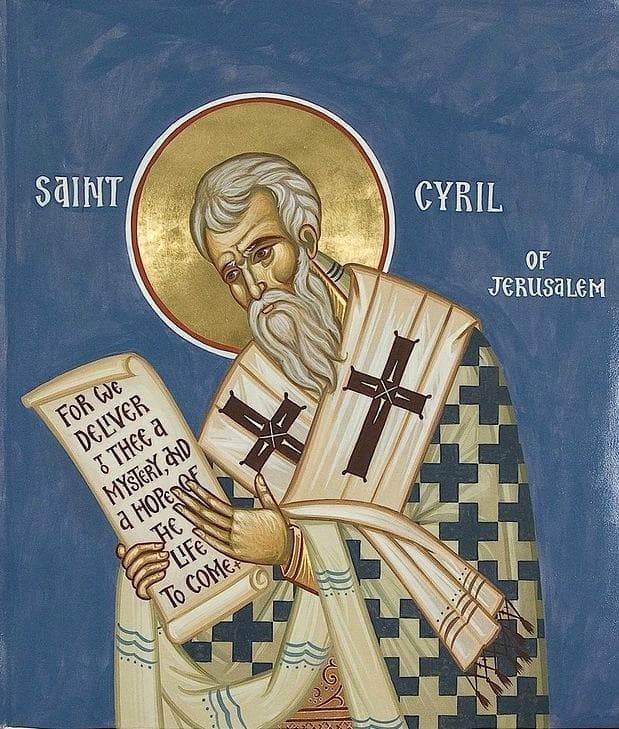
St. Cyril the Archbishop of Jerusalem
Saint Cyril, Archbishop of Jerusalem, was born in Jerusalem in the year 315 and was raised in strict Christian piety. Upon reaching the age of maturity, he became a monk, and in the year 346 he became a presbyter. In the year 350, upon the death of Archbishop Maximus, he succeeded him on the episcopal throne of Jerusalem.
As Patriarch of Jerusalem, Saint Cyril zealously fought against the heresies of Arius and Macedonius. In so doing, he aroused the animosity of the Arian bishops, who sought to have him deposed and banished from Jerusalem.
There was a miraculous portent in 351 at Jerusalem: at the third hour of the day on the Feast of Pentecost, the Holy Cross appeared in the heavens, shining with a radiant light. It stretched from Golgotha above the Mount of Olives. Saint Cyril reported this portent to the Arian emperor Constantius (351-363), hoping to convert him to Orthodoxy.
The heretic Acacius, deposed by the Council of Sardica, was formerly the Metropolitan of Caesarea, and he collaborated with the emperor to have Saint Cyril removed. An intense famine struck Jerusalem, and Saint Cyril expended all his wealth in charity. But since the famine did not abate, the saint pawned church utensils, and used the money to buy wheat for the starving. The saint’s enemies spread a scandalous rumor that they had seen a woman in the city dancing around in clerical garb. Taking advantage of this rumor, the heretics forcibly expelled the saint.
The saint found shelter with Bishop Silvanus in Tarsus. After this, a local Council at Seleucia, at which there were about 150 bishops, and among them Saint Cyril. The heretical Metropolitan Acacius did not want to allow him to take a seat, but the Council would not consent to this. Acacius stormed out of the Council, and before the emperor and the Arian patriarch Eudoxius, he denounced both the Council and Saint Cyril. The emperor had the saint imprisoned.
When the emperor Julian the Apostate (361-363) ascended the throne he repealed all the anti-Orthodox decrees of Constantius, seemingly out of piety. Saint Cyril returned to his own flock. But after a certain while, when Julian had become secure upon the throne, he openly apostasized and renounced Christ. He permitted the Jews to start rebuilding the Temple of Jerusalem that had been destroyed by the Romans, and he even provided them part of the funds for the building from the state treasury.
Saint Cyril predicted that the words of the Savior about the destruction of the Temple down to its very stones (Luke. 21:6) would undoubtedly transpire, and the blasphemous intent of Julian would come to naught. Soon there was such a powerful earthquake, that even the solidly set foundation of the ancient Temple of Solomon shifted in its place, and what had been rebuilt fell down and shattered into dust.
When the Jews resumed construction, a fire came down from the heavens and destroyed the tools of the workmen. Great terror seized everyone. On the following night, the Sign of the Cross appeared on the clothing of the Jews, which they could not remove by any means.
After this heavenly confirmation of Saint Cyril’s prediction, they banished him again, and the bishop’s throne was occupied by Saint Cyriacus. But Saint Cyriacus soon suffered a martyr’s death (October 28).
After the emperor Julian perished in 363, Saint Cyril returned to his See, but during the reign of the emperor Valens (364-378) he was exiled for a third time. It was only under the holy emperor Saint Theodosius the Great (379-395) that he finally returned to his archpastoral activity. In 381 Saint Cyril participated in the Second Ecumenical Council, which condemned the heresy of Macedonius and affirmed the Nicea-Constantinople Symbol of Faith (Creed).
Saint Cyril’s works include twenty-three Instructions (Eighteen are Catechetical, intended for those preparing for Baptism, and five are for the newly-baptized) and two discourses on Gospel themes: “On the Paralytic,” and “Concerning the Transformation of Water into Wine at Cana.”
At the heart of the Catechetical Instructions is a detailed explanation of the Symbol of Faith. The saint suggests that a Christian should inscribe the Symbol of Faith upon “the tablets of the heart.”
“The articles of the Faith,” Saint Cyril teaches, “were not written through human cleverness, but they contain everything that is most important in all the Scriptures, in a single teaching of faith. Just as the mustard seed contains all its plethora of branches within its small kernel, so also does the Faith in its several declarations combine all the pious teachings of the Old and the New Testaments.”
Saint Cyril, a great ascetic and a champion of Orthodoxy, died in the year 386.
Troparion, tone 4:
You appeared to your flock as a rule of faith, / an image of humility and a teacher of abstinence. / Because of your lowliness, Heaven was opened to you. / Because of your poverty, riches were granted to you. / O holy bishop, Cyril, pray to Christ our God to save our souls!
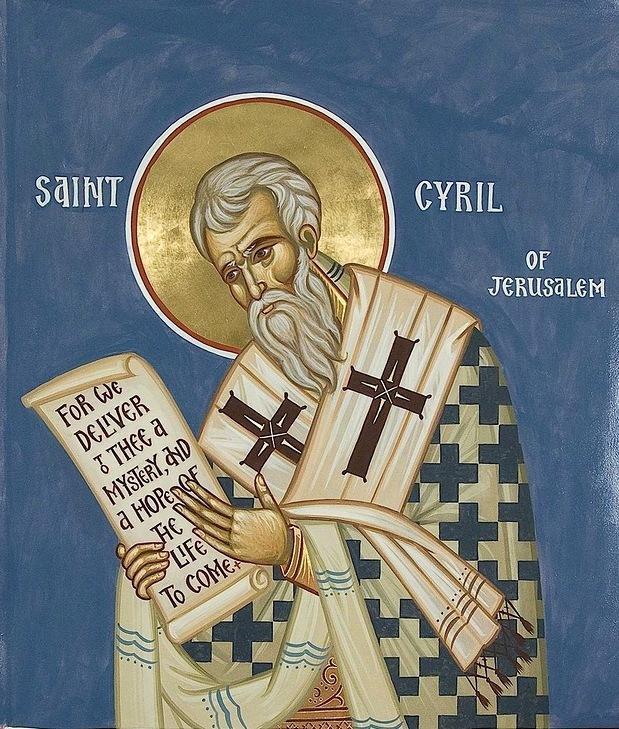
Saint Nikolai Velimirović
Saint Nikolai of Zhicha, “the Serbian Chrysostom,” was born in Lelich in western Serbia on January 4, 1881 (December 23, 1880 O.S.). His parents were Dragomir and Katherine Velimirovich, who lived on a farm where they raised a large family. His pious mother was a major influence on his spiritual development, teaching him by word and especially by example. As a small child, Nikolai often walked three miles to the Chelije Monastery with his mother to attend services there.
Sickly as a child, Nikolai was not physically strong as an adult. He failed his physical requirements when he applied to the military academy, but his excellent academic qualifications allowed him to enter the Saint Savva Seminary in Belgrade, even before he finished preparatory school.
After graduating from the seminary in 1905, he earned doctoral degrees from the University of Berne in 1908, and from King’s College, Oxford in 1909. When he returned home, he fell ill with dysentery. Vowing to serve God for the rest of his life if he recovered, he was tonsured at the Rakovica Monastery on December 20, 1909 and was also ordained to the holy priesthood.
In 1910 he went to study in Russia to prepare himself for a teaching position at the seminary in Belgrade. At the Theological Academy in Saint Petersburg, the Provost asked him why he had come. He replied, “I wanted to be a shepherd. As a child, I tended my father’s sheep. Now that I am a man, I wish to tend the rational flock of my heavenly Father. I believe that is the way that has been shown to me.” The Provost smiled, pleased by this response, then showed the young man to his quarters.
After completing his studies, he returned to Belgrade and taught philosophy, logic, history, and foreign languages at the seminary. He spoke seven languages, and this ability proved very useful to him throughout his life.
Saint Nikolai was renowned for his sermons, which never lasted more than twenty minutes, and focused on just three main points. He taught people the theology of the Church in a language they could understand, and inspired them to repentance.
At the start of World War I, Archimandrite Nikolai was sent to England on a diplomatic mission to seek help in the struggle of the Serbs against Austria. His doctorate from Oxford gained him an invitation to speak at Westminster Abbey. He remained in England for three short months, but Saint Nikolai left a lasting impression on those who heard him. His writings “The Lord’s Commandments,” and “Meditations on the Lord’s Prayer” impressed many in the Church of England.
Archimandrite Nikolai left England and went to America, where he proved to be a good ambassador for his nation and his Church.
The future saint returned to Serbia in 1919, where he was consecrated as Bishop of Zhicha, and was later transferred to Ochrid. The new hierarch assisted those who were suffering from the ravages of war by establishing orphanages and helping the poor.
Bishop Nikolai took over as leader of Bogomljcki Pokret, a popular movement for spiritual revival which encouraged people to pray and read the Bible. Under the bishop’s direction, it also contributed to a renewal of monasticism. Monasteries were restored and reopened, and this in turn revitalized the spiritual life of the Serbian people.
In 1921, Bishop Nikolai was invited to visit America again and spent two years as a missionary bishop. He gave more than a hundred talks in less than six months, raising funds for his orphanages. Over the next twenty years, he lectured in various churches and universities.
When Germany invaded Yugoslavia on April 6, 1941, Bishop Nikolai, a fearless critic of the Nazis, was arrested and confined in Ljubostir Vojlovici Monastery. In 1944, he and Patriarch Gavrilo were sent to the death camp at Dachau. There he witnessed many atrocities and was tortured himself. When American troops liberated the prisoners in May 1945, the patriarch returned to Yugoslavia, but Bishop Nikolai went to England.
The Communist leader Tito was just coming to power in Yugoslavia, where he persecuted the Church and crushed those who opposed him. Therefore, Bishop Nikolai believed he could serve the Serbian people more effectively by remaining abroad. He went to America in 1946, following a hectic schedule in spite of his health problems which were exacerbated by his time in Dachau. He taught for three years at Saint Savva’s Seminary in Libertyville, IL before he settled at Saint Tikhon’s Monastery in South Canaan, PA in 1951.
He taught at Saint Tikhon’s and also served as the seminary’s Dean and Rector. He was also a guest lecturer at Saint Vladimir’s Seminary in NY, and at Holy Trinity Monastery in Jordanville, NY.
On Saturday March 17, 1956 Bishop Nikolai served his last Liturgy. After the service he went to the trapeza and gave a short talk. As he was leaving, he bowed low and said, “Forgive me, brothers.” This was something unusual which he had not done before.
On March 18, 1956 Saint Nikolai fell asleep in the Lord Whom he had served throughout his life. He was found in his room kneeling in an attitude of prayer. Though he was buried at Saint Savva’s Monastery in Libertyville, IL, he had always expressed a desire to be buried in his homeland. In April of 1991 his relics were transferred to the Chetinje Monastery in Lelich. There he was buried next to his friend and disciple Father Justin Popovich (+ 1979).
English readers are familiar with Saint Nikolai’s Prologue from Ochrid, The Life of Saint Savva, A Treasury of Serbian Spirituality, and other writings which are of great benefit for the whole Church. He thought of his writings as silent sermons addressed to people who would never hear him preach. In his life and writings, the grace of the Holy Spirit shone forth for all to see, but in his humility he considered himself the least of men.
Though he was a native of Serbia, Saint Nikolai has a universal significance for Orthodox Christians in all countries. He was like a candle set upon a candlestick giving light to all (MT 5:15). A spiritual guide and teacher with a magnetic personality, he attracted many people to himself. He also loved them, seeing the image of God in each person he met. He had a special love for children, who hastened to receive his blessing whenever they saw him in the street.
He was a man of compunctionate prayer, and possessesed the gift of tears which purify the soul (Saint John Climacus, LADDER, Step 7). He was a true pastor to his flock protecting them from spiritual wolves, and guiding them on the path to salvation. He has left behind many soul-profiting writings which proclaim the truth of Christ to modern man. In them he exhorts people to love God, and to live a life of virtue and holiness. May we also be found worthy of the Kingdom of Heaven through the prayers of Saint Nikolai, and by the grace of our Lord Jesus Christ, to Whom be glory forever. Amen.
Troparion — Tone 8
O golden-tongued preacher proclaiming the risen Christ, / everlasting guide of the cross-bearing Serbian people, / resounding harp of the Holy Spirit, and dear to monastics who rejoice in you, / pride and boast of the priesthood, teacher of repentance, master for all nations, / guide of those in the army of Christ as they pray to God, / Holy Nikolai teacher in America and pride of the Serbian people, / with all the saints, implore the only Lover of mankind / to grant us peace and joy in his heavenly kingdom!