Orthodox Calendar February 19
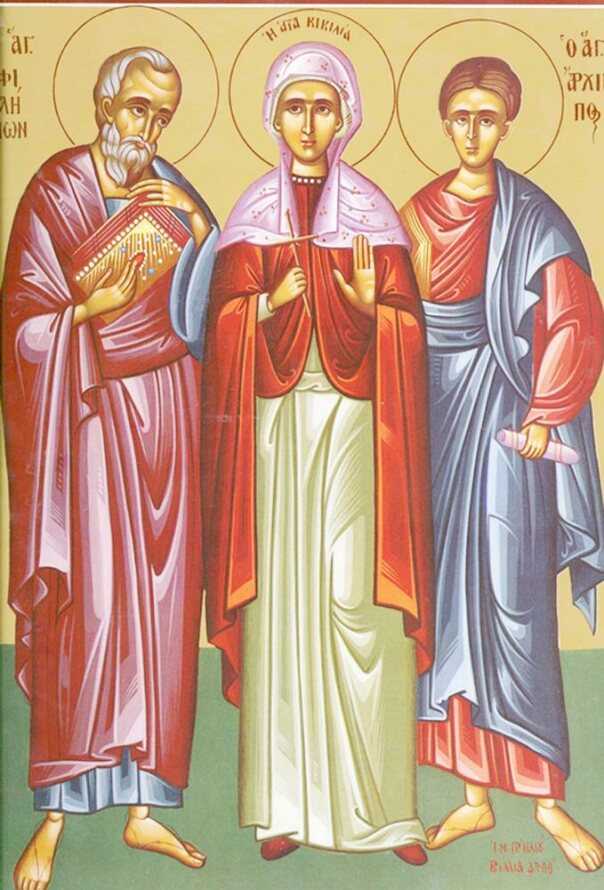
Apostles Archippus, Philemon and Apphia
Saints Archippus, Philemon and Apphia, Apostles of the Seventy were students and companions of the holy Apostle Paul. In the Epistle to Philemon, the Apostle Paul names Saint Archippus as his companion, and mentions him again in the Epistle to the Colossians (Col. 4:17).
Saint Archippus was bishop of the city of Colossae in Phrygia. Saint Philemon was an eminent citizen of this city, and the Christians gathered in his home to celebrate church services.
He was also made a bishop by Saint Paul and he went about the cities of Phrygia, preaching the Gospel. Later on, he became archpastor of the city of Gaza.
Saint Apphia, his wife, took the sick and vagrants into her home, zealously attending to them. She was her husband’s co-worker in proclaiming the Word of God.
During the persecution against Christians under the emperor Nero (54-68), the holy Apostles Archippus and Philemon and Apphia were brought to trial by the ruler Artocles for confessing faith in Christ.
Saint Archippus was brutally slashed with knives. After torture, they buried Saints Philemon and Apphia up to the waist in the ground, and stoned them until they died.
Saint Archippus is also commemorated on November 22.
Troparion — Tone 3
With your whole heart you followed the way of holiness / and became a companion of the Apostles, O Archippus. / By your word you preached the Faith, / and by your life you uprooted evil. / Having proved steadfast in contest you were granted the crown of righteousness.
Saint Philothei of Athens
Saint Philothei was born in Athens in 1522 to the noble Venizelos family, following many prayers to the Mother of God. She was baptised as Revoula and married at a very young age, against her will.
She endured much suffering at the hands of her husband, a violent man, who died after only three years of marriage. She then continued her life in purity, devoted to vigil, prayer, and fasting. Some years later, Saint Andrew the First-Called appeared to her in a dream and instructed her to build a monastery in his name.
Using the inheritance she had received, she founded the monastery and was the first to receive monastic tonsure there, taking the name Philothei. Alongside the monastery, she also established charitable facilities to benefit others, including a hospital, a shelter, and a school.
At that time, Greece was under Ottoman rule. Saint Philothei used her wealth to ransom as many enslaved people as possible, especially women, from their masters.
On one occasion, four women sought refuge in her monastery. They were discovered, and the saint was arrested. She was ready to receive martyrdom, since she refused to renounce Christ, but she was rescued through the intervention of friends from noble families.
Her apostolic zeal only increased. She later founded another convent in Patissia, a suburb of Athens, and continued her missionary and philanthropic work. She organised one of the earliest forms of education for girls in Athens, continued to rescue young women from Ottoman harems, and offered shelter to the poor, the elderly, and orphans. She was also widely known for her generosity and, even during her lifetime, was granted the gift of working miracles.
In 1588, she was captured by the Turks and brutally tortured. The nuns took her and brought her to Kalogreza—a place whose very name recalls her presence there (from the Greek kalogeros, meaning “monk”). They cared for her until 19 February 1589, when she fell asleep in the Lord.
Her holy relics are kept in the Metropolitan Cathedral of Athens, and she is one of the city’s patron saints, along with Saint Dionysius the Areopagite and Saint Hierotheos. She is also regarded as a special protector of victims of human trafficking.