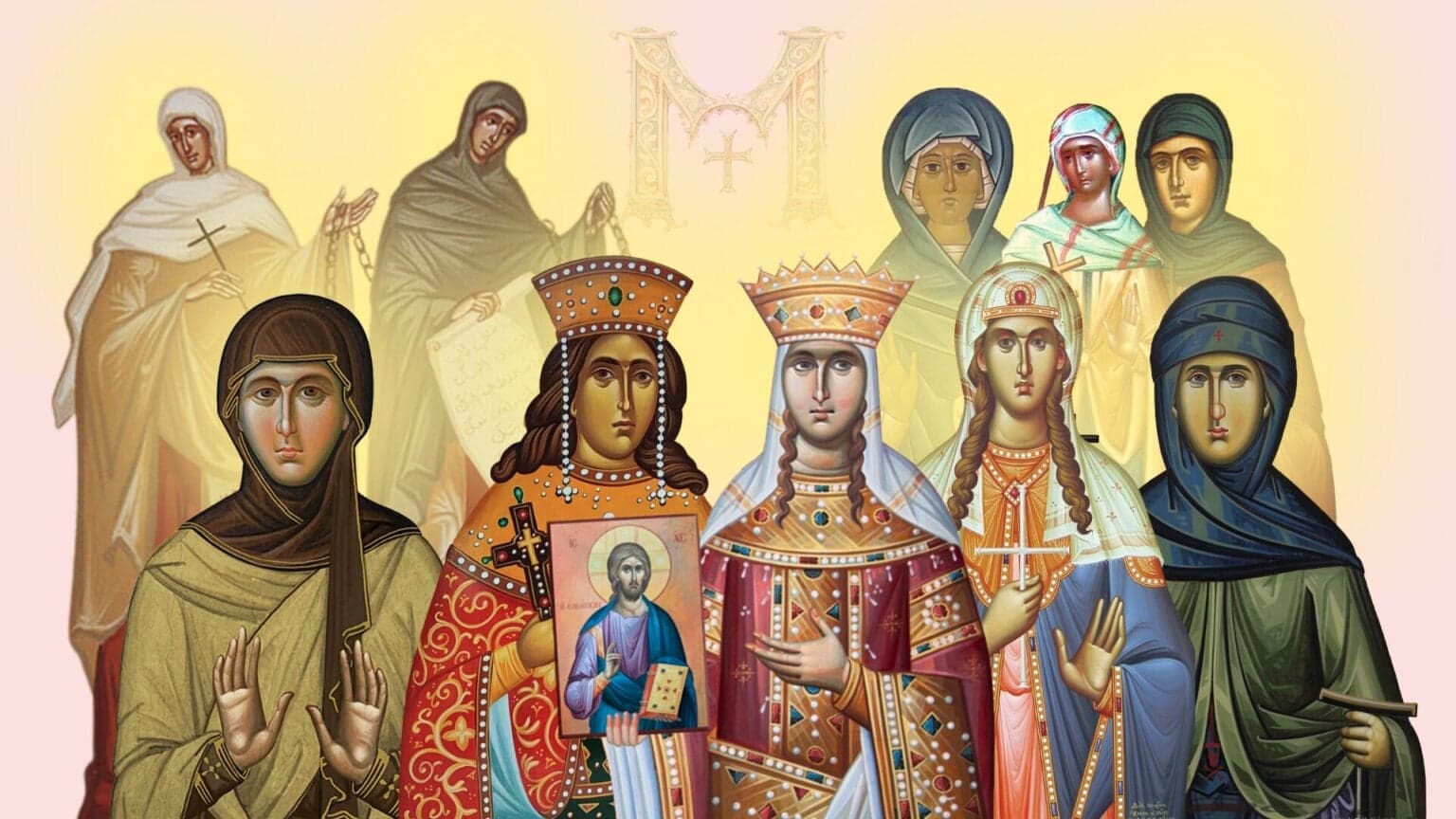
Digital Matericon: Women Saints of February (II) continues our monthly series dedicated to the lives of women saints commemorated throughout the Church year, highlighting a remarkable group of holy women remembered in the second half of February.
This instalment presents the spiritual portraits of Saint Scholastica, Saint Theodora the Empress, Saint Priscilla, Saint Mariamne, Saint Pulcheria the Empress, Saint Philothei of Athens, Saint Gorgonia, Saint Photini the Samaritan Woman, and the holy sisters Cyra and Marana.
Across very different historical, cultural, and social contexts—from the apostolic age and the Byzantine imperial court to monastic cells, missionary journeys, and martyrdom under persecution—these women reveal a shared witness of faith shaped by prayer, courage, humility, discernment, and sacrificial love.
Some sanctified family life and motherhood, others embraced consecrated virginity or radical asceticism; some served Christ through governance and public responsibility, while others bore silent testimony through suffering and seclusion. Together, they form a living icon of the many paths by which holiness manifests in the life of the Church.
This series is developed within the framework of the Commemorative Year 2026 of Holy Women in the Church Calendar, proclaimed by the Romanian Patriarchate. Inspired by this commemorative and pastoral initiative, Digital Matericon seeks to recover, present and interpret the spiritual legacy of women saints as enduring models for contemporary Christian life, offering readers a monthly encounter with the richness, diversity and depth of female sanctity in the Orthodox tradition.
Saint Scholastica – 10 February

The information about the life of Saint Scholastica has been transmitted by Saint Gregory the Dialogist (the Great). She was born in Italy and was the twin sister of Saint Benedict of Nursia. From an early age, she dedicated her life to God and entered a women’s monastery near the monastery her brother founded for monks.
The two siblings, together with the monks and nuns of their respective communities, used to meet in a house between the two monasteries to hold spiritual conversations. One year, Saint Scholastica insisted that they remain together throughout the night, keeping vigil and speaking about God. Saint Benedict, however, did not wish to break the rule that forbade him from spending the night outside the walls of the monastery.
Yet, through the prayers of his sister, a powerful storm arose and prevented the monks from leaving. In this way, they continued their conversation about the “joys of heaven” until dawn, as related by Saint Gregory the Dialogist.
Three days after this event, Saint Benedict saw the soul of his sister ascending to heaven in the form of a dove and understood the insistence of his sister, who had known that this would be their last meeting on earth.
Saint Benedict buried Saint Scholastica’s body in the tomb he had prepared for himself, leaving as his final wish that he too should be laid to rest in the same place after his death.
Saint Benedict departed to the Lord in the same year, 543, only forty days after his sister.
Saint Theodora the Empress – 11 February

Saint Theodora was from a Christian family in Paphlagonia, Asia Minor. She married the Byzantine Emperor Theophilos. After arriving at the imperial court in Constantinople, she was forced to conceal her personal devotion to the holy icons because of her husband’s opposition, as he forbade their veneration.
In 842, after the death of Theophilos—the last of the iconoclast emperors—Saint Theodora restored the veneration of icons. She ruled the empire for fourteen years, since her son was still a minor.
She entrusted the leadership of the Patriarchate of Constantinople to the iconophile hierarch Methodios, who had previously been persecuted by Emperor Theophilos. On 11 March 843, on the eve of the first Sunday of Great Lent, Saint Theodora supported the convocation of a council which confirmed the validity of all the decisions of the Seven Ecumenical Councils and formally restored the veneration of holy icons.
The following day, Sunday, a triumphant procession took place through the streets of Constantinople, led by the holy empress. The procession was followed by the Divine Liturgy at the Cathedral of Hagia Sophia and the public reading of the synodal decree by Patriarch Methodios.
This event is commemorated to this day through the annual Sunday of Orthodoxy celebrations, the first Sunday of Great Lent.
Saint Theodora’s work also had a missionary dimension, as she supported initiatives to proclaim the Gospel among Turkic and Slavic peoples. At the same time, she wisely managed the empire’s material resources and expanded them.
When her son reached the age to assume imperial authority, Saint Theodora withdrew to a monastery, where she reposed in the Lord in 867.
Her body was found to be incorrupt, and for six centuries her relics remained in Constantinople. Three years after the fall of the empire, in 1456, her holy relics were transferred to the Greek island of Corfu, where they were placed alongside those of Saint Spyridon. Today, they are preserved in the Cathedral of Panagia Spiliotissa on the island, along with the relics of Saint Spyridon, the island’s patron saint.
Saint Priscilla – 13 February

The name of Saint Priscilla is mentioned in the New Testament six times: three times in the Acts of the Apostles and three times in the Epistles of Saint Paul, always together with the name of her husband, Saint Aquila, one of the Seventy Apostles.
Saint Luke the Evangelist reports in the Acts of the Apostles that Saint Paul arrived in Corinth from Athens, where he met Saints Aquila and Priscilla and stayed with them, as they shared the same occupation: “tentmakers” (Acts 18:2).
Emperor Claudius expelled the Jews from Rome; thus, Saint Aquila, a Jew from Pontus, came to Corinth with his wife, Saint Priscilla (Acts 18:1).
The Book of Acts also records that the two spouses explained “the way of God more accurately” to a man named Apollos.
Saint Aquila and Saint Priscilla later travelled with Saint Paul to Ephesus, where the Apostle wrote his First Epistle to the Church in Corinth, mentioning them with these words:
“Aquila and Priscilla greet you warmly in the Lord, together with the church in their house” (1 Corinthians 16:19).
Saint Priscilla is commemorated together with her husband on 13 February, while Saint Aquila is also commemorated separately on 14 July.
Saint Mariamne – 17 February

Saint Mariamne was the sister of Saint Philip, one of the Twelve Apostles of the Saviour. After the Ascension of the Lord into heaven, she accompanied her brother, together with Saint Bartholomew the Apostle, to Hierapolis, in Phrygia, in what is today south-western Turkey.
In that region, many pagans worshipped vipers and snakes as idols. Through their preaching, the three saints converted some to Christianity and healed the sick. Among those healed was a blind man, who later received them into his house.
Their missionary activity stirred the anger of the local authorities, and the three were arrested and condemned on charges of sorcery. Saint Mariamne was stripped of her clothing, but a divine flame surrounded her and protected her from the people’s gaze.
Saints Philip and Bartholomew were then crucified. At that moment, a powerful earthquake struck the city, and the governor and several pagans were swallowed up by the earth. The people cried out to the saints, and the earthquake ceased.
The Christians managed to save Saint Bartholomew, but for Saint Philip it was already too late: he had given up his soul to the Lord. Saint Mariamne buried him in Hierapolis. Saint Bartholomew then baptised the inhabitants and departed for India and Armenia, where he would later suffer martyrdom.
Saint Mariamne went on to Lycaonia, where she continued her missionary work, and there she fell asleep in the Lord in peace.
Saint Pulcheria, Byzantine Empress – 17 February

Saint Pulcheria was a virgin empress who distinguished herself by her steadfast defence of the Orthodox faith at the Ecumenical Councils of Ephesus (431) and Chalcedon (451).
She was born in 399 and was the elder sister of Emperor Theodosius II. The two siblings became heirs to the imperial throne following their father’s death, Emperor Arcadius.
At only fifteen years of age, Saint Pulcheria was proclaimed Augusta and, in practice, guided the affairs of the empire for forty years. Through her support and influence, two major heresies were confronted and condemned: Nestorianism at the Council of Ephesus and Monophysitism at the Council of Chalcedon. After the success of both councils, her role was openly acknowledged by the people, who acclaimed her with the words: “Many years to the pious and Christ-loving empress! Many years to the champion of the true faith!”
In the year 450, her brother died unexpectedly. Saint Pulcheria then chose to marry the Roman senator Marcian, who was well known for his support of the Orthodox faith. The marriage was formal because her husband respected the vow of virginity the empress had made.
They lived lives of purity, marked by fasting and prayer, and worked together for the good of the empire and its people. Their wealth was used to build churches and monasteries, hospitals, and homes for the poor.
She founded the Church of the Mother of God at Blachernae and encouraged the spread of the veneration of the Forty Martyrs of Sebaste. According to some sources, she discovered their holy relics herself.
Saint Pulcheria fell asleep in the Lord at the age of forty-four, on 10 September 453, leaving her entire fortune to the poor. Marcian continued to reign alone for a further four years, until his own repose.
In the Orthodox calendar, Saint Pulcheria is commemorated on 17 February together with her husband, Saint Marcian the Emperor, and also on 10 September.
Saint Philothei of Athens – 19 February

Saint Philothei was born in Athens in 1522 to the noble Venizelos family, following many prayers to the Mother of God. She was baptised as Revoula and married at a very young age, against her will.
She endured much suffering at the hands of her husband, a violent man, who died after only three years of marriage. She then continued her life in purity, devoted to vigil, prayer, and fasting. Some years later, Saint Andrew the First-Called appeared to her in a dream and instructed her to build a monastery in his name.
Using the inheritance she had received, she founded the monastery and was the first to receive monastic tonsure there, taking the name Philothei. Alongside the monastery, she also established charitable facilities to benefit others, including a hospital, a shelter, and a school.
At that time, Greece was under Ottoman rule. Saint Philothei used her wealth to ransom as many enslaved people as possible, especially women, from their masters.
On one occasion, four women sought refuge in her monastery. They were discovered, and the saint was arrested. She was ready to receive martyrdom, since she refused to renounce Christ, but she was rescued through the intervention of friends from noble families.
Her apostolic zeal only increased. She later founded another convent in Patissia, a suburb of Athens, and continued her missionary and philanthropic work. She organised one of the earliest forms of education for girls in Athens, continued to rescue young women from Ottoman harems, and offered shelter to the poor, the elderly, and orphans. She was also widely known for her generosity and, even during her lifetime, was granted the gift of working miracles.
In 1588, she was captured by the Turks and brutally tortured. The nuns took her and brought her to Kalogreza—a place whose very name recalls her presence there (from the Greek kalogeros, meaning “monk”). They cared for her until 19 February 1589, when she fell asleep in the Lord.
Her holy relics are kept in the Metropolitan Cathedral of Athens, and she is one of the city’s patron saints, along with Saint Dionysius the Areopagite and Saint Hierotheos. She is also regarded as a special protector of victims of human trafficking.
Saint Gorgonia – 23 February

Saint Gorgonia was the daughter of Saint Gregory of Nazianzus and Saint Nonna, and the sister of Saint Gregory the Theologian. Her brother left us most of the information about her life, especially regarding the virtues she cultivated.
She was married and had five children, two of whom later became bishops. Although she lived a full family life, she never abandoned her spiritual pursuits, such as prayer, fasting, and keeping vigil. Her home was always open to strangers and to those in need, and she showed particular care for widows.
Saint Gregory the Theologian emphasises that his sister served God by uniting the life of a married woman with that of a nun, so that her way of life would not have been essentially different, whichever path she might have chosen. As he himself explains, Saint Gorgonia taught him that neither marriage nor monastic life binds us to God or separates us from Him and from the world; rather, they are simply different ways of acquiring virtue.
On one occasion, the cart in which the saint was travelling overturned, and the animals dragged her along the ground, causing her severe injuries. According to some sources, she refused medical treatment so as not to expose her body to a stranger. She entrusted herself entirely to God and was healed in a miraculous way.
Another trial came in the form of a serious illness that caused her great suffering. This time, during the night, she crawled to the holy altar on her own and, after praying to God there, was restored to health.
She continued her life of service for a time and then received foreknowledge of her approaching death. She was only thirty-nine years old, and her parents were still alive. Lying on her deathbed, she whispered her final words to her father:
“In peace I will both lie down and sleep” (Psalm 4:8).
Saint Photini the Samaritan Woman – 26 February

Saint Photini is the Samaritan woman who spoke with Christ at Jacob’s well, as recorded in the Gospel of John (John 4:7–29). Before this encounter, she had lived a life devoted to worldly pleasures, but after her conversation with Christ, a higher spiritual awareness was born in her soul, and she left behind her former way of life.
She was baptised together with her two sons and her five sisters, and all of them became proclaimers of the faith in Christ. At that time, the persecution of Christians under Emperor Nero had begun. One of her sons converted a Roman commander to Christianity, an event that greatly angered the emperor.
Saint Photini and her family went willingly to Rome in order to bear witness to Christ before Emperor Nero. He remained unmoved and ordered that all eight of them be beaten with iron hammers until their bones were crushed. Yet they remained unharmed.
The emperor then changed his approach and attempted to entice them with wealth, but the saints remained steadfast in their faith and even converted the emperor’s own daughter.
As a result, they were again subjected to severe torture for three years, according to some sources. They were thrown into a furnace, forced to drink poison, and blinded, yet each time they emerged miraculously unharmed.
Ultimately, all of them received the crown of martyrdom, Saint Photini being the last to suffer. According to some accounts, she ended her life by being thrown into a well, while other synaxaria relate that Christ healed her wounds and that she then reposed in peace after several days.
Saint Photini is also commemorated on the Fifth Sunday after Pascha, known as the Sunday of the Samaritan Woman.
Her Greek name, Photini (“the luminous one” or “the enlightened one”), has semantic equivalents in several languages: in Slavonic, Svetlana; in Italian, Lucia; in French, Claire; in Spanish, Clara; and in Romanian, Luminița.
Saints Cyra and Marana – 28 February

Saints Cyra and Marana were two sisters who lived in the fourth century in the city of Veria (Beroea) in Syria. Although they came from a wealthy family, seeing the disbelief of some close to them, they decided to withdraw from the world to live a life of constant ascetic struggle.
Their life was recorded by Blessed Theodoret of Cyrrhus, who also knew them personally. He was the only man whom they allowed to visit them and the only one permitted to speak with them.
The two holy women built a small stone enclosure with only a narrow opening through which they received their food. The structure provided no protection from cold, heat, or rain, and the sisters wore loose, long garments. They also wore iron chains around their necks, waists, and wrists, so that Saint Cyra, who was physically weaker, could scarcely remain standing.
The only occasions on which they left their place of ascetic seclusion were pilgrimages to Jerusalem and to the tomb of Saint Thecla in Isauria. Blessed Theodoret records that during their journeys, the two saints observed a strict fast, eating nothing except during their time in Jerusalem.
The two holy sisters reposed in the Lord in the year 450.
Read also the lives of Women Saints of the first half of February.