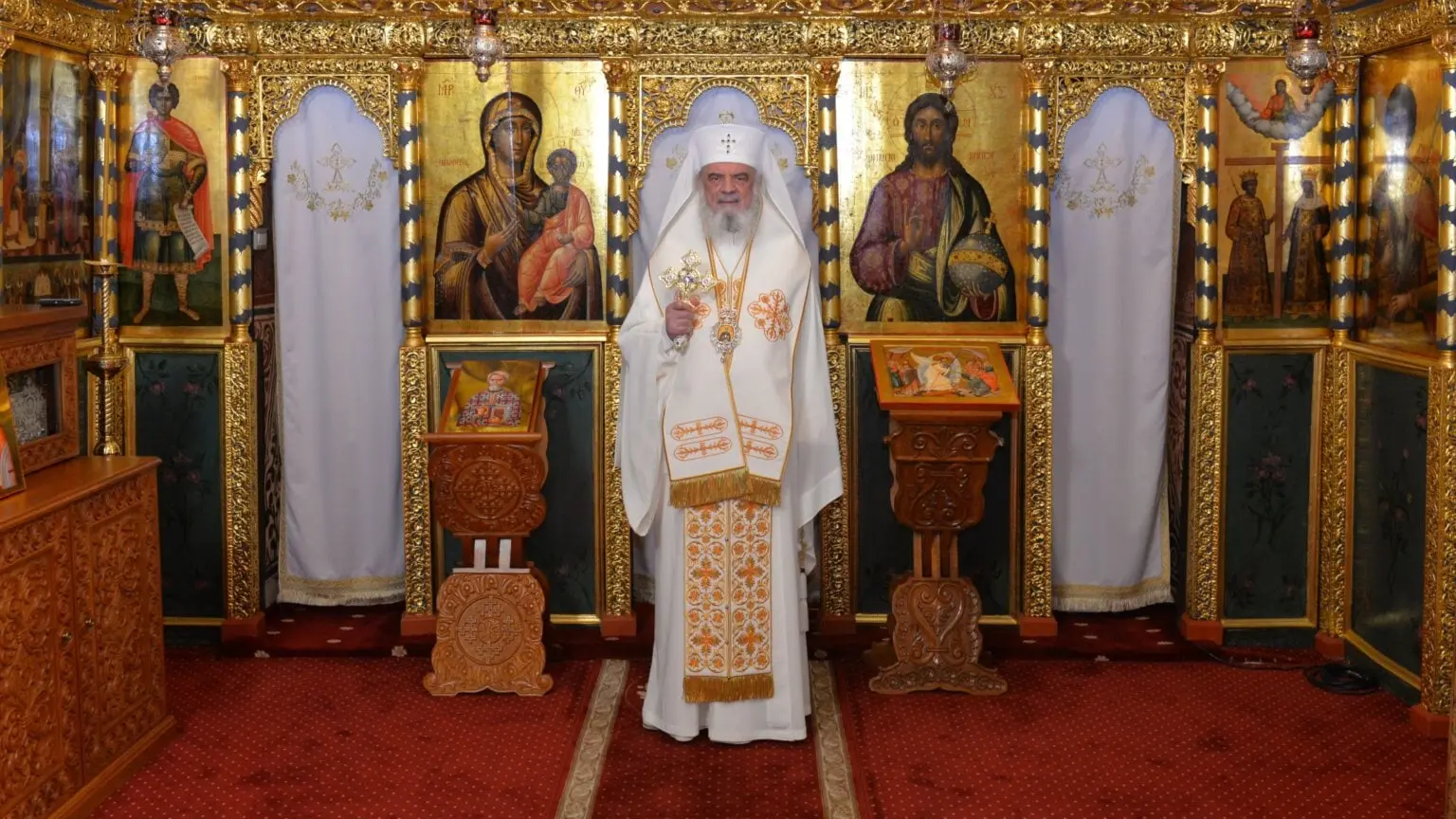
In just eleven days, you will be able to witness the Great Consecration of the National Cathedral. Ecumenical Patriarch Bartholomew and Patriarch Daniel will celebrate the service. Beginning on Sunday, 26 October 2025, the faithful will have the opportunity to enter the Cathedral and venerate even in the Holy Altar until the end of the month.
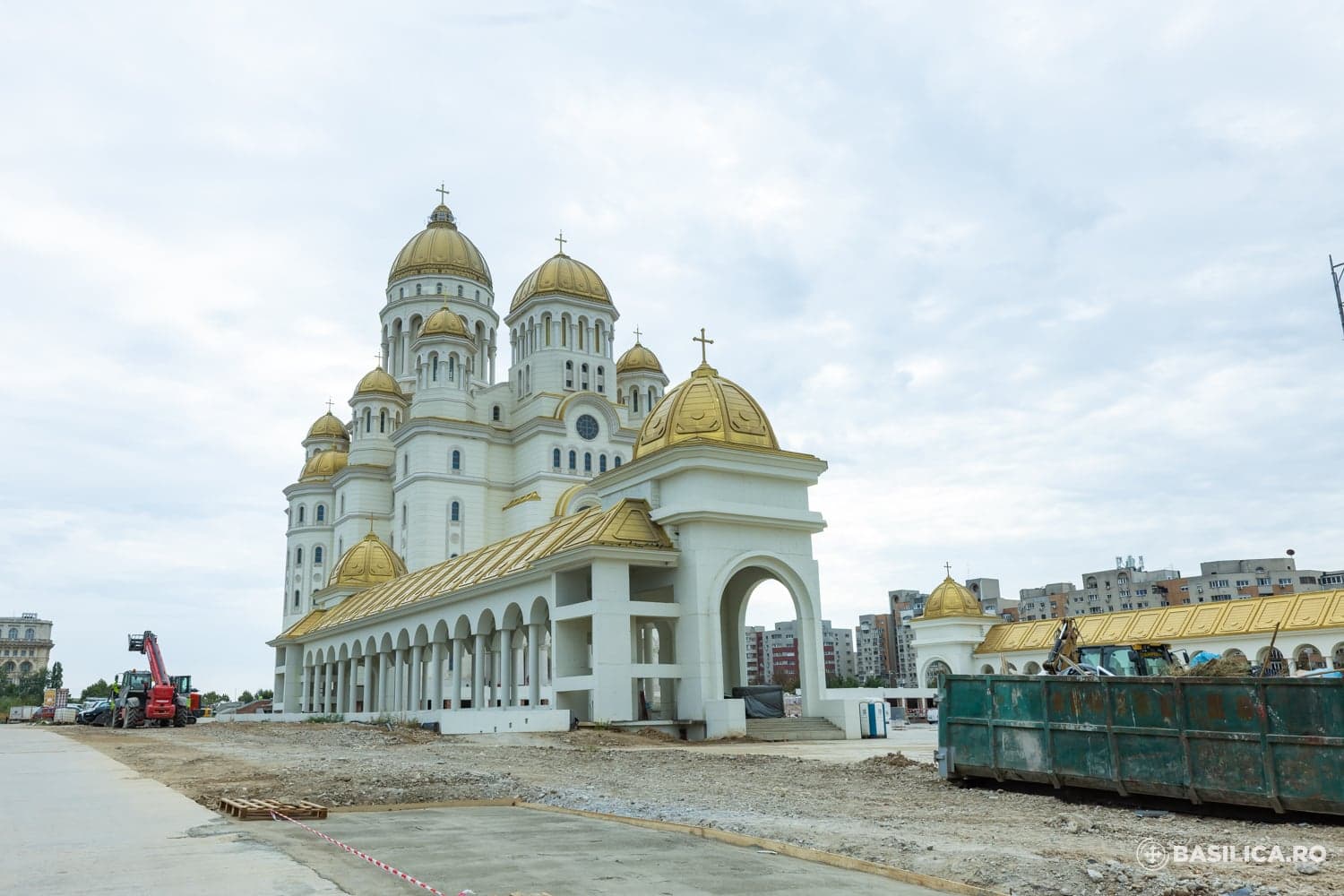
Before stepping inside the Cathedral, you may wish to take some time to admire the exterior elements of the architectural ensemble of the National Cathedral of the Salvation of the Nation — the porticoes, the square, and the towers. All these components contribute to defining this sacred space within the urban landscape of Bucharest, standing as a testimony to Romanian history and spirituality.
One detail that can only be seen from an aerial view is that the entire ground on which the National Cathedral stands has been shaped in the form of a chalice — a reference to the Holy Eucharist, the central Mystery of the Church and the one that will be most frequently celebrated in this Cathedral.
Please find the French, Italian and Greek translations below.
The Porticoes, Esplanade, and Towers of the National Cathedral
The exterior elements of the architectural ensemble of the National Cathedral – the porticoes, the esplanade, and the towers – contribute to defining this sacred space within the urban landscape of Bucharest, as a testimony to Romanian history and spirituality, a synthesis of tradition and modernity.
Porticoes
Inspired by the Brâncovenesque porches, the porticoes of the National Cathedral fulfil both an aesthetic and a practical role, defining the space of the esplanade. The main access is from the two porticoes (north-western and south-western), leading into a porch with arches which marks the entrance to the Cathedral. On the northern and southern sides of the esplanade, the porticoes delimit the area of the Outdoor Altar, creating an appropriate framework for services celebrated in the open air.
Esplanade
In front of the Cathedral extends a broad esplanade (square), designed to facilitate participation in the divine services. This open space, with an area of 11,600 sqm, not only highlights the monumentality of the church but can also accommodate 23,200 persons during outdoor liturgical events.
Beneath the esplanade lies a vast underground space, larger than the footprint of the Cathedral itself, symbolically named the “Urban Cave of Saint Andrew the Apostle”, with a total volume of 87,505.67 cbm and a capacity of 6,900 persons. It is intended for cultural, catechetical, and social activities, as well as for setting up a museum.
The 8 Towers
The Cathedral’s silhouette is defined by its eight towers, which combine architectural elements from different regions of Romania – such as the slender Transylvanian towers – with the monumentality characteristic of Western cathedrals. The central ensemble consists of one principal tower and four secondary towers, and to the West, three more large towers.
The main Pantocrator Tower reaches a height of 120 metres to the base of the cross. Inside, the dome of this tower houses a monumental mosaic icon of Christ Pantocrator (the Almighty), with a diameter of 12 metres and a surface of over 150 sqm. The cross atop the principal tower measures 7 metres in height and weighs 7 tonnes.
The bell tower, located on the western side above the exonarthex, houses the six bells of the Cathedral, cast in Innsbruck by the renowned Grassmayr foundry. With a combined weight of 33 tonnes, they are set at a height of 60 metres, and the principal bell, with free swing, weighs 25 tons. The bell tower is flanked by two large towers.
Everything in the Cathedral has significance
“The exterior and interior artistry are two components of particular importance in establishing a climate of spiritual communication. Tradition will not be abandoned, but interpreted as a state of continual deepening. The artistic expression must convey the canonical Orthodox message, so that nothing in the construction or in the interior decoration should be arbitrary or without spiritual meaning.
The volume of the Cathedral is to represent the place housing the Mystery of the Holy Eucharist, the Church itself, with the ground plan in the form of a chalice. The whole construction rises heavenwards through eight golden towers. The largest one, the Pantocrator, represents Jesus Christ, the Head of the Church, accompanied by four smaller towers symbolising the Four Evangelists: Matthew, Mark, Luke, and John. To the west, the bell tower represents the Mother of God, while the adjacent towers represent Saints Andrew and Philip the Apostles, who began the Christianisation of the Romanian (Geto-Dacian) people. The length of the Cathedral (120 m) is equal to the height of the Pantocrator Tower, for Christ Who was crucified and buried is the same Christ Who is risen and ascended into heaven.
This meaning of the architectural composition may be considered a call to spiritual elevation: that through Jesus Christ we may become partakers of the eternal life and joy of the Most Holy Trinity.”
† DANIEL
Patriarch of the Romanian Orthodox Church
Presentation leaflet in English about the exterior of Romania’s National Cathedral: free download.
Please see all leaflets in 4 languages here.
Les portiques, l’esplanade et les tours de la Cathédrale Nationale
Les éléments extérieurs de l’ensemble architectural de la Cathédrale Nationale – les portiques, l’esplanade et les tours – contribuent à l’inscription de ce lieu sacré dans le paysage urbain de Bucarest. Ils en font un témoignage de l’histoire et de la spiritualité roumaines, véritable synthèse entre tradition et modernité.
Inspirés des porches d’entrée de style brancovénien, les portiques de la Cathédrale Nationale remplissent une double fonction, esthétique et pratique, en structurant l’espace de l’esplanade. L’accès principal s’effectue par les deux portiques (au nord-ouest et au sud-ouest), qui mènent à un narthex à arcades marquant l’entrée de la cathédrale. Sur les côtés nord et sud de l’esplanade, les portiques encadrent l’Autel d’été (Altarul de vară) et offrent un espace liturgique à la célébration des offices en plein air.
Devant la Cathédrale s’étend une esplanade (parvis) conçue pour faciliter la participation des fidèles aux offices. Cet espace ouvert, couvrant 11 600 m², met non seulement en valeur la monumentalité de l’édifice sacré, mais possède également la capacité d’accueillir 23 200 fidèles lors des célébrations liturgiques en plein air.
Sous l’esplanade se développe un vaste espace souterrain, dont l’emprise dépasse le périmètre au sol de la cathédrale. Symboliquement dénommé « la Grotte urbaine Saint-André l’Apôtre », cet espace souterrain présente un volume total de 87 505,67 m³ avec une capacité d’accueil de 6 900 personnes. Il est destiné à des activités culturelles, catéchétiques et sociales, ainsi qu’à l’aménagement des expositions muséales temporaires.
La silhouette de la Cathédrale est définie par ses tours qui intègrent de manière synthétique des éléments architecturaux issus de diverses régions de la Roumanie. On y distingue notamment l’influence des tours élancés de Transylvanie, harmonieusement associés à la monumentalité typique des cathédrales occidentales. L’ensemble se compose de huit tours : une tour centrale flanquée de quatre tours secondaires à l’est et trois grandes tours à l’ouest.
La tour principale (Pantocrator) atteint une hauteur de 120 mètres jusqu’à la base de la croix. À l’intérieur, sa coupole abrite une icône du Christ Pantocrator (Tout-Puissant/Atotțiitorul), réalisée en mosaïque. Cette œuvre iconographique monumentale mesure 12 mètres de diamètre et couvre une superficie de plus de 150 m². La croix qui surmonte la tour principale atteint 7 mètres de hauteur et pèse 7 tonnes.
La tour-clocher, située sur le côté ouest, au-dessus de l’exonarthex, abrite les six cloches de la cathédrale, fondues à Innsbruck (Autriche) par la célèbre entreprise Grassmayr. Elles pèsent au total 33 tonnes et sont installées à 60 mètres de hauteur. La cloche principale, avec ses plus de 25 tonnes, est la plus grande cloche à battant libre d’Europe.
« La plasticité extérieure et intérieure constitue deux éléments de première importance pour établir un climat d’intercommunication. La tradition ne sera pas abandonnée, mais interprétée comme un état de perpétuel approfondissement. La plasticité doit porter le message canonique orthodoxe, de sorte que rien dans la construction ou la décoration intérieure ne soit laissé au hasard, dépourvu de sens spirituel.
Le volume de la cathédrale doit représenter le lieu qui abrite le Mystère de la Sainte Eucharistie, l’Église, le terrain entier ayant la configuration d’un calice. L’ensemble de l’édifice s’élève vers le ciel grâce à huit tours dorées. La toure la plus haute, nommée Pantocrator, symbolise Jésus-Christ, Chef/Tête de l’Église, et est entourée de quatre petites tours représentant les quatre Évangélistes : Matthieu, Marc, Luc et Jean. Vers l’ouest, la tour-clocher représente la Vierge Marie, tandis que les tours adjacentes symbolisent les Saints Apôtres André et Philippe, qui ont initié la christianisation du peuple roumain (gèto-daco-romain). La longueur de la cathédrale (120 mètres) est égale à la hauteur de la tour Pantocrator, puisque le Christ crucifié et enseveli est le même que le Christ ressuscité et élevé au ciel.
Ce symbolisme de la composition architecturale peut être considéré comme un appel à l’élévation spirituelle, afin que, par Jésus-Christ, nous communions à la vie et à la joie éternelles de la Très Sainte Trinité » (Patriarche Daniel).
I Portici, la Piazza e le Guglie della Cattedrale Nazionale
Gli elementi esterni del complesso architettonico della Cattedrale Nazionale – i portici, la piazza e le guglie – contribuiscono a definire questo spazio sacro nel paesaggio urbano di Bucarest, come testimonianza della storia e della spiritualità romena, sintesi tra tradizione e modernità.
Ispirati ai portici in stile Brâncoveanu, i portici della Cattedrale Nazionale svolgono un ruolo estetico e allo stesso tempo pratico, definendo lo spazio della spianata. L’accesso principale è rappresentato dai due portici (nord-ovest e sud-ovest) attraverso un portico ad arcate, che costituisce l’ingresso alla cattedrale. Sui lati nord e sud della piazza, i portici delimitano l’area dell’altare estivo, creando un ambiente appropriato per lo svolgimento delle funzioni religiose all’aperto.
Di fronte alla cattedrale si trova una spianata progettata per facilitare la partecipazione alle funzioni religiose. Questo spazio aperto, con una superficie di 11.600 m², non solo esalta la monumentalità della chiesa, ma ha anche la capacità di ospitare 23.200 persone durante gli eventi liturgici all’aperto.
Sotto la spianata si trova un ampio spazio sotterraneo, più grande della pianta della cattedrale, simbolicamente chiamato “La Grotta Cittadina di Sant’Andrea Apostolo“, con un volume totale di 87.505,67 m³ e una capacità di 6.900 persone, destinato ad attività culturali, catechetiche, sociali e all’organizzazione di un museo.
La silhouette della cattedrale è definita dalle sue otto guglie, che combinano elementi architettonici di diverse regioni della Romania, come le snelle torri della Transilvania, con la monumentalità tipica di alcune cattedrali occidentali. L’insieme centrale è formato da una guglia principale e quattro guglie secondarie, mentre a ovest si innalzano altre tre grandi cupole.
La guglia principale (il Pantocratore) raggiunge un’altezza di 120 metri alla base della croce. All’interno, la cupola di questa guglia ospita un’icona del Cristo Pantocratore (l’Onnipotente), realizzata in mosaico. Questa monumentale rappresentazione iconografica ha un diametro di 12 metri e una superficie di oltre 150 metri quadrati. La croce sulla guglia principale è alta 7 metri e pesa 7 tonnellate.
La torre campanile, situata sul lato occidentale, sopra l’esonartece, ospita le sei campane della cattedrale, fuse a Innsbruck dalla rinomata azienda Grassmayr. Hanno un peso totale di 33 tonnellate e si trovano a un’altezza di 60 metri, e la campana principale, a oscillazione libera, pesa 25 tonnellate. La torre-campanile è affiancata da due grandi cupole.
“L’arte plastica esterna e quella interna sono due componenti di particolare importanza per stabilire un clima di intercomunicazione. La tradizione non sarà abbandonata, ma sarà interpretata come uno stato di approfondimento permanente. L’arte plastica dovrà essere portatrice del messaggio ortodosso canonico, affinché nulla di ciò che la costruzione o la decorazione interna rappresentano sia accidentale, privo di significato spirituale.
Il volume della costruzione della cattedrale deve rappresentare il luogo che custodisce il Mistero della Santa Eucaristia, la Chiesa, la terra che ha la configurazione di un calice. L’intera costruzione è rivolta verso il cielo attraverso otto guglie dorate. La guglia più grande, il Pantocratore, rappresenta Gesù Cristo, il Capo della Chiesa, con quattro guglie più piccole accanto, che simboleggiano i quattro Evangelisti: Matteo, Marco, Luca e Giovanni. A ovest, il campanile rappresenta la Madre di Dio, e le guglie adiacenti rappresentano i Santi Apostoli Andrea e Filippo, che iniziarono la cristianizzazione del popolo romeno (Geto-Daco-Romano). La lunghezza della cattedrale (120 m) è pari all’altezza della guglia del Pantocratore, perché Cristo il Crocifisso e Sepolto è lo stesso che è risorto e asceso al cielo.
Questo significato della composizione architettonica può essere considerato come una chiamata all’elevazione spirituale, affinché attraverso Gesù Cristo possiamo diventare partecipi della vita eterna e della gioia della Santissima Trinità”.
† DANIEL
Patriarca della Chiesa Ortodossa Romena
H ΠΛΑΤΕIΑ ΚΑI ΟI ΤΡΟYΛΛΟΙ
Τὰ ἐξωτερικὰ στοιχεῖα τοῦ ἀρχιτεκτονικοῦ συνόλου τοῦ Ἱεροῦ Ἐθνικοῦ Καθεδρικοῦ Ναοῦ – οἱ στοές, ἡ πλατεῖα καὶ οἱ τροῦλλοι – συμβάλλουν στὸν καθορισμὸ τοῦ ἱεροῦ τούτου χώρου μέσα στὸ ἀστικὸ τοπίο τοῦ Βουκουρεστίου, ὡς μαρτυρία τῆς ρουμανικῆς ἱστορίας καὶ πνευματικότητας, σύνθεση μεταξὺ παραδόσεως καὶ συγχρονικότητας.
Ἐμπνευσμένες ἀπὸ τὰ μπρανκοβενικὰ προπύλαια, οἱ στοὲς τοῦ Ἱεροῦ Ἐθνικοῦ Καθεδρικοῦ Ναοῦ ἔχουν ἀισθητικὸ καί, παράλληλα, πρακτικὸ ρόλο, καθορίζοντας τὸν χῶρο τῆς ἐσπλανάδας. Ἡ κύρια πρόσβαση πραγματοποιεῖται ἀπὸ τὶς δύο στοές (τὴ βορειοδυτικὴ καὶ τὴ νοτιοδυτική), διαμέσου ἑνὸς ἀψιδωτοῦ προπυλαίου, ποὺ σηματοδοτεῖ τὴν εἴσοδο στὸν Ἱερὸ Καθεδρικὸ Ναό. Στὶς βόρειες καὶ νότιες πλευρὲς τῆς πλατείας, οἱ στοὲς ὁριοθετοῦν τὴν περιοχή τοῦ Ἱεροῦ Θερινοῦ Βήματος, δημιουργώντας ἕνα κατάλληλο πλαίσιο γιὰ τὴν τέλεση ὑπαίθριων ἱερῶν ἀκολουθιῶν.
Ἔμπροσθεν τοῦ Ἱεροῦ Καθεδρικοῦ Ναοῦ ἐκτείνεται μιὰ ἐσπλανάδα (πλατεῖα), σχεδιασμένη γιὰ νὰ διευκολύνει τὴ συμμετοχὴ τῶν πιστῶν στὶς ἱερὲς ἀκολουθίες. Ὁ ἀνοικτὸς αὐτὸς χῶρος, ἐμβαδοῦ 11.600 τετραγωνικῶν μέτρων, ὄχι μόνον ἀναδεικνύει τὴ μνημειακότητα τοῦ ναοῦ, ἀλλὰ ἔχει καὶ τὴ δυνατότητα νὰ φιλοξενεῖ 23.200 προσώπα, κατὰ τὴν τέλεση ἐξωτερικῶν λειτουργικῶν ἐκδηλώσεων.
Κάτω ἀπὸ τὴν ἐσπλανάδα ἐκτείνεται ἕνας ὑπόγειος χῶρος εὐρύχωρος, μὲ διαστάσεις μεγαλυτέρες ἀπὸ τὸ ἀποτύπωμα τοῦ ναοῦ ἐπὶ τοῦ ἐδάφους, ὁ ὁποῖος ὀνομάζεται συμβολικὰ «Τὸ Ἀστικὸ Σπήλαιο τοῦ Ἁγίου Ἀποστόλου Ἀνδρέου» καὶ ἔχει συνολικὸ ὄγκο 87.505,67 κυβικῶν μέτρων καὶ χωρητικότητα 6.900 προσώπων· προορίζεται δὲ γιὰ πολιτιστικὲς, κατηχητικὲς καὶ κοινωνικὲς δραστηριότητες, ὡς καὶ γιὰ τὴν ὀργάνωση μουσεῖου.
Ἡ σιλουέτα τοῦ Ἱεροῦ Καθεδρικοῦ Ναοῦ ὁρίζεται ἀπὸ τοὺς ὀκτὼ τρούλλους του, ποὺ συνδυάζουν ἀρχιτεκτονικὰ στοιχεῖα ἀπὸ διάφορες περιοχὲς τῆς Ρουμανίας, ὅπως τοὺς κομψοὺς πύργους τῆς Τρανσυλβανίας, μὲ τὴ μνημειακότητα ποὺ χαρακτηρίζει μερικοὺς δυτικοὺς καθεδρικοὺς ναούς. Τὸ κεντρικὸ σύνολο ἀποτελεῖται ἀπὸ ἕναν κύριο τροῦλλο καὶ τέσσερις δευτερεύοντες τρούλλους, ἐνῶ, στὰ δυτικά, ὑψοῦνται ἄλλοι τρεῖς μεγάλοι τροῦλλοι.
Ὁ κεντρικὸς τροῦλλος (τοῦ Παντοκράτορος) ἐκτείνεται σὲ ὕψος 120 μέτρων, ἕως τὴ βάση τοῦ σταυροῦ. Στὸ ἐσωτερικό του, ὁ θόλος τοῦ τρούλλου φιλοξενεῖ ἑνὸς μεγάλου μεγέθους εἰκόνα τοῦ Χριστοῦ Παντοκράτορος, ἐκτελεσμένη ἐν ψηφιδωτῷ. Ἡ μνημειώδης αὐτὴ εἰκονογραφικὴ παράσταση ἔχει διάμετρο 12 μέτρων καὶ ἐπιφάνεια ποὺ ὑπερβαίνει τὰ 150 τετραγωνικὰ μέτρα. Ὁ σταυρὸς ἐπάνω στὸν κεντρικὸ τροῦλλο ἔχει ὕψος 7 μέτρων καὶ βάρος 7 τόνων.
Ὁ καμπαναριὸς τροῦλλος, ὁ ὁποῖος βρίσκεται στὴ δυτικὴ πλευρά, ἐπάνω ἀπὸ τὸν ἐξωνάρθηκα, στεγάζει τὶς ἕξι καμπάνες τοῦ Ἱεροῦ Καθεδρικοῦ Ναοῦ, χυτευμένες στὸ Ἴνσμπρουκ ἀπὸ τὴν περίφημη ἐταιρεία Grassmayr.
Αὐτὲς ἔχουν συνολικὸ βάρος 33 τόνων καὶ εἶναι τοποθετημένες σὲ ὕψος 60 μέτρων, ἐνῶ ἡ κύρια καμπάνα, μὲ ἐλεύθερη ταλάντευση, ζυγίζει 25 τόνους. Ὁ καμπαναριὸς τροῦλλος πλαισιώνεται ἀπὸ δύο μεγάλους τρούλλους.
«Ἡ ἐξωτερικὴ καὶ ἡ ἐσωτερικὴ πλαστικὴ ἀποτελοῦν δύο συνιστῶσες ὑψίστης σημασίας γιὰ τὴ διαμόρφωση κλίματος ἀμοιβαίας ἐπικοινωνίας. Ἡ παράδοση δὲν θὰ ἀπορριφθεῖ, ἀλλὰ θὰ ἐρμηνευθεῖ ὡς κατάσταση διαρκούς ἐμβαθύνσεως.
Ἡ πλαστικὴ ὀφείλει νὰ εἶναι φορέας τοῦ ὀρθοδόξου κανονικοῦ μηνύματος, οὕτως ὥστε τίποτε ἀπ’ ὅσα ἀποτελοῦν τὴν κατασκευὴ ἢ τὴν ἐσωτερικὴ διακόσμηση νὰ μὴν εἶναι τυχαῖο, οὔτε ἄνευ πνευματικοῦ νοήματος.
Ὁ ὄγκος τῆς οἰκοδομῆς τοῦ Ἱεροῦ Καθεδρικοῦ Ναοῦ ὀφείλει νὰ ἀπεικονίζει τὸν τόπο ποὺ στεγάζει τὸ Μυστήριο τῆς Θείας Εὐχαριστίας, τὴν Ἐκκλησία, καί, γι’ αὐτὸ τὸν λόγο, ὁ χῶρος ἔχει τὴ μορφὴ ποτηρίου. Ὅλο τὸ οἰκοδόμημα ἀνατείνεται πρὸς τὸν οὐρανὸ διὰ τῶν ὀκτὼ ἐπίχρυσων τρούλλων. Ὁ μέγιστος τροῦλλος, ὁ τοῦ Παντοκράτορος, ἀπεικονίζει τὸν Ἰησοῦ Χριστό,
τὴν Κεφαλὴ τῆς Ἐκκλησίας, καὶ πλαισιώνει ἀπὸ τέσσερις μικροτέρους τρούλλους, οἱ ὁποῖοι συμβολίζουν τοὺς τέσσερις Ἁγίους Εὐαγγελιστές: Ματθαῖο, Μᾶρκο, Λουκᾶ καὶ Ἰωάννη. Πρὸς δυσμάς, ὁ καμπαναριὸς τροῦλλος ἀντιπροσωπεύει τὴν Ὑπεραγία Θεοτόκο, ἐνῶ οἱ παρακείμενοι τροῦλλοι ἀπεικονίζουν τοὺς Ἁγίους Ἀποστόλους Ἀνδρέα καὶ Φίλιππο, οἱ ὁποῖοι ἤρξαντο τῆς ἐκχριστιανίσεως τοῦ ρουμανικοῦ (γετο-δακο-ρωμαϊκοῦ) λαοῦ. Τὸ μῆκος τοῦ Ἱεροῦ Καθεδρικοῦ Ναοῦ (120 μέτρων) εἶναι ἴσον μὲ τὸ ὕψος τοῦ τρούλλου τοῦ Παντοκράτορος, ἐπειδὴ ὁ Χριστὸς ὁ Σταυρωθεὶς καὶ Ταφεὶς εἶναι ὁ Ἴδιος μὲ τὸν Χριστὸ τὸν Ἀναστάντα καὶ Ἀνελθόντα εἰς τοὺς οὐρανούς.
Αὐτὴ ἡ σημασία τῆς ἀρχιτεκτονικῆς συνθέσεως δύναται νὰ θεωρηθεῖ ὡς πρόσκληση πρὸς πνευματικὴ ἀνάταση, ὥστε διὰ τοῦ Ἰησοῦ Χριστοῦ νὰ γίνουμε μέτοχοι τῆς αἰώνιας ζωῆς καὶ χαρᾶς τῆς Παναγίας Τριάδος».
† ΔΑΝΙΗΛ
Πατριάρχης τῆς Ρουμανικῆς Ὀρθοδόξου Ἐκκλησίας
Photo credit: Basilica.ro / Mircea Florescu (archive)