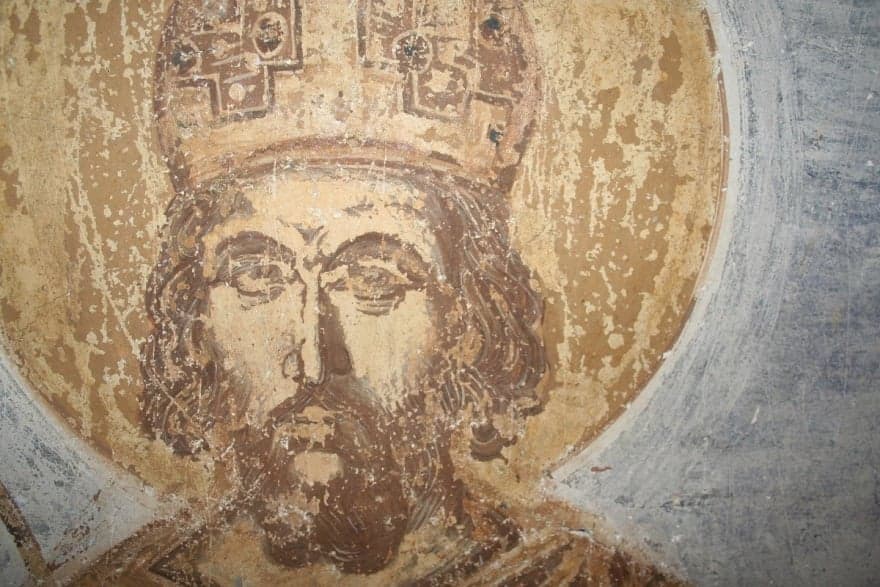
A unique portrait of Constantine XI Paleologos, the last Byzantine emperor, was recently discovered in the Church of the Monastery of the Holy Archangels in the Aegion region of Greece. According to archaeologists, the painting was created during the Byzantine emperor’s lifetime.
The Greek Ministry of Culture announced that archaeologist Anastasia Koumousi uncovered the portrait of the last Byzantine emperor during restoration work on the church’s paintings.
“It is the last chronologically preserved portrait of an emperor in monumental Byzantine painting and the only portrait of Constantine Paleologos from his reign (January 6, 1449 – May 29, 1453),“ the ministry stated.
The fresco depicts a mature man wearing imperial regalia: a purple mantle adorned with crowned double-headed eagles, the emblem of the Paleologos dynasty, a jewel-encrusted crown, and a sceptre with a cross at its top.
The presence of the double-headed eagle on the figure’s robe and the other insignia allowed researchers to identify the man as an emperor unmistakably.
Historians believe the emperor was depicted in the monastery’s church because his brothers significantly renovated the monastic establishment during Constantine Paleologos’s reign over the Byzantine Empire.
Photo: www.culture.gov.gr