Orthodox Calendar, March 8
Holy Priest-Martyr Liviu Galaction of Cluj
Saint Liviu Galaction was born on May 16, 1898, in the village of Cristian, Brașov County. His father, Nicolae Munteanu, was a teacher, and his mother, Maria, was a homemaker. They had six children, of whom Liviu Galaction was the second.
From childhood, he showed great love for God and deep reverence for the Holy Church. He first studied at the Romanian school in Cristian, founded and led by his father. He then attended Andrei Șaguna High School in Brașov and the Theological Institute in Sibiu, graduating in 1920. In 1923, he earned a doctorate in theology from the Faculty of Orthodox Theology in Chernivtsi.
That same year, he married Silvia, and God blessed them with three children. In 1924, after Bishop Nicolae Ivan founded the Theological Academy in Cluj, the young Liviu Galaction was called to serve as a professor at the school that would form future priests and servants of the Holy Altar in the Diocese of Cluj. He received the grace of the priesthood through the laying on of hands by the same bishop on February 17, 1927.
A Theologian and Spiritual Father
Saint Liviu Galaction was the longest-serving professor at the Theological Academy in Cluj and eventually became its rector. His theology was a living confession of faith, not only in its content and manner of teaching but also in the witness of his own life. Those who knew him testified that he was “the perfect professor, who knew how to be both father and brother to his students, a teacher and a companion in both knowledge and ignorance.”
He authored numerous theological and cultural articles, warning against the dangers of godless ideologies that were increasingly present in his time.
A Courageous Shepherd Amid Persecution
After Northern Transylvania fell under Horthy’s regime in 1940, Father Liviu Galaction showed great courage and steadfastness. He refused to abandon Cluj, remaining alongside Bishop Nicolae Colan and other Romanian intellectuals to strengthen the faith and hope of the persecuted Orthodox Romanians of Transylvania.
His loving heart led him to support not only his fellow countrymen but also people of other ethnicities and faiths. It is known, for example, that he saved three Jewish youths from deportation and certain death by helping them cross the border to safety.
After Northern Transylvania was liberated, the hardships did not cease, for the communist atheist regime took power in Romania, promoting class hatred and dialectical materialism—Marxist ideologies that Father Liviu Galaction had opposed in his writings.
The beginning of his persecution and suffering came in 1952 when the Theological Institute in Cluj, which he led, was shut down. He was denied the right to transfer as a professor to another theological institute, and under false accusations, his home was confiscated and nationalized. He was then appointed serving priest at the Church of the Holy Three Hierarchs in Bistrița, where, for six years, he labored with great zeal and dedication, strengthening the faithful in the Orthodox faith. His homilies attracted large gatherings of believers, which drew the disfavor of the Communist Secret Police, who began to monitor him closely.
Martyrdom for Christ
In 1958, Bishop Teofil Herineanu, seeking to revive the spiritual life of the Diocese, recalled Father Liviu Galaction to Cluj as an administrative vicar. That August, during a council of protopriests, he was entrusted with drafting a catechetical program for the instruction of children and adults. Working alongside Father Ioan Bunea of the Theological Seminary, Bishop Teofil approved the plan and sent it to the deaneries. However, before it could be implemented, tragedy struck.
On November 21, 1958, Father Liviu Galaction was arrested, interrogated, and subjected to brutal physical and psychological torture until his trial on May 6, 1959. Throughout his ordeal, he remained steadfast in faith and hope in God, declaring that he was ready to embrace martyrdom for Christ. He was sentenced to 17 years of hard labor, though upon appeal, his sentence was reduced to 8 years.
He was imprisoned first in Gherla and later in Aiud, where he bore witness to the Orthodox faith at the cost of his life. After enduring immense suffering, he surrendered his soul into the hands of the Savior on March 8, 1961. His body was discarded into the common grave of the martyrs at Aiud, where countless other confessors of the faith had also suffered for Christ.
Glorified Among the Saints
For his sacrificial love for Christ, whom he served throughout his life, and for his perfect confession of the ancient Christian faith—sealed with the trial of blood in an era of unbelief and atheism—God has glorified His servant, the Holy Hieromartyr Liviu Galaction, among the choir of the Holy Martyrs.
Troparion, tone 8:
O Confessor of Orthodoxy, guide of youth and praise of teachers, Father Liviu Galaction, you enlightened all with your teachings; O supporter of those in trouble and passion-bearer for the true faith, pray to Christ God to save our souls.

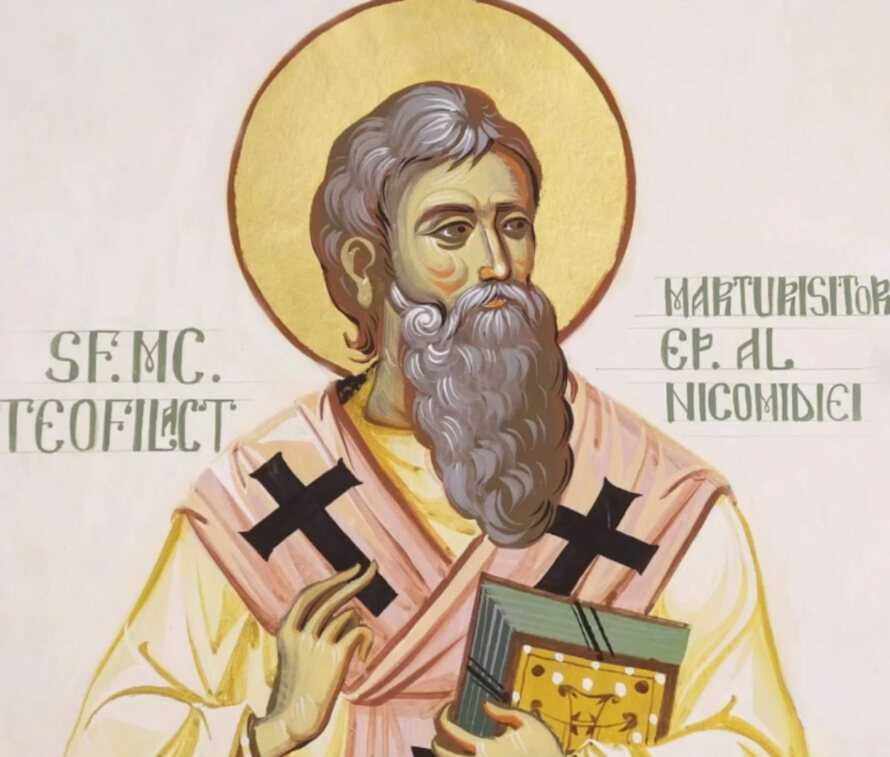
Saint Theophylactus
Saint Theophylactus lived at Constantinople in the eighth century during the time of the Iconoclast heresy. After the death of the iconoclast emperor Leo IV the Khazar (775-780), Emperor Constantine VI (780-797) ascended the throne.
At the same time, the holy Patriarch Paul (August 30), not having the strength to continue guiding the flock in the face of iconoclasm, voluntarily resigned his office (784).
Saint Tarasius (February 25) was chosen in his place. At that time, he was an eminent imperial counselor. Under the supervision of the new Patriarch the Seventh Ecumenical Council (787) was convened to condemn the Iconoclast heresy.
A relatively peaceful time began for the Church, and monasteries again began to fill with monks.
Saint Theophylactus, a gifted disciple of Saint Tarasius, with the blessing of the Patriarch, went to a monastery on the coast of the Black Sea with Saint Michael (May 23).
The zealous ascetics by their God-pleasing labors and intense prayer were granted the gift of wonderworking by God. During a drought, when the workers in the field were weakened by thirst, the saints prayed and an empty vessel became filled with enough water to last the entire day.
After several years in the monastery, they were both consecrated as bishops by Patriarch Tarasius. Saint Michael was made Bishop of Synada, and Saint Theophylactus was made Bishop of Nicomedia.
Heading the Church of Nicomedia, Saint Theophylactus cared for the flock entrusted to him. He built churches, hospices, homes for wanderers, he generously distributed alms, was the guardian of orphans, widows and the sick, and personally attended those afflicted with leprosy, not hesitating to wash their wounds.
When the iconoclast Leo the Armenian (813-820) came to the imperial throne, the terrible heresy burst forth with renewed strength.
But the iconoclast emperor was not able to influence Saint Nicephorus (June 2), the successor of Patriarch Tarasius, who with the other bishops vainly urged Leo not to destroy the peace of the Church.
Saint Theophylactus was present at the negotiations of the emperor with the Patriarch. Denouncing the heretics, Saint Theophylactus predicted a speedy death for Leo the Armenian.
For his bold prophecy the saint was sent into exile to the fortress Strobil (in Asia Minor). He languished for thirty years until his death, which took place around the year 845.
After the restoration of icon-veneration in the year 847 under the empress Saint Theodora (February 11) and her son Michael, the holy relics of Saint Theophylactus were returned to Nicomedia.
Troparion, tone 3:
As an unsleeping guardian of the Church, you were a refuter of godlessness. By defending and honoring the icon of Christ, you were made to endure exile and affliction. Righteous Father Theophylactus, entreat Christ our God to grant us His great mercy.