Orthodox Calendar, June 5
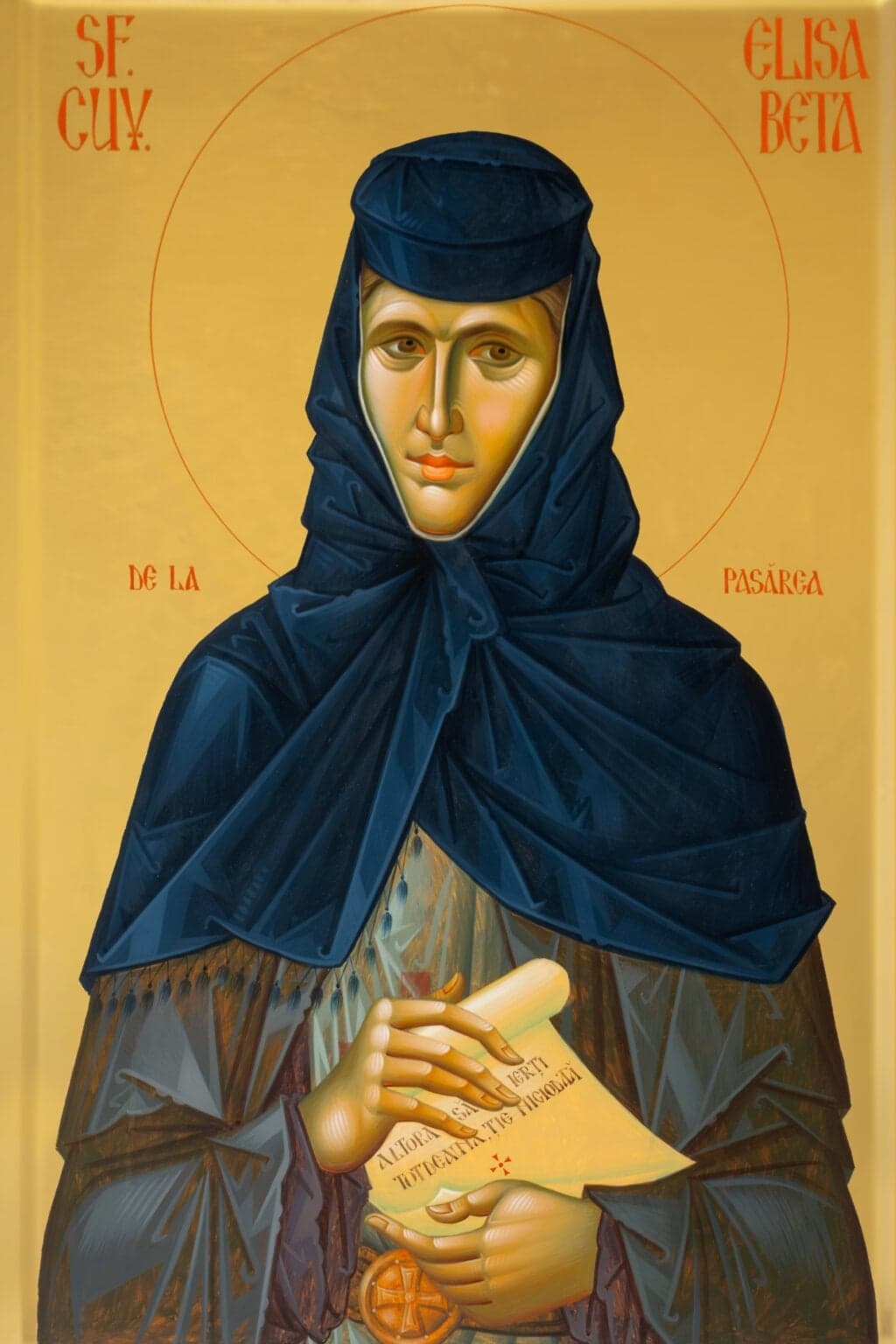
Venerable Elizabeth of Pasărea
Venerable Elizabeth of Pasărea was born on July 16, 1970, in the commune of Moldova-Sulița, Suceava County, and received the name Rodica at Holy Baptism. Her parents, Vasile and Maria Lazăr, had eleven children, two of whom reposed in the Lord at a young age.
While in the seventh grade, Rodica made her first pilgrimage to a monastery, visiting Agapia Monastery. She was so deeply impressed by the nuns there that she resolved to embrace the monastic life. Upon returning home, she devoted herself more intensely to prayer and sought solitude. In 1986, she undertook a pilgrimage to several holy monasteries in order to discern where she should enter monasticism.
She travelled with two cousins who likewise desired the monastic life. They first received the counsel and blessing of Saint Cleopa of Sihăstria, then continued to Cernica Monastery, where they venerated the relics of Saint Hierarch Calinic. There they were advised to visit Pasărea Monastery, of which they had never previously heard. The monastery made such a profound impression on them that the thought of settling there took root in their hearts. They then travelled to Saint Mary Monastery in Techirghiol, where they sought the guidance of Archimandrite Arsenie Papacioc.
After learning of their desire to become nuns, the venerable elder, unaware of their thoughts regarding Pasărea, told them: “You should go to Pasărea Monastery. There is a good spiritual father there, Fr Macarie, a great spiritual pillar of the Bucharest region.” Thus they resolved to join the sisterhood of Pasărea Monastery.
In September 1986, at the age of sixteen, Rodica bade farewell to her family and departed for the monastery together with her two cousins. They first stopped at Sihăstria, where they received the blessing of Saint Cleopa, and then visited Saint Paisie, who told them: “Let your souls so shine before men that they may see your good works and glorify our Father who is in heaven.” Upon arriving at Pasărea Monastery, they were received with joy by the sisterhood.
From the moment she entered the monastery, Sister Rodica became an example of monastic life, adorned with many virtues. She carried out her obediences with great diligence and, whenever she completed her own work, would assist those around her.
Four years later, on December 12, 1990, she was tonsured as a rassophore by Archimandrite Macarie Ioniță, confessor of Pasărea Monastery, receiving the name Elizabeth. She was then entrusted with obedience at the Romanian Patriarchate’s metal-chasing workshop located at Pasărea Monastery.
In 1996, she was transferred to the Romanian Settlement in Jerusalem, where she served as chapel attendant and chanter. While in the Holy Land, she fell gravely ill, and doctors gave her little hope of survival. She began to pray fervently that God would have mercy upon her and grant her healing. A nun advised her also to pray to Saint John Jacob of Neamț, known as a swift helper.
While praying, she experienced a fearful vision. She saw her soul separated from her body, carried away by demons and cast into the torments of hell. There she cried out to the Mother of God and to Saint John Jacob to rescue her.
Then the Mother of God and Saint John appeared and rebuked the demons, saying: “Why have you seized this soul before it has been judged?” They delivered her from that dreadful place of torment. There she saw not only laypeople whom she recognised, but also monks, priests and bishops suffering in hell and weeping bitterly.
Afterwards, Saint John led her to behold the beauty of Paradise. They crossed a marvellous meadow filled with flowers of extraordinary beauty and variety.
Every blade of grass and every flower, when touched, resonated with heavenly sounds and harmonies. As they proceeded, they encountered saints who bowed to them, while Saint John identified them and instructed her to venerate them. They then arrived at a radiant and splendid royal palace.
Upon entering, they saw countless steps whose summit could not be discerned. The angelic powers stood upon the steps, bowing their heads as they passed. Then a voice like thunder was heard from the throne above: “She is not worthy to enter here. Take her back to repent, for she is not yet prepared.”
They bowed and departed from the palace. Saint John told her that God had granted her additional years for repentance, so that she might one day be found worthy to return to that place. He also instructed her to follow the life of stillness in the wilderness, assuring her that he would protect her and would send her his belt. Through this divine revelation, Mother Elizabeth received the calling to dwell in the mountains of Bucovina.
When her soul returned to her body, she rose quickly from her bed and began making prostrations, weeping bitterly over what she had seen and experienced. The nuns who were with her in Jerusalem tried to stop her, reminding her that she was gravely ill. Weeping, she replied that she was no longer ill, for Saint John Jacob had healed her.
After recovering, she returned to Romania and, with the blessing of Saint Cleopa of Sihăstria, Fr Arsenie Papacioc and Bishop Gherasim (Cucoșel), she withdrew to the Giumalău Mountains, where she embraced a life of severe ascetic struggle as a hermit. When forestry operations later began in the area, she was forced to relocate to the Neamț Mountains, to a place known as Coroi’s Ravine, before eventually returning to the Giumalău Mountains.
She endured many temptations from demons but placed her trust in God and His saints. She would later say: “You cannot imagine the hatred demons bear towards mankind or how often they beat and tormented me, yet divine grace saved me, especially since I wear the belt of Saint John Jacob around my waist. The place where I live is wild and terrifying, where no human foot had ever trodden, and I suffered greatly there. I was attacked by bears and wolves, but the good God delivered me. Often the demons gathered to beat me, yet they were burned by the divine grace received through Saint John Jacob and poured out upon the places and objects associated with him. Then they would cry out in fury: ‘We cannot approach this cursed woman, for she is girded with charms.’ Thus they referred to Saint John’s belt, which I received from an elderly nun in Jerusalem, who herself had received it from Fr Ioanichie Pârâială, a disciple of Saint John.”
Throughout her years in the wilderness, Rassophore Elizabeth maintained spiritual ties with her monastery of tonsure. On August 6, 1998, the Feast of the Transfiguration of the Lord, she was tonsured into the Lesser Schema and received the name Theodora. On April 19, 2006, she was tonsured into the Great Schema and received once more the name Elizabeth.
This spiritual mother was distinguished above all by profound humility. She constantly found reasons to reproach herself. She taught that, in a life of stillness, one’s spiritual senses become sharpened, enabling a person to know oneself better, perceive one’s weaknesses and grow in humility.
One night, through the temptation of the evil one, a bookshelf in her hermitage cell collapsed and struck her. Frightened, she immediately began blaming herself, saying that the shelf had fallen because she had not secured it properly.
At that moment she heard a harsh voice saying maliciously: “What would have happened if you had blamed me?” Therefore, Saint Elizabeth taught that whenever trials or difficulties befall us, we should blame neither other people nor the devil, but only ourselves, for in this way the enemy loses his power over us.
In 2014, weakened by cancer, she returned to Pasărea Monastery, where she continued the rule of prayer and ascetic struggle she had cultivated in the wilderness. This great ascetic was also adorned by God with the gift of foresight, leading many people to the knowledge of God. She knew in advance the day of her departure to the Lord and spiritually prepared the nuns close to her for that separation.
At only forty-four years of age, on June 5, 2014, Saint Venerable Elizabeth, her body exhausted by illness and severe ascetic labours yet filled with peace and love, departed to the heavenly dwellings. She was buried in the cemetery of Pasărea Monastery.
During her earthly life and after her repose, Saint Venerable Elizabeth revealed herself to be a great intercessor before God and a wonderworker.
Through her holy prayers, O Lord Jesus Christ our God, have mercy on us and save us. Amen.
Troparion — Tone 1
Following the venerables into the depths of the wilderness, you lived an ascetic life and gained the grace of the Holy Spirit. You awakened souls to repentance, while consoling many people in their suffering. You were shown a guide to monastics, therefore we chant, O Saint Elizabeth: Glory to God who gave you strength! Glory to Him who crowned you! Glory to Him who works healings for all through you!
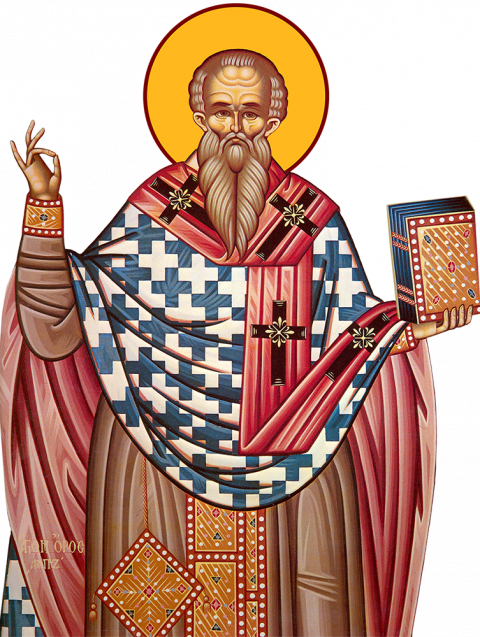
Hieromartyr Dorotheus, Bishop of Tyre
The Hieromartyr Dorotheus was bishop of the Phoenician city of Tyre, during the time of the persecution against Christians under the emperor Diocletian (284-305). Heeding the words of the Gospel (Mt.10:23), the saint withdrew from Tyre and hid from the persecutors.
He returned to Tyre during the reign of Saint Constantine the Great (306-337, May 21), again occupying the bishop’s throne he guided his flock for more than fifty years, and converted many of the pagans to Christianity. When the emperor Julian the Apostate (361-363) began openly to persecute Christians, Saint Dorotheus was already over 100 years old.
He withdrew from Tyre to the Myzean city of Udum (present day Bulgarian Varna). Delegates of the emperor arrested him there for his refusal to offer sacrifice to idols. They began to torture the holy Elder, and under torture he surrendered his soul to the Lord (+ ca. 362) at the age of 107.
Some ascribe to Saint Dorotheus the compilation of a work, “The Synopsis”, a collection of sayings, and including lives of the holy prophets and apostles.
Troparion — Tone 4
O Dorotheus, wise hierarch of Christ, / you received the light of wisdom as a gift from the Father of lights. / You increased the talents given to you / and in your old age contested beyond the bounds of nature. / And now, O Hieromartyr, you even intercede for our souls!