Orthodox Calendar February 24
First and second finding of the Honorable Head of the Holy Glorious Prophet, Forerunner, and Baptist of the Lord, John
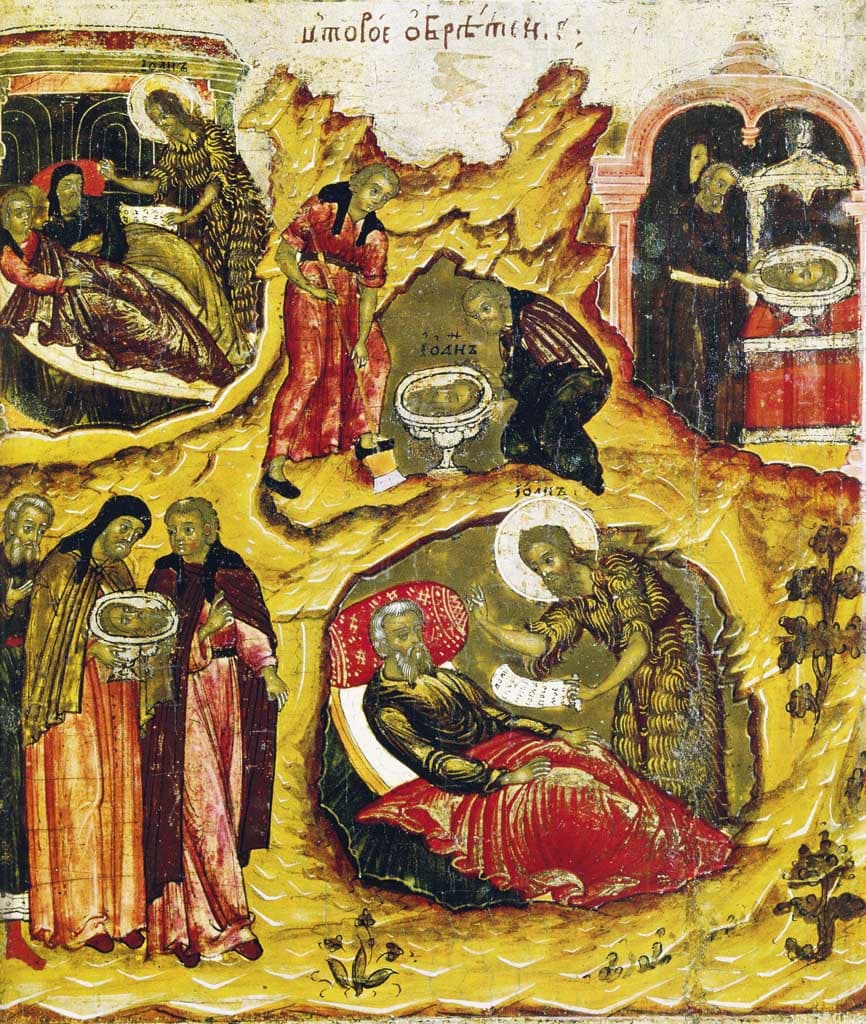
After the Beheading of the Holy Prophet, Forerunner and Baptist John (August 29), his body was buried by disciples in the Samarian city of Sebaste, and his venerable head was hidden by Herodias in an unclean place. Saint Joanna (June 27), the wife of King Herod’s steward Chuza (Luke 8:3), secretly took the holy head and placed it into a vessel and buried it on the Mount of Olives in one of Herod’s properties.
After many years, this property passed into the possession of a government official who became a monk with the name of Innocent. He built a church and a cell there. When they started to dig the foundation, the vessel with the venerable head of John the Baptist was uncovered. Innocent recognised its great holiness from the signs of grace emanating from it. Thus occurred the First Finding of the Head. Innocent preserved it with great piety, but fearful that the holy relic might be abused by unbelievers before his own death he again hid it in that same place, where it was found. Upon his death, the church fell into ruin and was destroyed.
During the days of Saint Constantine the Great (May 21), when Christianity began to flourish, the holy Forerunner appeared twice to two monks journeying to Jerusalem on a pilgrimage to the holy places, and he revealed the location of his venerable head.
The monks uncovered the holy relic and, placing it into a sack of camel-hair, they proceeded homewards. Along the way, they encountered an unnamed potter and gave him the precious burden to carry. Not knowing what he was carrying, the potter continued on his way. But the holy Forerunner appeared to him and ordered him to flee from the careless and lazy monks, with what he held in his hands. The potter concealed himself from the monks and at home he preserved the venerable head with reverence. Before his death, he placed it in a water jug and gave it to his sister.
From that time the venerable head was successively preserved by devout Christians until the priest Eustathius (infected with the Arian heresy) came into possession of it. He beguiled a multitude of the infirm who had been healed by the holy head, ascribing their cures to the fact that it was in the possession of an Arian. When his blasphemy was uncovered, he was compelled to flee. After he buried the holy relic in a cave, near Emesa, the heretic intended to return later and use it for disseminating falsehood.
God, however, did not permit this. Pious monks settled in the cave, and then a monastery arose at this place. In the year 452 Saint John the Baptist appeared to Archimandrite Marcellus of this monastery and indicated where his head was hidden. This became celebrated as the Second Finding. The holy relic was transferred to Emesa, and later to Constantinople.
Saint Petronius of Prodromos Skete on Mount Athos
The Holy Elder Petronius of Prodromos Skete was born on 23 May 1916 in the village of Fărcașa, in the region of Neamț, on the blessed soil of Romania, into a pious peasant family.
At his baptism he received the name Petru. His parents, Ion and St Olimpias Tănase, had eight children—six daughters and two sons—with Elder Petronius being the seventh among the siblings.
From early childhood Saint Petronius developed a zeal for spiritual things, his mother serving as a living example of ascetic struggle and love for God and neighbour. At the age of fourteen, in 1930, feeling a call to the monastic life, he entered as a novice brother at Neamț Monastery, the renowned lavra in which many holy elders had laboured. He spent his first year of obedience at the Vovidenia Skete, then went on to the School of Church Chanters at Neamț Monastery. There Brother Petru met the holy John Jacob the New Chozebite, from whose spiritual presence he benefited greatly.
Between 1935 and 1941 he attended the Monastic Seminary at Cernica Monastery, and from 1941 he continued his studies at the Central Seminary in Bucharest in order to penetrate the mysteries of theological teaching.
On 14 August 1942 Brother Petru was tonsured a monk at Neamț Monastery, the ancient hesychast lavra of Saint Paisius Velichkovsky, receiving the name Petronius.
In September 1942, Elder Petronius went to live in the community of Antim Monastery in Bucharest to pursue his theological studies, and a year later he also enrolled in the Faculty of Mathematics, while at the same time labouring in the Patriarchal Administration in Bucharest.
Saint Petronius was ordained a hierodeacon on 22 September 1942, and from 15 December 1947 he was appointed to serve at the Patriarchal Cathedral in Bucharest.
On 26 December 1947 he received the gift of the priesthood, and at the end of the same Divine Liturgy he was elevated to the rank of protosyncellus.
Between 1946 and 1948, Elder Petronius fulfilled the obedience of secretary to Patriarch Nicodim Munteanu, a fact that reveals the esteem and trust in which Saint Petronius was held by the Patriarch of Romania.
Elder Petronius also took part in the spiritual gatherings of the Burning Bush at Antim Monastery, where he came to know the great ascetic and confessor of Christ, Father John Kulygin, who had learned the prayer of the heart in the Paisian tradition of Optina Monastery.
After the repose of Patriarch Nicodim Munteanu (27 February 1948), Saint Petronius returned to the community of Antim Monastery in Bucharest. In an age hostile to the faith, under the communist regime that incited people to unbelief and hatred of neighbour, Patriarch Justinian courageously established the Higher Monastic Seminary at Neamț Monastery and decided that the best-prepared monks from Antim Monastery should go there to teach—among them Saint Petronius, who thus returned to his monastery of repentance.
On 5 May 1952s Saint Petronius was appointed spiritual father (confessor). Throughout his life he remained deeply shaken by this great authority granted to him: the power to bind and loose the sins of those who confess.
When the communist regime abolished the Seminary at Neamț Monastery, Elder Petronius went to Slatina Monastery in the renowned community led by the holy elder Cleopas of Sihăstria, which was under the protection of Saint Theodore the Studite.
There, Elder Petronius organised the monastic choir and directed the Monastic School. After the arrest of Saint Cleopas and his withdrawal into the wilderness, he was elected abbot by the monastery council and shepherded the community from 1957 to 1959. When the fathers proposed that he become abbot, he begged them with tears not to entrust him with this obedience, considering himself unworthy; yet at their insistence he accepted the responsibility, submitting himself to the will of God.
In May 1959, shortly before the promulgation of Decree 410 which expelled monks from monasteries, Elder Petronius was forced by the authorities to leave Slatina Monastery. He withdrew to Broșteni in the Suceava region, to one of his sisters, and was obliged to work as a forester. Father Petronius’s exile lasted until 1961, when he left his sister’s home and settled at Curtea de Argeș Monastery through the care of Bishop Pavel Șerpe and Patriarch Justinian Marina. Saint Petronius was with great difficulty given the position of watchman and cashier-secretary.
For a long time the Elder was harassed, insulted and mocked by the communist authorities, who refused to grant him permission to reside in the monastery. Only through the personal intervention of the ever-memorable Patriarch Justinian Marina was the matter resolved, though the communist authorities never forgot this defeat and continually sought pretexts to humiliate him.
On 9 May 1963 Patriarch Justinian Marina succeeded in officially enrolling Saint Petronius at Curtea de Argeș Monastery and restored his right to serve at the Holy Altar, a right abusively taken from him by the communists. Seeing this, the authorities turned against the Elder with even greater unjust hatred. In 1965, after many struggles waged by Elder Petronius against the unbelievers, he fell ill with chronic hepatitis.
A few months later Saint Petronius chose to withdraw to Sihăstria Monastery, where they had begun to receive some of the monks who had been driven from their monasteries. In 1975, with great difficulty, Elder Petronius went on pilgrimage to the Holy Land and from there to the Holy Mount Athos. On this occasion he benefited greatly in spirit from meeting the holy Elder Dionysius of Kolitsou and other Romanian and Greek ascetics labouring in those places.
Shortly after returning to Romania, in 1976, Saint Petronius received an obedience from Patriarch Justinian Marina to gather a group of five monks and go to the Holy Mount Athos to offer spiritual help to the community of Prodromos Skete.
Thus, Saint Petronius established the daily celebration of the Divine Liturgy and the seven daily services at the Forerunner’s Skete, while also working on the restoration of the monastic settlement. On 15 October 1984, Elder Petronius was elected abbot by the skete’s community, against his own will. After their insistence, the Saint obeyed the council, thereby demonstrating in time the providential work of God, who revived the spiritual life of Prodromos Skete through this great ascetic.
For twenty-seven years, Father Petronius shepherded the Romanian Skete of the Honourable Forerunner as abbot until the beginning of February 2011, when, at the age of ninety-five and because of health problems, he withdrew from the abbacy.
During his abbacy the skete was reborn: the community grew to more than forty monks, the church and premises were restored, and—most importantly—the order of services and the tradition of the great Athonite ascetics were faithfully preserved and handed on.
Saint Petronius was a beacon of Christ who illumined the wilderness of Vigla on Mount Athos with his ascetic struggles and teachings. The elder ascetic was a very humble, withdrawn monk who preached far more by deed and by the example of his life. He loved the church so deeply that he used to say a Christian, even if ill, should prefer to go to church rather than remain in bed.
Though in the last years of his life he endured severe physical sufferings, Saint Petronius never complained, entrusting himself entirely to the care of God. Until the last day he was able to come to church, the Elder never sat in the choir stalls during the Divine Liturgy. He stood outside the stalls so as not to be overcome by self-love and be forced to sit down. In the refectory, to practise self-control, he never ate everything placed on his plate.
Saint Petronius spent much time in his cell in prayer. He was very silent and ceaselessly recited the Jesus Prayer. Elder Petronius avoided going to other monasteries for feasts or memorials; he preferred to remain in his cell, saying that it both teaches and saves the monk. At the same time he answered every letter addressed to him, offering spiritual counsel to all. Saint Petronius had the gift of not remembering evil and readily forgave everyone who wronged him.
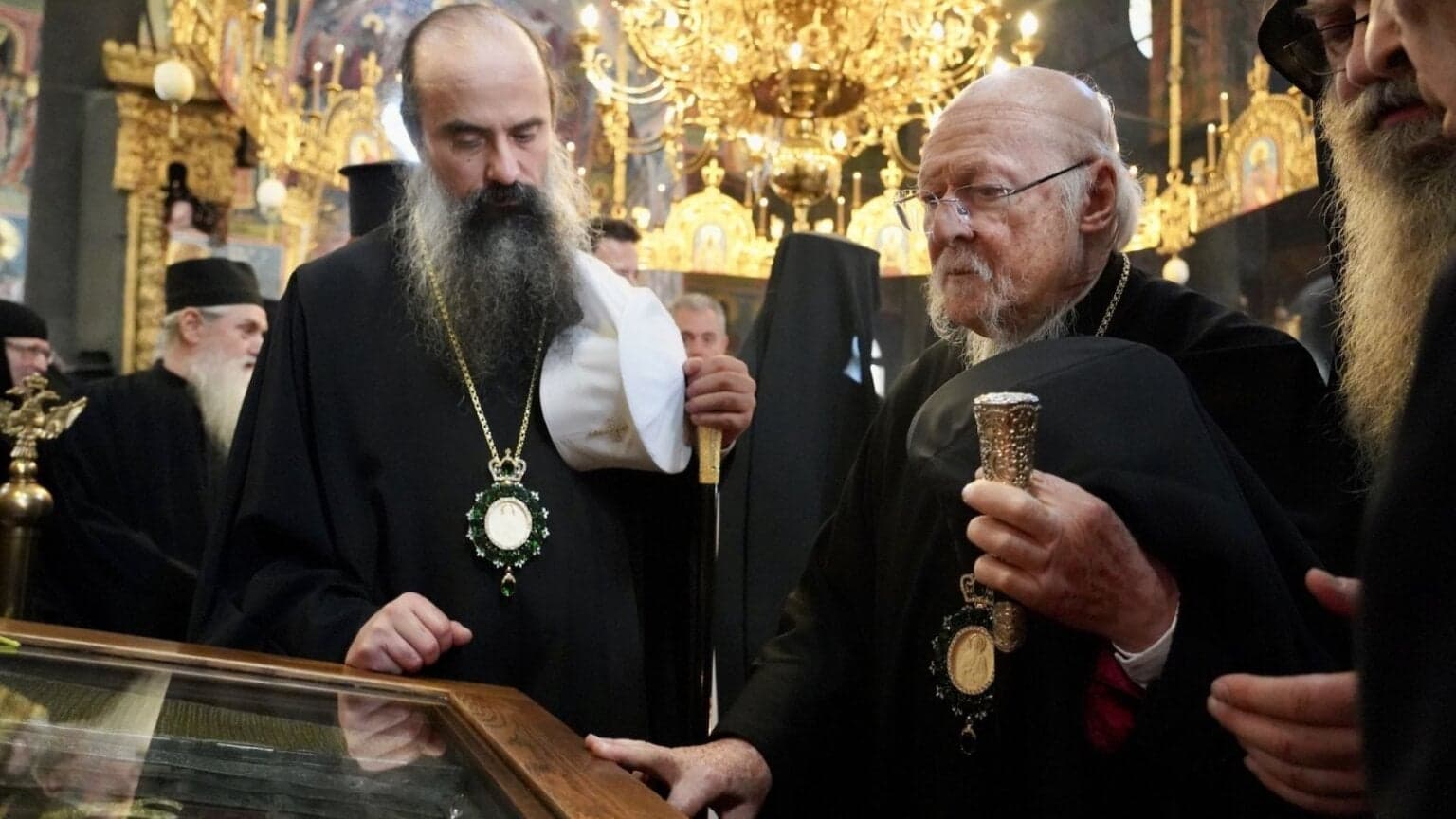
Having pleased God and men through his angelic way of life, he completed this earthly course on 22 February 2011. Shining in virtue, in love and in humility, he became a receptive vessel of divine gifts, of discernment and of foresight, and proved himself a wise guide of souls on the path of salvation. He was canonised by the Ecumenical Patriarchate on 31 August 2025.
Troparion, tone 5:
Let us, all faithful, honour Saint Petronius, the glory and great praise of Athos, Romania’s adornment and a pillar of Prodromos skete, who in our times he shone like a sun through signs and words, perfect in ascetic struggle, he revealed himself as the beauty of the Spirit.