Orthodox Calendar December 1
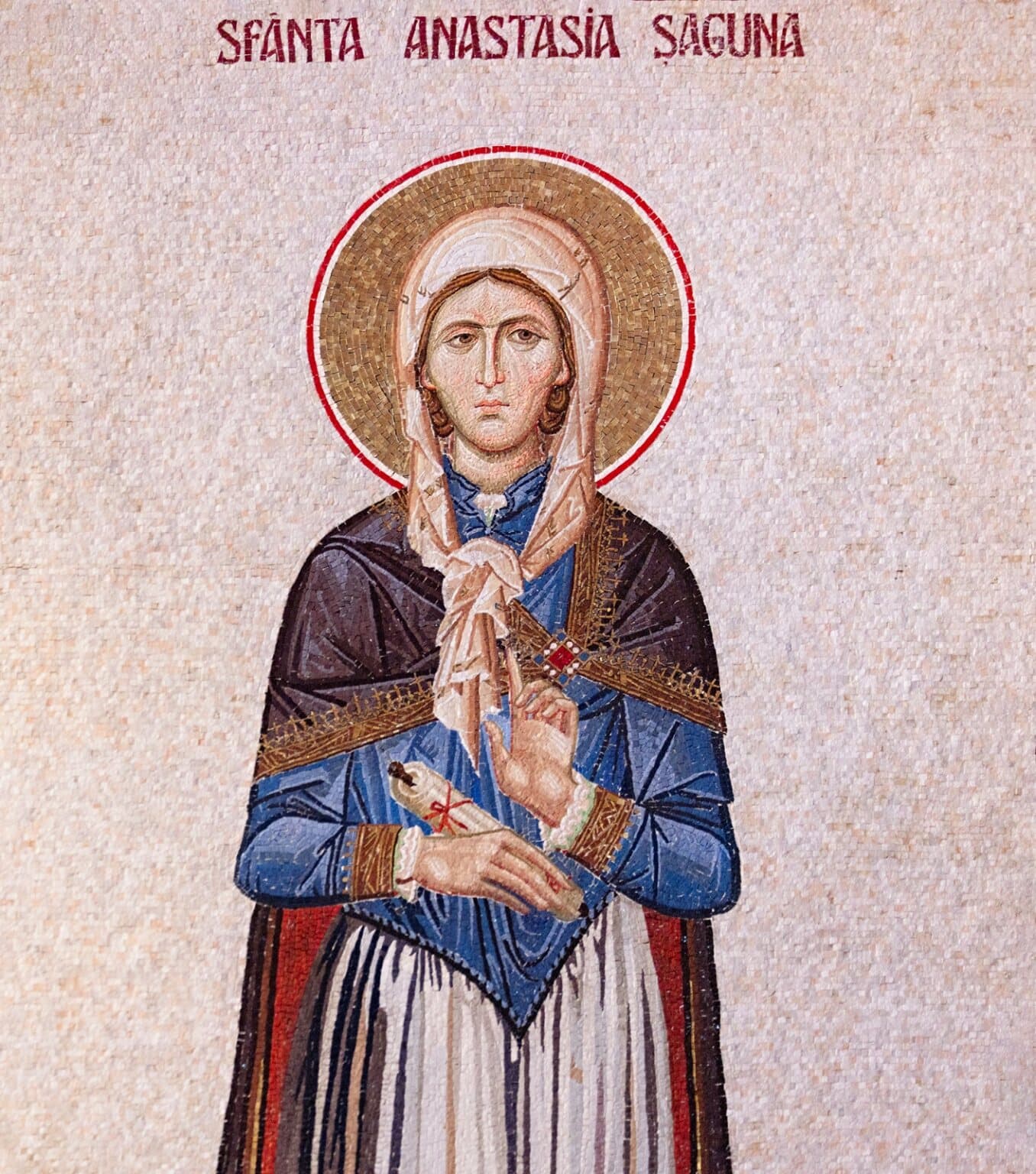
Saint Anastasia, the Mother of Saint Andrew Șaguna, Metropolitan of Transylvania
Blessed Anastasia was born in 1785 to faithful parents, Aromanian merchants from Macedonia who had settled in Miskolc, Hungary. Raised in the fear of God, in honour and in the Orthodox faith, she married Naum, the son of a merchant and a widower. They were blessed with four children: Evreta, Ecaterina, Anastasiu who would become the Metropolitan of Transylvania, and Maria who reposed in childhood. When their father squandered the family’s possessions, lived without order, and even treated Anastasia harshly, she took her children and sought shelter in her parents’ home.
The wise mother kept vigil day and night, labouring in every way to raise her children well. God strengthened her through her good father Mihail, the children’s grandfather, who supported her. Their father, losing courage and hope, sought to escape his troubled state and, for certain material advantages, joined those united with the Pope of Rome, forcing the children to be brought up in that foreign confession. Anastasia firmly resisted both her husband and the foreign authorities. For a time she managed to keep them away, sending her children to the Greek school in Pest. By imperial decree, however, they were later transferred to the Catholic school.
During all this, Anastasia remained steadfast. With great skill and wisdom, through the teachings she gave her sons, she thwarted the schemes of those tireless hunters of souls. At home she instructed her children in the faith of their forefathers, and on Sundays and great feast days she sent young Anastasiu with prosphora to the Orthodox church in Miskolc, a church built through the efforts and sacrifices of his grandparents, Mihail and Evreta.
She even travelled to the Emperor in Vienna to seek the fulfilment of her desire, though without success. For God, in His boundless goodness and wisdom, had arranged matters differently, so that the victory of truth would shine more brightly. Though the children were raised in the Catholic school, when they reached maturity all three expressed their desire to return to the Orthodox Church. Despite many obstacles, their request was granted. The youngest son of the blessed mother, strengthened by her ceaseless prayers, embraced monastic life, taking the name of the First-Called Apostle. God appointed him to accomplish His will for the salvation of the oppressed Orthodox Romanians, for he became the restorer of the Orthodox Metropolis of Transylvania.
Seeing her beloved son devote his entire being and life to the Church of his ancestors, and having succeeded through such hard struggles to deliver him from error, Blessed Anastasia reposed in the Lord in peace on January 17, 1836, at the age of 51. She was buried in Pest, her soul filled with the virtues born of faith.
Through her holy prayers, Lord Jesus Christ our God, have mercy on us and save us. Amen.
Holy Prophet Nahum
His name means “God consoles,” was from the village of Elkosh (Galilee). He lived during the seventh century B.C. The Prophet Naum prophesies the ruin of the Assyrian city of Nineveh because of its iniquity, the destruction of the Israelite kingdom, and the blasphemy of King Sennacherib against God. The Assyrian king Ashurbanipal died in 632 B.C., and over the next two decades, his empire began to crumble. Nineveh fell in 612 B.C.
Nahum differs from most of the prophets in as much as he does not issue any call to repentance, nor does he denounce Israel for infidelity to God.
Details of the prophet’s life are unknown. He died at the age of forty-five, and was buried in his native region. He is the seventh of the Twelve Minor Prophets.
Troparion — Tone 4
We celebrate the memory / of Your prophet Nahum, O Lord; / through him we beseech You: / Save our souls.
The Prophet Nahum and Saint Nahum of Ochrid (December 23) are invoked for people with mental disorders.
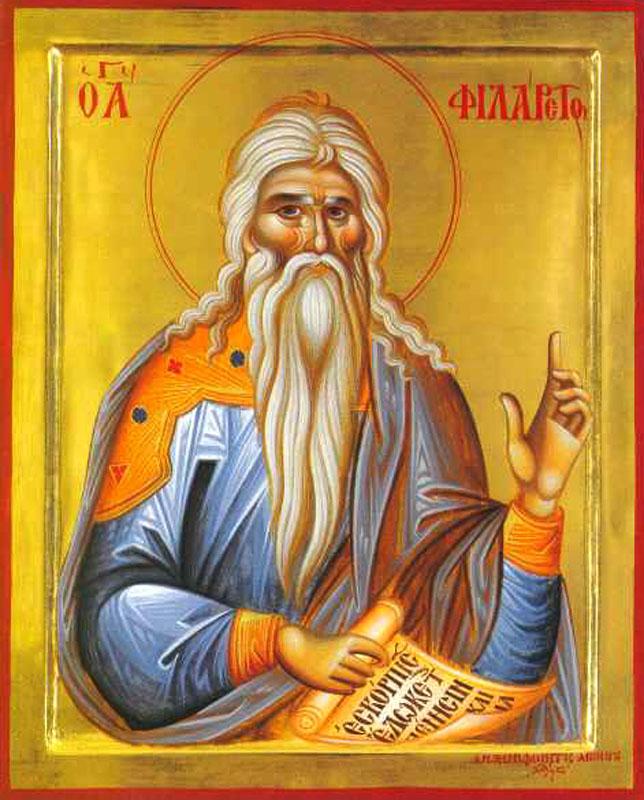
Righteous Philaret the Merciful
He was son of George and Anna, was raised in piety and the fear of God. He lived during the eighth century in the village of Amnia in the Paphlagonian district of Asia Minor. His wife, Theoseba, was from a rich and illustrious family, and they had three children: a son John, and daughters Hypatia and Evanthia.
Philaret was a rich and illustrious dignitary, but he did not hoard his wealth. Knowing that many people suffered from poverty, he remembered the words of the Savior about the dread Last Judgment and about “these least ones” (Mt. 25:40); the Apostle Paul’s reminder that we will take nothing with us from this world (1 Tim 6:7); and the assertion of King David that the righteous would not be forsaken (Ps 36/37:25). Philaret, whose name means “lover of virtue,” was famed for his love for the poor.
One day Ishmaelites [Arabs] attacked Paphlagonia, devastating the land and plundering the estate of Philaret. There remained only two oxen, a donkey, a cow with her calf, some beehives, and the house. But he also shared them with the poor. His wife reproached him for being heartless and unconcerned for his own family.
Mildly, yet firmly he endured the reproaches of his wife and the jeers of his children. “I have hidden away riches and treasure,” he told his family, “so much that it would be enough for you to feed and clothe yourselves, even if you lived a hundred years without working.”
The saint’s gifts always brought good to the recipient. Whoever received anything from him found that the gift would multiply, and that person would become rich. Knowing this, a certain man came to Saint Philaret asking for a calf so that he could start a herd. The cow missed its calf and began to bellow.
Theoseba said to her husband, “You have no pity on us, you merciless man, but don’t you feel sorry for the cow? You have separated her from her calf.” The saint praised his wife, and agreed that it was not right to separate the cow and the calf. Therefore, he called the poor man to whom he had given the calf and told him to take the cow as well.
That year there was a famine, so Saint Philaret took the donkey and went to borrow six bushels of wheat from a friend of his. When he returned home, a poor man asked him for a little wheat, so he told his wife to give the man a bushel. Theoseba said, “First you must give a bushel to each of us in the family, then you can give away the rest as you choose.”
Philaretos then gave the man two bushels of wheat. Theoseba said sarcastically, “Give him half the load so you can share it.” The saint measured out a third bushel and gave it to the man. Then Theoseba said, “Why don’t you give him the bag, too, so he can carry it?” He gave him the bag. The exasperated wife said, “Just to spite me, why not give him all the wheat.” Saint Philaret did so.
Now the man was unable to lift the six bushels of wheat, so Theoseba told her husband to give him the donkey so he could carry the wheat home. Blessing his wife, Philaret gave the donkey to the man, who went home rejoicing. Theoseba and the children wept because they were hungry.
The Lord rewarded Philaret for his generosity: when the last measure of wheat was given away, an old friend sent him forty bushels. Theoseba kept most of the wheat for herself and the children, and the saint gave away his share to the poor and had nothing left. When his wife and children were eating, he would go to them and they gave him some food. Theoseba grumbled saying, “How long are you going to keep that treasure of yours hidden? Take it out so we can buy food with it.”
During this time the Byzantine empress Irene (797-802) was seeking a bride for her son, the future emperor Constantine Porphyrogenitos (780-797). Therefore, emissaries were sent throughout all the Empire to find a suitable girl, and the envoys came to Amneia.
When Philaret and Theoseba learned that these most illustrious guests were to visit their house, Philaret was very happy, but Theoseba was sad, for they did not have enough food. But Philaret told his wife to light the fire and to decorate their home. Their neighbors, knowing that imperial envoys were expected, brought everything required for a rich feast.
The envoys were impressed by the saint’s daughters and granddaughters. Seeing their beauty, their deportment, their clothing, and their admirable qualities, the envoys agreed that Philaret’ granddaughter, Maria was exactly what they were looking for. This Maria exceeded all her rivals in quality and modesty and indeed became Constantine’s wife, and the emperor rewarded Philaret.
Thus fame and riches returned to Philaret. But just as before, this holy lover of the poor generously distributed alms and provided a feast for the poor. He and his family served them at the meal. Everyone was astonished at his humility and said: “This is a man of God, a true disciple of Christ.”
He ordered a servant to take three bags and fill one with gold, one with silver, and one with copper coins. When a beggar approached, Philaret ordered his servant to bring forth one of the bags, whichever God’s providence would ordain. Then he would reach into the bag and give to each person, as much as God willed.
Saint Philaret refused to wear fine clothes, nor would he accept any imperial rank. He said it was enough for him to be called the grandfather of the Empress. The saint reached ninety years of age and knew his end was approaching. He went to the Rodolpheia (“The Judgment”) monastery in Constantinople. He gave some gold to the Abbess and asked her to allow him to be buried there, saying that he would depart this life in ten days.
He returned home and became ill. On the tenth day he summoned his family, he exhorted them to imitate his love for the poor if they desired salvation. Then he fell asleep in the Lord. He died in the year 792 and was buried in the Rodolpheia Judgment monastery in Constantinople.
The appearance of a miracle after his death confirmed the sainthood of Righteous Philaret. As they bore the body of the saint to the cemetery, a certain man, possessed by the devil, followed the funeral procession and tried to overturn the coffin. When they reached the grave, the devil threw the man down on the ground and went out of him. Many other miracles and healings also took place at the grave of the saint.
After the death of the righteous Philaret, his wife Theoseba worked at restoring monasteries and churches devastated during a barbarian invasion.
Troparion — Tone 3
From the wealth of your faith in God, / you distributed your riches to the poor, O Philaret. / Your life was adorned with compassion / and you glorified the Giver of mercy. / Implore him to have compassion and mercy on those who praise you!
Tr by oca.org