Orthodox Calendar, April 9
Great and Holy Thursday
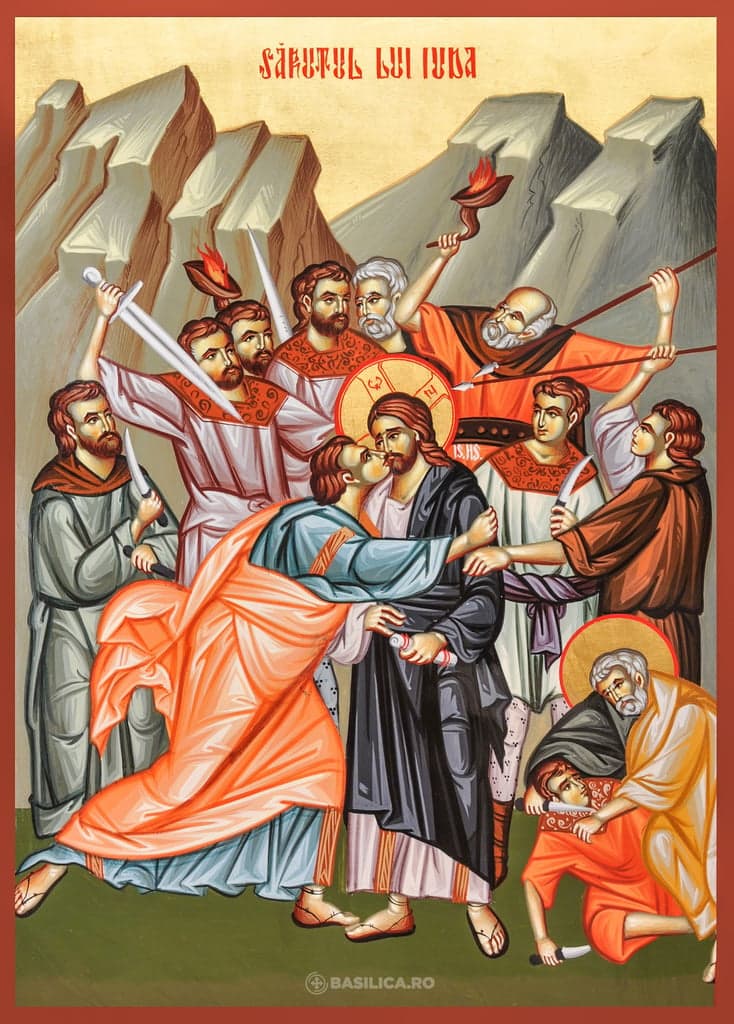
Two events shape the liturgy of Great and Holy Thursday: the Last Supper of Christ with His disciples, and the betrayal of Judas. The meaning of both is in love. The Last Supper is the ultimate revelation of God’s redeeming love for man, of love as the very essence of salvation.
And the betrayal of Judas reveals that sin, death and self-destruction are also due to love, but to deviated and distorted love, love directed at that which does not deserve love. Here is the mystery of this unique day, and its liturgy, where light and darkness, joy and sorrow are so strangely mixed, challenges us with the choice on which depends the eternal destiny of each one of us.
“Now before the feast of the Passover, when Jesus knew that His hour was come… having loved His own which were in the world, He loved them unto the end…” (John 13:1).
To understand the meaning of the Last Supper we must see it as the very end of the great movement of Divine Love which began with the creation of the world and is now to be consummated in the death and resurrection of Christ.
God is Love (1 John 4:8). And the first gift of Love was life. The meaning, the content of life was communion. To be alive man was to eat and to drink, to partake of the world. The world was thus Divine love made food, made Body of man. And being alive, i.e. partaking of the world, man was to be in communion with God, to have God as the meaning, the content and the end of his life.
Communion with the God-given world was indeed communion with God. Man received his food from God and making it his body and his life, he offered the whole world to God, transformed it into life in God and with God.
The love of God gave life to man, the love of man for God transformed this life into communion with God. This was paradise. Life in it was, indeed, eucharistic.
Through man and his love for God the whole creation was to be sanctified and transformed into one all-embracing sacrament of Divine Presence and man was the priest of this sacrament.
But in sin man lost this eucharistic life. He lost it because he ceased to see the world as a means of Communion with God and his life as eucharist, as adoration and thanksgiving. . . He loves himself and the world for their own sake; he made himself the content and the end of his life.
He thought that his hunger and thirst, i.e. his dependence of his life on the world—can be satisfied by the world as such, by food as such.
But world and food, once they are deprived of their initial sacramental meaning—as means of communion with God, once they are not received for God’s sake and filled with hunger and thirst for God, once, in other words, God is no longer their real “content,” can give no life, satisfy no hunger, for they have no life in themselves…(…)
But if man betrayed, God remained faithful to man. He did not “turn Himself away forever from His creature whom He had made, neither did He forget the works of His hands, but He visited him in diverse manners, through the tender compassion of His mercy” (Liturgy of Saint Basil).
A new Divine work began, that of redemption and salvation. And it was fulfilled in Christ, the Son of God Who in order to restore man to his pristine beauty and to restore life as communion with God, became Man, took upon Himself our nature, with its thirst and hunger, with its desire for and love of, life.
And in Him life was revealed, given, accepted and fulfilled as total and perfect Eucharist, as total and perfect communion with God. He rejected the basic human temptation: to live “by bread alone”; He revealed that God and His kingdom are the real food, the real life of man.
And this perfect eucharistic Life, filled with God, and, therefore Divine and immortal, He gave to all those who would believe in Him, i,e. find in Him the meaning and the content of their lives. Such is the wonderful meaning of the Last Supper.
The Last Supper is the restoration of the paradise of bliss, of life as Eucharist and Communion.
But this hour of ultimate love is also that of the ultimate betrayal. Judas leaves the light of the Upper Room and goes into darkness.
“And it was night” (John 13:30).
Why does he leave? Because he loves, answers the Gospel, and his fateful love is stressed again and again in the hymns of Holy Thursday. It does not matter indeed, that he loves the “silver.” Money stands here for all the deviated and distorted love which leads man into betraying God. It is, indeed, love stolen from God and Judas, therefore, is the Thief.
by Very Rev. Alexander Schmemann, S.T.D.
Professor of Liturgical Theology, Saint Vladimir’s Seminary
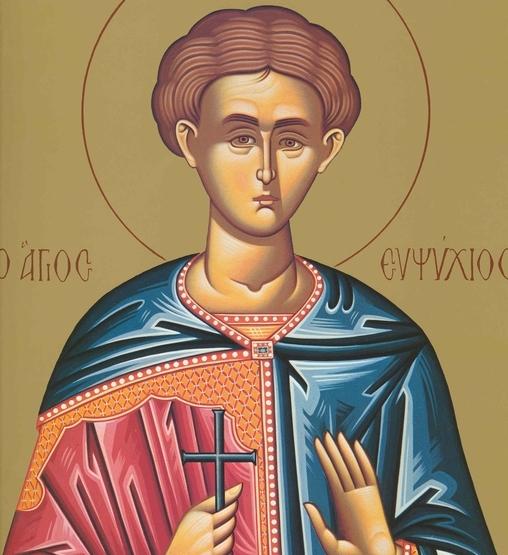
Martyr Eupsychius of Caesarea, in Cappadocia
The Holy Martyr Eupsychius was born in the city of Caesarea in Cappadocia and received a Christian upbringing by his illustrious parents.
During the reign of Julian the Apostate (361-363), Saint Eupsychius entered into a Christian marriage.
At Caesarea there was a pagan temple to the goddess Fortuna, whom Julian the Apostate revered. As Eupsychius was going to his wedding, the pagans were offering sacrifice to the goddess Fortuna.
Saint Eupsychius was filled with zeal for the Lord, and he destroyed the temple. He knew that this would inevitably result in his punishment. Saint Eupsychius distributed all his possessions to the poor and prepared himself for martyrdom.
The enraged emperor Julian loosed his wrath not only upon Saint Eupsychius, but against all the inhabitants of this city. Some of the citizens were executed, while the more respectable were sent into exile. Christian clergy were drafted into military service, and he looted the churches of anything valuable. The city was deprived of its title Caesarea [i.e. “Imperial”] and resumed its original name of Maza. He also imposed a severe tax on the inhabitants. The emperor threatened to annihilate the city altogether, if the people did not build a new pagan temple in place of the one destroyed.
Julian tried to compel Saint Eupsychius to offer sacrifice to idols. For many days they tormented the saint on a rack, and also with iron claws. But his faith was firm, and the judge sentenced the martyr to be beheaded with a sword.
Then Julian embarked on a campaign against the Persians, marching through Cappadocia and approaching Caesarea. Danger threatened the city, since the emperor intended to raze it to its foundations. But then Saint Basil the Great (January 1), showing Julian the proper respect as sovereign authority, came out to meet him carrying with him three loaves of barley bread, which he ate. The emperor ordered his retainers to take the loaves, and to give Saint Basil a pinch of hay saying, “You have given us barley, cattle fodder. Now receive hay from us in return.”
The saint answered, “O Emperor, we bring you that which we ourselves eat, and you give us cattle feed. You mock us, since you, by your might, are not able to transform hay into bread, the essential food of mankind.”
Julian angrily retorted, “I’ll shove this hay down your throat when I return here from Persia. I shall raze this city to its very foundations, and plow over this ground and turn it into a field. I know that it was on your advice that the people dared to destroy the statues and temple of Fortuna.”
After this the emperor continued on his way, but soon perished in his campaign against the Persians. He was struck down in the year 363 by the holy Great Martyr Mercurius (November 24).
After the emperor’s demise, the Christians of the city of Caesarea built a splendid church over the grave of Saint Eupsychius, and from his holy relics they received help and healing.
Troparion — Tone 3
With steadfast heart you finished your course and cast down the wily foe, / for you were armed with the power of the Cross, blest Eupsychius. / You were numbered with the host of martyrs and have attained eternal glory. / Always entreat Christ our God to save us who honor you.
Today is also celebrated Saint Vadim.
Translation by OCA.