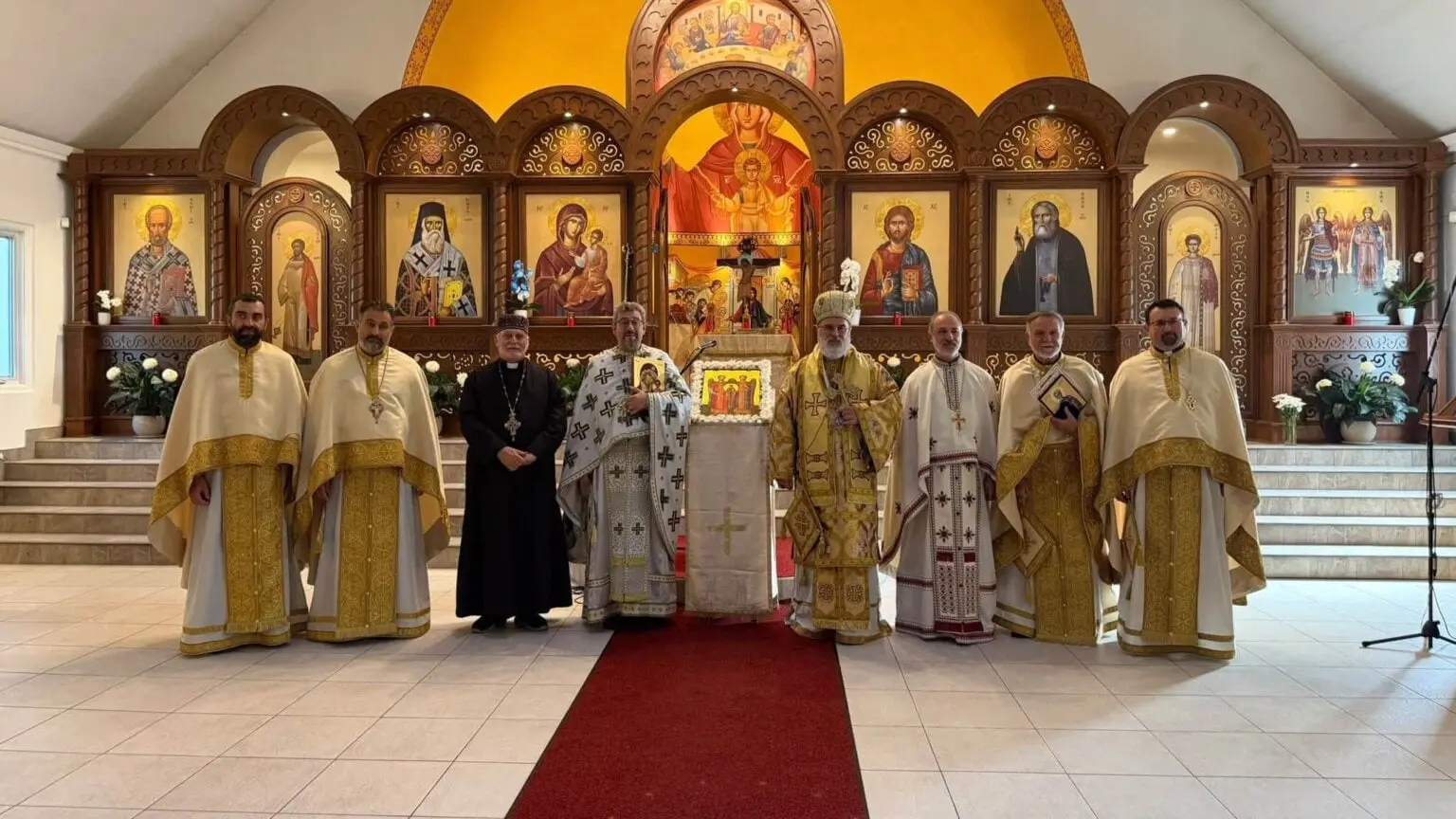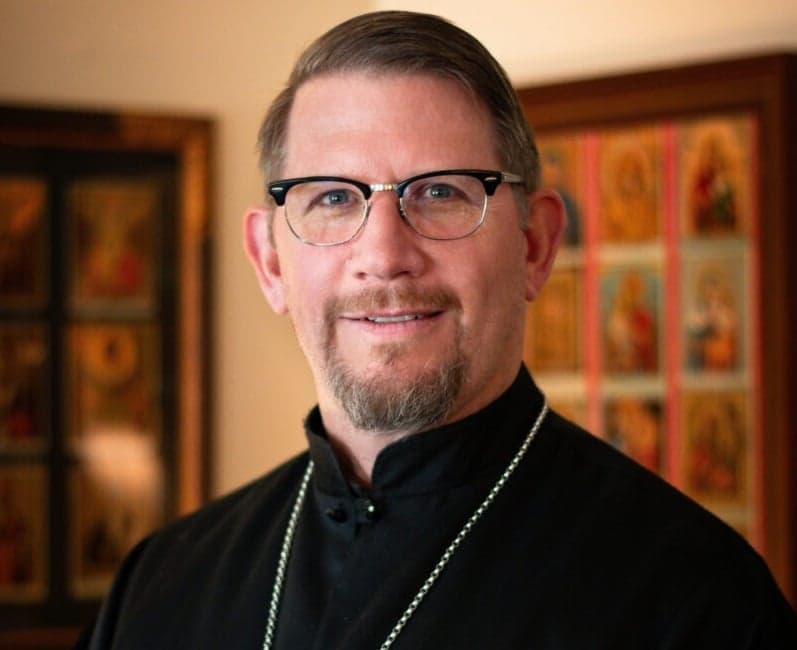
Father John Parker is the Dean of St. Tikhon’s Orthodox Seminary in South Canaan, Pennsylvania – the oldest Orthodox theological institution in North America. After nearly three decades of ministry and of forming young people preparing for the priesthood, Father Parker speaks with depth and joy about the gift of life, the role of the family, friendship in Christ, and how faith can transform fear into a blessing.
In this interview, part of the #FridayForLife series, he offers a luminous perspective on how Orthodox teaching calls us to a life of service, courage, and love for our fellow human beings.
Every single one of us is unique
Alexandra Nadane: As Dean of St. Tikhon’s Seminary, guiding many young people preparing for Church service, how do you approach this mission personally?
Fr. John Parker: I am honored to be asked to share my perspectives on this question today: how does Orthodox teaching shape a life of service and compassion?” How do I approach this mission personally? The key is “person”. Every single one of us, from the moment of conception until natural death, is created as a unique, irreplaceable, unique human person.
God calls us into existence! “Let there be light!”… and there was light! “Let there be birds and fishes…” and there were birds and fishes. “Let there be YOU!” …and there were you! And I!
The Lord’s gift to us, the sacred gift of Life, is given for us in two directions: for Him to take the center of our lives –and for us to imitate Him, and more fully, to participate in His life. This is a marvel, a wonder. One of my dear mentors wrote a famous book teaching people to see the God-given purpose in their lives. I suggest we look to the Crucifixion, Death, Burial, Resurrection, and Ascension of the Lord in order to see our purpose.
Even when the world is at its messiest–including wars at the global level, and uncertainty and tragedy at the personal level, we believe in “God is with us!” Through His presence in our lives, we become, every one of us, lamps of God’s mercy and self-sacrificial love in the world–living testimonies to God’s goodness.
Family is our first eucharistic community
Alexandra Nadane: What role does family play in your life, and what advice would you give to those who want to build a stable, principled family?
Fr. John Parker: I was taught that there are two blessed “states” of life: married and monastic. Everyone needs a community. Husband and wife are blessed from the beginning to be fruitful and multiply, to form an inner community. Those not married are called to a life of celibate chastity; such chastity is best lived in a monastic setting. “It is not good for man to be alone…” I am blessed to have seen so far almost 32 years of marriage.
We have two adult sons, each married, and each with children. It is a blessing to see one’s children’s children. I am, and have been, far from the best parent. Fond of quoting the Scriptures to my children, I would say, “Children, obey your parents!” To which they would reply, “Fathers, do not provoke your children to wrath!” How beautiful to be in a Scripture-quoting battle with one’s sons!
What advice would I give to those who want to build a stable, principled family? The following:
- Let your children see you apologize to one another and forgive one another, without making it a show.
- An example to children is increasing humility in the parents, especially shown through asking active forgiveness when doing wrong in the family. And asking specific forgiveness. “Son (Name), please forgive me for yelling at you. I am very sorry.” etc.
- Priortize being an active member of a vibrant, local eucharistic community. The decision to “go to church” is made at baptism, not on Sunday mornings.
- Prioritize tithing–giving your first and best 10% of your money to the Lord. “Where your treasure is, there will your heart be also.” As St Paul quotes, “ bad company corrupts good morals.”
- Husbands and wives: devote yourselves to outdoing one another is showing one another honor.
- Don’t let the sun go down on anger in a marriage. Try to be the first to forgive, regardless.
- A parent cannot simultaneously be a friend to his or her own children–at least not until they reach adulthood.
- It is vital for each of us to remember that our children are held in trust by us from the Lord, an accounting which we have to give to Him, until the day that the children are able to answer for their own actions. Therefore, it is best to share with children: “this is not my opinion; I am teaching you what Jesus taught us. We are struggling to live a life worthy of God, and this is *who we are*. You may be unhappy with us; you may feel that we are being unkind or unfair. If we are, we will answer to God for that; but we are striving to raise you the way he taught us…”
God meets people where they are
Alexandra Nadane: Who shaped you spiritually, and what life lessons did you learn from them?
Fr. John Parker: I was raised in the Anglican Tradition, and my childhood spiritual mentor was Fr Fred. His love for God was completely infectious. He would do anything Jesus asks. And he took a regular and active role in making disciples of all teenagers. He was never ashamed to ask about another’s spiritual life and growth, and yet one never felt judged. He entrusted ministry to young people, allowing them to grow into Christian maturity.
- Fr John Breck received my family and me into the Orthodox Faith. He is also a living example of a peaceful presence. He taught me almost all that I know about the pastoral life. Especially that, while God has clear standards for us, each individual the Lord meets where he is, in order to raise him up. Morality is not a gray area, but human life on earth deals with a lot that is neither completely black, nor completely white.
- Fr Thomas Hopko, of blessed memory, made the biggest links for me between “the Word of the Cross” – our dogmatic beliefs, and the pastoral life–integrating what we believe with how we live it out. I would strongly recommend every one of his podcasts on Ancient Faith Podcasts.
- My long-time friend, con-celebrant, and mentor, Fr Marcus Burch, has taught me over many years the deep value of a strong friendship, and how to support one another in times of difficulty by a ministry of presence through listening–he also has taught me a lot about how to enjoy life and to find the joy in another person.
Your value is given by God, not by the world
Alexandra Nadane: What should a young person do if they want to follow a good path in life?
Fr. John Parker: There are many, many voices and images, calls, and distractions that compete for our attention every day. Here are a few suggestions I could make to a young person to follow not a good path, but the most excellent way:
- Your value and worth are defined by God who made you, and not by any human being on earth–certainly not your enemies, and definitely not social media. You are an invaluable treasure knit together by God, and made to be a lighthouse shining towards Him for others who know neither who they are, or whose they are.
- Devote yourself to Jesus Christ and follow the ways He sets before us. He will never forsake you or leave you alone, and as He tells us, His commandments are life. He wants the best for us, and He can rescue us from the worst. Call on Him even in simple ways, regularly. “Lord, help me!” “Lord, I don’t know what to do: point the way…” etc.
- When you don’t do (a) above, dust yourself off, say, “I am sorry Lord; grant me to start again now….” and do so.
- Until you are very strong in the faith and confident in choosing Jesus’ ways, build Christian friendships with those who are committed to Jesus, too. Be kind to all others but do your best not to go to their parties and be subject to their influence. Love those folks, and show Jesus to them, but be built up with those who are choosing the narrow path.
- Listen to the testimonies–the personal stories of how Jesus is saving people–from the most difficult scenarios when they call unto Him. If you write me at [email protected], I’ll share some with you. Be motivated not by their former lives, but the radical transformations that Jesus has made in them with the turn to Him to live.
- Try to remember that the Christian life is a Cross. While we can carry a cross with joy, which we hope to do, a cross is painful, and as far as the world is concerned, doesn’t end well. But as one of my friends says, “Jesus didn’t come to make bad men better; he came to give dead men life.” The Christian life is not about getting better. It is about finding true life and living it here and now; and the main gift that Jesus gives us is victory over the grave.
Faith is not being able to see the finish line, but knowing that God will be with us all the way there
Alexandra Nadane: What encouragement would you offer to parents who unexpectedly learn they will have a child and feel afraid or uncertain about going forward?
Fr. John Parker: There is no doubt that unexpected pregnancy can cause deep worry, concern, fear, and even sorrow, in the life of a woman–and her man–when pregnancy is a surprise. Even under the most difficult of circumstances, the newly conceived child is a one created in the image and likeness of God and is a living human being possessing the sacred gift of life.
The Lord Jesus Christ writes straightly with crooked lines. Whatever hardship might be faced in such a tender and frightful moment can become the most beautiful blessing in offering the fear and difficulty to the Lord: “Lord, help!”
But this must also be undergirded by being honest with God in all the areas of our lives. Especially when such a pregnancy comes as a result of unchastity, fornication, or adultery, it is very important to be honest with God there also: “I have not followed your ways!”
And then to adjust the course of one’s life, learning to follow the ways of Jesus, and asking the help of pious Christians around us. None of us is guiltless before God; and one-way others thank God, for the miracles of divine U-turns in their own lives, is to help those who are in the process of doing so themselves. In the context of honesty and repentance in one’s own life, be honest and vocal about help that is needed, prepared to suffer whatever difficulties come in the path of turning around.
All those difficulties, though difficult (or maybe impossible) to see through in the moment, are possible with God. Faith is not being able to see the finish line, but knowing that God will be with us all the way there.
Someone once said that becoming a saint is “to do the next right thing”. I would add: regardless of what I have done to this moment, becoming a saint–living a life for Jesus, is “to do the next right thing” – regardless of how hard it may seem. Offering it to Jesus automatically lightens the load, keeping in mind the following two things:
– the command most frequently recorded in the Holy Scriptures is, “Fear not!”; and second
– Jesus, one of whose names is “Emmanuel” (“God with us”), gave many promises. His last one was, “I am with you always, even to the end of the age.” He will never forsake you or leave you alone.
Photo: St. Tikhon’s Orthodox Theological Seminary