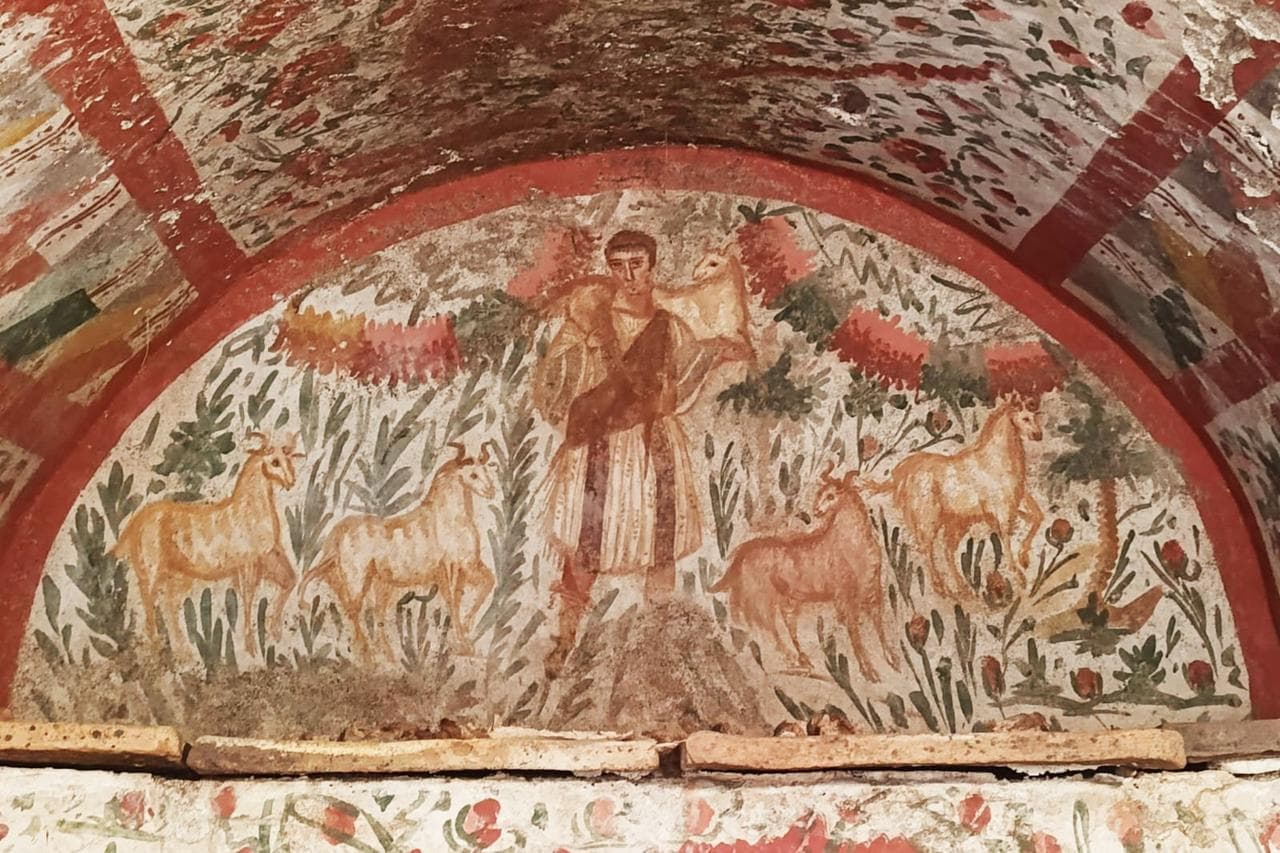
A rare depiction of Jesus as the “Good Shepherd” has been uncovered in a chamber tomb in the Hisardere Necropolis in the ancient city of Nicaea (modern-day Iznik), in Turkey’s Bursa province, Turkiye Today reported.
Researchers consider the scene to be the only known example of its kind identified so far in Anatolia, describing it as a discovery of major significance for archaeology in Turkey and worldwide.
Arkeolojihaber, a Turkish archaeology news outlet, first reported the find on social media.
Context
The discovery comes as 2025 marks 1,700 years since the First Ecumenical Council, which was held in Nicaea.
Excavations at the Hisardere Necropolis are being carried out with the permission of Turkey’s Ministry of Culture and Tourism, under the coordination of Tolga Koparal, director of the Iznik Museum. Scientific supervision is provided by Professor Aygun Ekin Meric of the Dokuz Eylul University’s Department of Archaeology, together with expert Gulsen Kutbay.
The Hisardere Necropolis was used as a burial ground between the 2nd and 5th centuries by both wealthy families from Iznik and less privileged social groups. The site includes various types of graves, among them chamber tombs covered with terracotta slabs, considered characteristic of the Iznik area.

The Good Shepherd
The newly documented chamber tomb (hypogeum) discovered during the 2025 excavation season has drawn particular attention for its frescoes. The structure is oriented along a north–south axis. Although the southern wall has suffered severe damage, the eastern, western, and northern walls, as well as the ceiling, have been largely preserved, allowing for a detailed study of the decorative programme.
Unlike other painted tombs in the region, this hypogeum contains human figures, making it stand out within the local funerary landscape.
An elevated platform known as a kline, covered with square terracotta tiles and used for laying the deceased, was identified on the northern wall. Directly behind this platform, on the same wall, the rare composition of the Good Shepherd has been preserved.
Read more: The Good Shepherd – the representative icon of 2024 in the Romanian Patriarchate
Roman style
The Good Shepherd scene depicts Jesus Christ as a youthful, beardless figure wearing a simple tunic. He carries a large horned goat on his shoulders, while pairs of goats arranged symmetrically on either side complete the composition.
Researchers note that this is one of the rare instances in the region where Jesus is portrayed in a distinctly Roman artistic style.
Moreover, this is the first time a representation of Christ has been identified in a tomb within the Hisardere Necropolis, further increasing the importance of the discovery for the study of early Christian visual culture in Anatolia.

Dating and significance
Although no artefacts were recovered from within the tomb to allow direct dating, its structural features closely match those of other examples already known in the necropolis. On this basis, the tomb has been dated to the 3rd century, placing it firmly in the period of early Christianity.
Given this dating and the fact that it likely preserves the only known Good Shepherd scene in Anatolia, the tomb is regarded as one of the most remarkable early Christian monuments documented in the region.
Earlier this year, also in Nicaea, archaeologists brought to light the remains of what is believed to have been the “Church of the Holy Fathers,” following a decade of research after its initial discovery.
Photo: Arkeolojihaber / Instagram