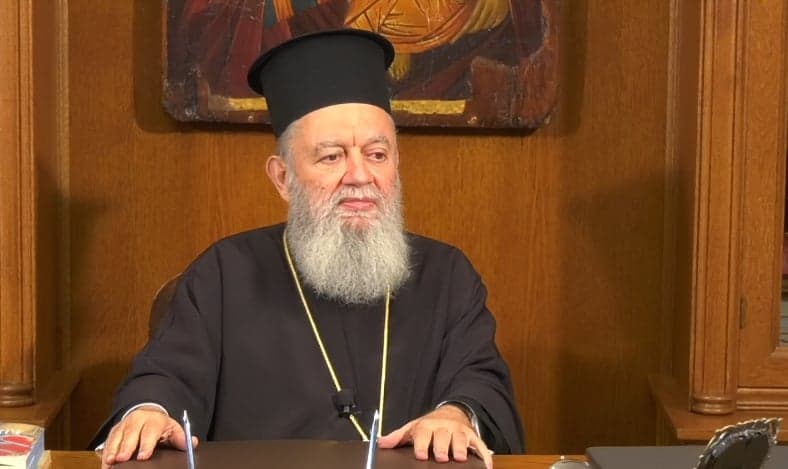
The Holy Synod of the Church of Greece devoted particular attention on Wednesday to an increasingly relevant issue: the online presence of clergy. Metropolitan Chrysostomos of Chalkida outlined the benefits and risks of online pastoral ministry, along with several guiding principles, in a presentation to the Synod.
“I believe that reality itself has given a positive and irrefutable answer to the supposed question of whether clergy should use the internet,” His Eminence said.
The metropolitan noted that the development of modern technology should be viewed within the broader evolution of modern Western civilisation, shaped by the ideas of the Enlightenment.
“The answer to whether the internet is good or bad will be given by the user himself, through the purpose for which it is used and the way it is used,” he emphasised.
A fruitful catch, but not without risks
Metropolitan Chrysostomos highlighted the benefits of a “miraculous catch” in the digital environment, where clergy can reach large numbers of people.
However, he also warned of the dangers hidden in the deep waters where this “fishing” takes place, as well as the possibility that the fisherman himself might become entangled in the nets.
“Technological progress, I believe we all agree, also requires corresponding spiritual progress. As our capabilities increase, so too must our sense of responsibility, for the sake of human dignity. The struggle is difficult and unequal! Nevertheless, we must undertake it,” the Metropolitan of Chalkida said.
Other challenges
The metropolitan also addressed the spiritual danger posed by the clergy influencer, who builds a large community centred on his own personality rather than on the Church.
He raised concerns about clergy potentially crossing the canonical boundaries of pastoral ministry by addressing a global audience, as well as the challenges associated with the use of artificial intelligence.
Principles for clergy’s online conduct
In the final part of his presentation, Metropolitan Chrysostomos proposed eight guiding principles for clergy who wish to maintain an online presence:
- A clergyman remains a clergyman online. The metropolitan recalled that every public appearance by a clergyman, including online, “must express the ecclesiological relationship with the bishop and the local Church or the Holy Synod”. He emphasised that the Holy Canons do not abolish freedom of expression or individual liberty but serve as guidance.
- Not every issue requires a public response. Clergy do not need to take a public position on every subject or event.
- Information must be verified before it is shared. This is especially important when it concerns individuals or serious social and ecclesiastical matters.
- Disagreement does not justify abusive language. Confrontation must never become an excuse for insults, mockery, defamation or contempt.
- Pastoral confidentiality must be respected. Confidential pastoral relationships must not become material for public communication.
- Private digital communication requires particular care. Clergy should exercise special caution in their personal online exchanges.
- Online ministry must not become personal branding. Digital activity should direct people towards Christ and the Church rather than towards the construction of a personal “brand”.
- Digital communication should lead to real-life communion. Wherever possible, online engagement should encourage people to participate in parish life, liturgical worship and personal fellowship.
The Church must be where people are without losing its identity
“The growing presence of clergy on the internet is not a passing or temporary phenomenon. It will continue to increase,” Metropolitan Chrysostomos of Chalkida said in conclusion.
“The essential question, however, will remain the same: how can the Church be present where people are without losing the very way in which it exists as the Church?”
“We need clergy who are able to use contemporary means without being used by them,” he added.
Another issue brought before the Holy Synod of the Church of Greece was the pastoral care of people affected by loneliness and psychological exhaustion.