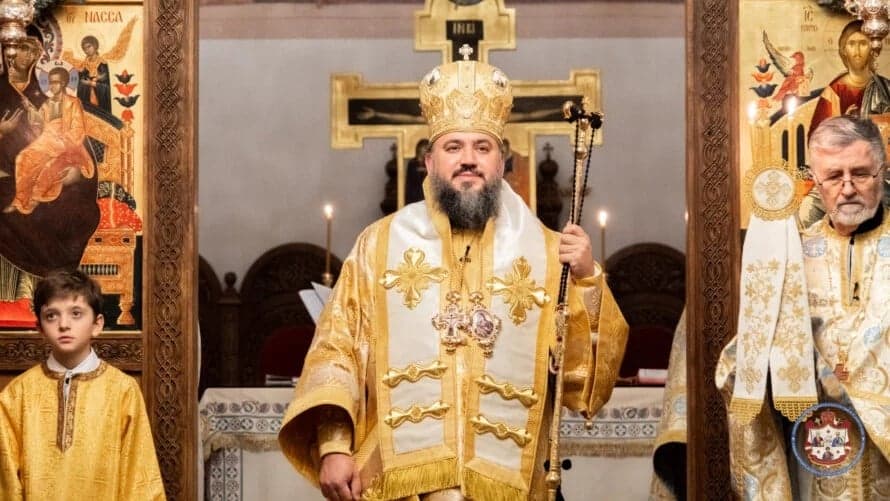
“Whoever understands the mystery of forgiveness understands that the Lord came to wipe away the sin of this world,” Archbishop Atanasie of Great Britain and Northern Ireland said on Sunday in his message at the beginning of Great Lent.
Referring to the well-known liturgical hymn “Open to me the doors of repentance,” chanted during the Triodion period, the Archbishop stressed that repentance and forgiveness are the central themes of the Lenten season.
“Repentance is the moment of an ever-authentic encounter between man and his Creator, the moment of an ongoing return to oneself, that instant so pleasing to the Lord – the unforgettable embrace between the all-merciful Father and the prodigal son, whose image we bear,” Archbishop Atanasie said.
“Great is the mystery of repentance, for it begins with forgiveness – a forgiveness that today we find so difficult to offer and even less often to seek. From here begins the mystery of embracing the cross, which becomes for us a source of life and grace.”
Forgiveness at the Heart of Lent
The Romanian Archbishop placed particular emphasis on forgiveness as the foundation of Christian life.
“A true Christian forgives fully and from the heart, without setting conditions, without demanding justifications. We see God descending to us so that, through forgiveness, He may lift us up.”
“Yet our entire relationship with the Lord is based on forgiveness,” he said, adding that “the one who forgives resembles God because he brings resurrection to the soul of the forgiven” and “raises his neighbour from the anguish of despair.”
Forgiveness, he explained, springs from love: “To the extent that we love, to that same extent we forgive. God came and continues to come to forgive man – this is the mystery of salvation.”
Christian love does not remain at the level of words or feelings, but is verified concretely in the capacity to forgive. Where forgiveness is absent, love remains fragile, conditional or incomplete. When offered from the heart, it reflects spiritual maturity and the living application of the Gospel in daily life.
The Path to the Resurrection
Archbishop Atanasie underlined that the Lenten journey is inseparable from embracing the Cross: “only by embracing the Cross can we reach the end of the Fast.”
The path to God, he said, is “often narrow and thorny, a harsh road of self-restraint, fasting, and enduring suffering for Christ, whom we must love ‘with all our heart, with all our soul, with all our mind, and with all our strength.’ (Mark 12:30).”
He also recalled the three virtues that structure the spiritual ascent of Lent: “mercy toward those who suffer, prayer, and self-restraint.” Fasting thus becomes more than a dietary discipline; it is a confession that we love “the Giver of gifts more than His gifts.”
The Archbishop concluded with an encouragement: “The path may seem arduous, but the dawn of the Resurrection already shines in the distance. Let us set out courageously, for ‘from death to life and from earth to heaven, Christ our God has led us, we who sing the hymn of victory!’”
Photo: roarch.org.uk