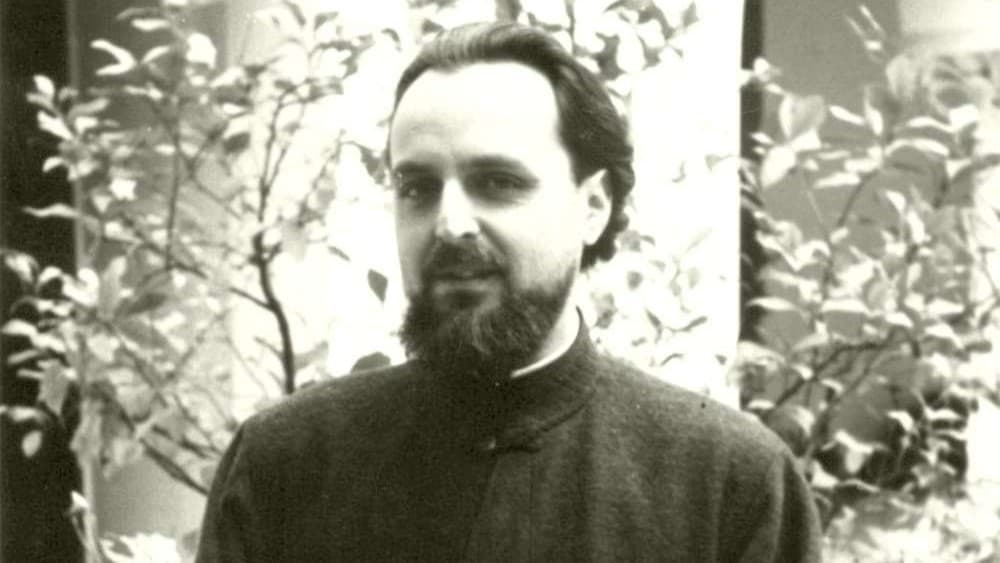
Archimandrite Andrei Scrima, a leading figure of the “Burning Bush” hesychast movement, was born 100 years ago on 1 December 1925 in Gheorgheni, Harghita County.
He studied in Bucharest, following an extensive intellectual path that included mathematics, philosophy and theology.
Scrima became the assistant of philosopher Anton Dumitriu, through whom he encountered the “Burning Bush” group at Antim Monastery. There, he was introduced to the spiritual tradition of hesychasm.
Monastic Vocation
His encounter with Father John Kulygin proved decisive, guiding him toward monastic life. Scrima taught at the Higher Monastic Seminary of Neamț Monastery.
After the seminary was shut down, he withdrew to Slatina Monastery, where he was tonsured a monk. In 1956 — the same year he left Romania — he received the monastic habit. He then spent five months at the Ecumenical Institute in Geneva. Afterward, he departed for Paris and went on pilgrimage to Mount Athos.
Between 1957 and 1959, he travelled to Benares, India, where he completed doctoral studies with a comparative analysis of Christianity and Hinduism.
Scholar and Church Envoy
Returning to Paris in 1960, he obtained French citizenship. The following year, he met Ecumenical Patriarch Athenagoras I. He later represented him at the Second Vatican Council from 1963 to 1965.
Father Andrei Scrima continued his mission as a professor of philosophy and religious studies at the French University in Beirut. He also served as an archimandrite at the Deir al-Harf monastery in Lebanon.
He returned to Romania in 1991 and settled permanently in 1995, dedicating his efforts to major cultural projects.
He reposed in the Lord on 16 August 2000 and was laid to rest at Cernica Monastery.
Photo: Lumina Newspaper