“Through the way in which the Lord Christ, Who ascended in glory to heaven, helped His Church through Saints Constantine and Helen, they became a source of inspiration for all later pious Christian emperors, kings and princes,” Patriarch Daniel of Romania said on Thursday.
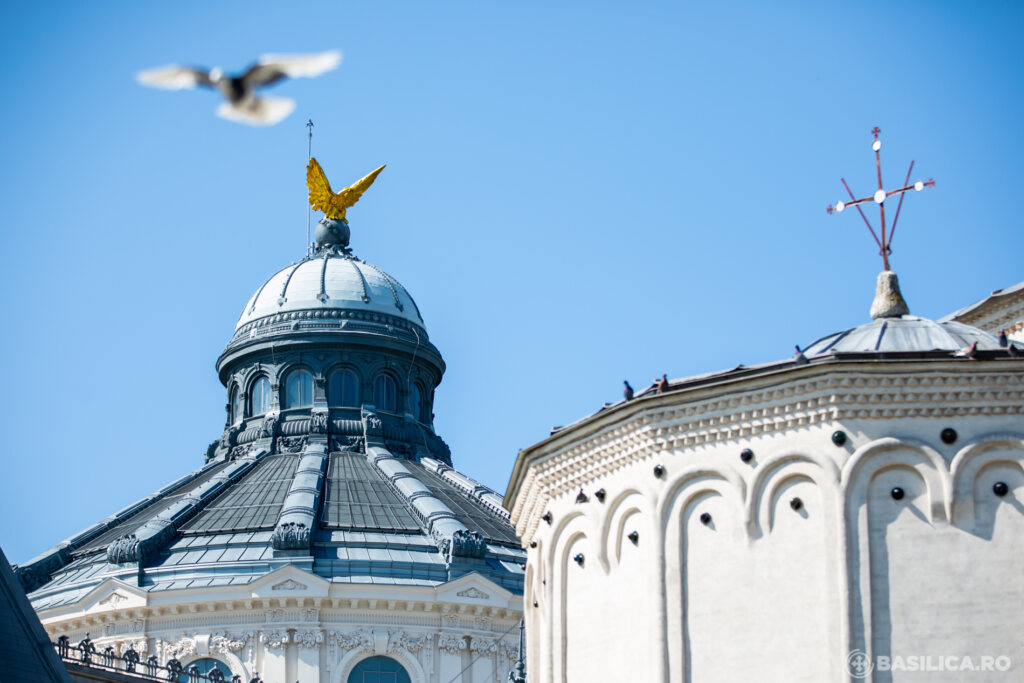
His Beatitude celebrated the Divine Liturgy at the outdoor altar of the Patriarchal Cathedral on the occasion of the historic patronal feast of the cathedral.
Concelebrating with the Patriarch were Archbishop Nifon of Târgoviște, Honorary Metropolitan and Patriarchal Exarch, Archbishop Casian of Lower Danube, Patriarchal Auxiliary Bishops Varlaam of Ploiești and Paisie of Sinaia, and Assistant Bishop Timotei of Prahova of the Archdiocese of Bucharest.
On the same day, the Orthodox Church celebrated both the Ascension of the Lord and the feast of Saints Constantine and Helen. Patriarch Daniel explained the spiritual connection between the two feasts and their significance for the life of the Church.
The work of Christ and the Holy Spirit
Patriarch Daniel explained that the forty days between the Resurrection and the Ascension were a period in which the disciples were prepared for their mission in the world.
“The Lord Jesus initiated His disciples into the knowledge of the mysteries of the Kingdom of Heaven, preparing them to receive the Holy Spirit and to preach repentance, the Gospel of salvation and eternal life to all nations.”

Referring to the spiritual meaning of the feast, His Beatitude stressed that “the Lord Jesus Christ ascended into heaven in order to prepare a dwelling place in heaven for His disciples and for all those who believe in Him and love Him”.
The Patriarch of Romania explained that the Ascension is closely linked to the coming of the Holy Spirit and His work in human life.
“Here we see the great mystery of the Ascension of the Lord, making way for the Descent of the Holy Spirit upon the disciples ten days later, at Pentecost.”
“The Christian life is life in Christ and life in the Holy Spirit, because it is communicated or shared through the Holy Spirit. This divine-human communion in the world gathers within itself different persons and peoples, united through the same right faith, the same grace and the same holy life in the love of the Holy Trinity.”
“Pentecost is the day of the constitution of the Church. But for this, it was necessary that human nature, sanctified through the Cross and Resurrection of Christ, be placed upon the throne of the Holy Trinity. Because through this sanctified and deified human nature of Christ crucified, risen and ascended into heaven, the life of Christ is transmitted to the Church through the Holy Spirit,” he added.
Saints Constantine and Helen, supporters of the Church
Patriarch Daniel also spoke about how Christ ascended into heaven, continued to help His persecuted Church on earth through Saints Constantine and Helen, whom he described as models of support for and confession of the Christian faith.
“Another great holy work of the Lord Jesus Christ ascended in glory to heaven, helping His persecuted Church on earth, was the conversion of the Roman Caesar Constantine, son of Caesar Constantius Chlorus.”

“Together with his mother, the Holy Empress Helen, Saint Constantine the Great supported the building of several churches in the Holy Land — in Bethlehem, Nazareth and Jerusalem — including the Church of the Ascension on the Mount of Olives. Saints Constantine and Helen helped the poor and founded many churches throughout the Eastern and Western Roman Empire.”
The Patriarch of Romania recalled the decisive moment in the life of Saint Constantine the Great, noting that before the battle against Maxentius, he saw the sign of the Holy Cross in the sky, and after the victory, “he confessed that he had felt the help of God”, which he regarded as a “divine exhortation”.
In conclusion, Patriarch Daniel emphasised that Saints Constantine and Helen continue to remain models of faith “for all diligent and generous Christians, in every age and among all peoples, to the glory of the Most Holy Trinity and the joy of the Church”.
Photo: Basilica.ro / Raluca-Emanuela Ene