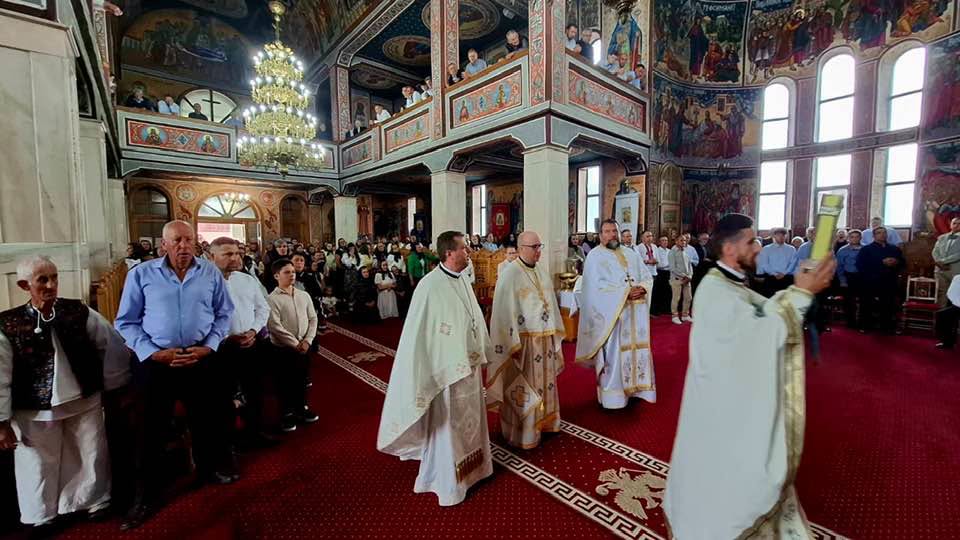
“We give thanks to God for this great gift that He has bestowed upon Moldavia,” said Metropolitan Teofan of Moldavia and Bukovina on Monday, May 4, at the local proclamation of the canonisation of Saint Mavra of Ceahlău.
His Eminence also expressed gratitude to Patriarch Daniel of Romania, who blessed the proposal for the canonisation submitted by the Metropolis of Moldavia and Bukovina.
“Can we, who live today amid the turmoil of life, in continual inner and outer motion, aspire for something of the fullness of grace present in Saint Mavra’s heart, of her longing for God, to descend into our own hearts?” the Metropolitan asked.

“We can accomplish this, even according to the measure of our littleness and weaknesses, in two places: in the Divine Liturgy and in the room of prayer — in the monastic cell or in the prayer corner of every family home throughout the world,” His Eminence explained.
The Metropolitan underlined that by participating in the Divine Liturgy, we fulfil the manifestation of our longing for heaven and for God.
“A person who bears the name of Christ — the name Christian — is called to behold the Morning Star of holiness. Even if one cannot draw near to it, one should never lose sight of it. We must recognise our lowly condition and our great distance from God, while at the same time never losing sight of holiness as the guiding light towards which every Christian soul should strive,” the Metropolitan of Moldavia and Bucovina added.
The saint’s first feast day

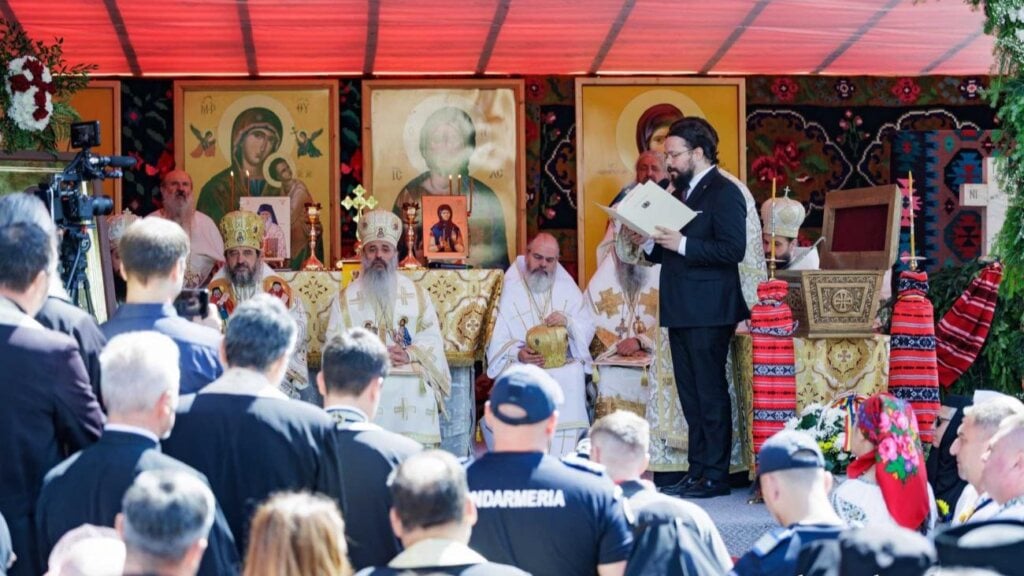
The proclamation of the canonisation took place at Durău Monastery.
It was preceded by the Divine Liturgy celebrated by Metropolitan Teofan together with Bishop Andrei of Covasna and Harghita and the assistant bishops Nichifor of Botoșani, Nectarie of Bogdania, Damaschin of Dorna and Teofil of Trotuș.
Also serving were the exarchs of the monasteries of the Archdiocese of Iași and other invited clergy. The liturgical responses were offered by the “Saint Joseph of Văratec” Byzantine choir of Văratec Monastery.
The Synodal Tomos and the Patriarch’s message

Following the Divine Liturgy, the Synodal Tomos of Canonisation was read by Bishop Damaschin.
“Blessed and worthy of all praise is the commemoration of those who attained holiness, who acquired boldness before God through their life filled with piety and good deeds,” wrote the hierarchs of the Holy Synod of the Romanian Orthodox Church in the document.
“The Most Holy Trinity ordained from eternity to deem them worthy of likeness to God, making them partakers of the light of the grace of the Holy Spirit and placing them in the Church of the righteous, in the company of the saints.”

Răzvan Mihai Clipici, Patriarchal Counsellor at the Culture, Church Painting and Restoration Sector of the Patriarchal Administration, delivered the message of Patriarch Daniel.
“The highest and most hidden work of Saint Mavra of Ceahlău was the prayer of the heart, or hesychast prayer,” His Beatitude said.
“This prayer, which has the gift of gathering all the powers of the soul into a single inward movement through the unceasing invocation of the name of the Lord Jesus Christ, ignited within the venerable saint the purifying light of divine love.”

“The second fundamental characteristic of Saint Mavra of Ceahlău’s life was her profound humility. The work of unceasing prayer bore fruit in Saint Mavra in due time through the light of the grace of the Holy Spirit, manifested in her spiritual gifts: foresight, healing and spiritual guidance,” the Patriarch of Romania further emphasised.
His Beatitude also recalled that the saint became a guide to the hesychast nuns of the region, leaving behind a lasting spiritual legacy.
At the conclusion of the ceremony, the saint’s icon was presented to the faithful, then carried in procession and placed for veneration in the courtyard of Durău Monastery.
Vigil service on the eve of the feast
On Saturday evening, the Vigil service for the saint’s first feast day was celebrated by Assistant Bishop Teofil of Trotuș of the Archdiocese of Roman and Bacău.
In his sermon, the hierarch explained the saint’s name, which he said derives from Mamvri (Mamre), the place where God was received by Patriarch Abraham.
“In the Holy Land, there is this place where Abraham received God under the form of the three angels and was blessed because he had a broad and welcoming heart. I believe Saint Mavra resembles Patriarch Abraham in this regard, because her heart was spacious, and God dwelt within her soul,” His Grace said.
About Saint Mavra

The saint was born in the Bistrița Valley and embraced monastic life at Silvestru Skete from a young age. After receiving the great schema, she withdrew to an isolated cell, dedicating herself to prayer and asceticism, always accompanied by a faithful doe.
In Poiana Maicilor, together with her disciples, she founded a small hermit settlement. Towards the end of her life, she withdrew to Ponoară beneath the Ceahlău peak, where, after years of ascetic struggle, she surrendered her soul into the hands of the Lord and was buried at Poiana Maicilor. Her relics have remained undiscovered.
She was canonised during the working session of the Holy Synod of the Romanian Orthodox Church on 1 July 2025, together with other Romanian holy women — princess consorts, venerable mothers, martyrs and mothers of saints.
The general proclamation of the canonisation of the 16 holy women took place on 6 February 2026 at the Patriarchal Cathedral.
Photo: Doxologia.ro / Fr. Silviu Cluci