Orthodox Calendar April 17
Great and Holy Thursday
Two events shape the liturgy of Great and Holy Thursday: the Last Supper of Christ with His disciples, and the betrayal of Judas. The meaning of both is in love. The Last Supper is the ultimate revelation of God’s redeeming love for man, of love as the very essence of salvation.
And the betrayal of Judas reveals that sin, death and self-destruction are also due to love, but to deviated and distorted love, love directed at that which does not deserve love. Here is the mystery of this unique day, and its liturgy, where light and darkness, joy and sorrow are so strangely mixed, challenges us with the choice on which depends the eternal destiny of each one of us.
“Now before the feast of the Passover, when Jesus knew that His hour was come… having loved His own which were in the world, He loved them unto the end…” (John 13:1).
To understand the meaning of the Last Supper we must see it as the very end of the great movement of Divine Love which began with the creation of the world and is now to be consummated in the death and resurrection of Christ.
God is Love (1 John 4:8). And the first gift of Love was life. The meaning, the content of life was communion. To be alive man was to eat and to drink, to partake of the world. The world was thus Divine love made food, made Body of man. And being alive, i.e. partaking of the world, man was to be in communion with God, to have God as the meaning, the content and the end of his life.
Communion with the God-given world was indeed communion with God. Man received his food from God and making it his body and his life, he offered the whole world to God, transformed it into life in God and with God.
The love of God gave life to man, the love of man for God transformed this life into communion with God. This was paradise. Life in it was, indeed, eucharistic.
Through man and his love for God the whole creation was to be sanctified and transformed into one all-embracing sacrament of Divine Presence and man was the priest of this sacrament.
But in sin man lost this eucharistic life. He lost it because he ceased to see the world as a means of Communion with God and his life as eucharist, as adoration and thanksgiving. . . He loves himself and the world for their own sake; he made himself the content and the end of his life.
He thought that his hunger and thirst, i.e. his dependence of his life on the world—can be satisfied by the world as such, by food as such.
But world and food, once they are deprived of their initial sacramental meaning—as means of communion with God, once they are not received for God’s sake and filled with hunger and thirst for God, once, in other words, God is no longer their real “content,” can give no life, satisfy no hunger, for they have no life in themselves…(…)
But if man betrayed, God remained faithful to man. He did not “turn Himself away forever from His creature whom He had made, neither did He forget the works of His hands, but He visited him in diverse manners, through the tender compassion of His mercy” (Liturgy of Saint Basil).
A new Divine work began, that of redemption and salvation. And it was fulfilled in Christ, the Son of God Who in order to restore man to his pristine beauty and to restore life as communion with God, became Man, took upon Himself our nature, with its thirst and hunger, with its desire for and love of, life.
And in Him life was revealed, given, accepted and fulfilled as total and perfect Eucharist, as total and perfect communion with God. He rejected the basic human temptation: to live “by bread alone”; He revealed that God and His kingdom are the real food, the real life of man.
And this perfect eucharistic Life, filled with God, and, therefore Divine and immortal, He gave to all those who would believe in Him, i,e. find in Him the meaning and the content of their lives. Such is the wonderful meaning of the Last Supper.
The Last Supper is the restoration of the paradise of bliss, of life as Eucharist and Communion.
But this hour of ultimate love is also that of the ultimate betrayal. Judas leaves the light of the Upper Room and goes into darkness.
“And it was night” (John 13:30).
Why does he leave? Because he loves, answers the Gospel, and his fateful love is stressed again and again in the hymns of Holy Thursday. It does not matter indeed, that he loves the “silver.” Money stands here for all the deviated and distorted love which leads man into betraying God. It is, indeed, love stolen from God and Judas, therefore, is the Thief.
by Very Rev. Alexander Schmemann, S.T.D.
Professor of Liturgical Theology, Saint Vladimir’s Seminary

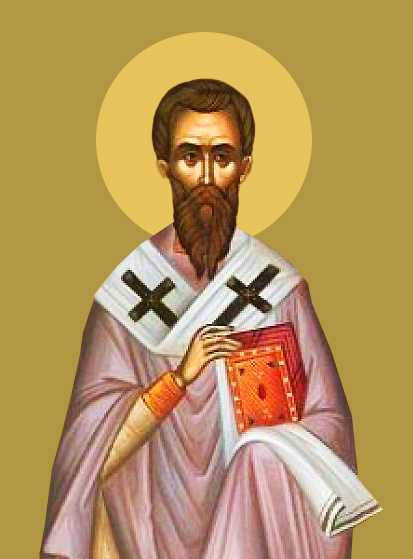
Hieromartyr Simeon the Bishop in Persia
Hieromartyr Simeon, Bishop of Persia, suffered during a persecution against Christians under the Persian emperor Sapor II (310-381). They accused the saint of collaborating with the Roman Empire and of subversive activities against the Persian emperor.
In the year 344, the emperor issued an edict which imposed a heavy tax upon Christians. When some of them refused to pay it, this was regarded as an act of rebellion, so the emperor began a fierce persecution against Christians.
Saint Simeon was brought to trial in iron fetters as a supposed enemy of the Persian realm, together with the two hieromartyrs Habdelai and Ananias. The holy bishop would not even bow to the emperor, who asked why he would not show him the proper respect. The saint answered, “Formerly, I bowed because of your rank, but now, when you ask me to renounce my God and abandon my faith, it is not proper for me to bow to you.”
The emperor urged him to worship the sun, and he threatened to eradicate Christianity in his land if he refused. But neither urgings nor threats could shake the steadfast saint, and they led him off to prison. Along the way the eunuch Usphazanes, a counselor of the emperor, saw the saint. He stood up and bowed to the bishop, but the saint turned away from him because he, a former Christian, out of fear of the emperor, now worshipped the sun.
The eunuch repented with all his heart, he exchanged his fine attire for coarse garb, and sitting at the doors of the court, he cried out bitterly, “Woe to me, when I stand before my God, from Whom I am cut off. Here was Simeon, and he has turned his back on me!”
The emperor Sapor learned about the grief of his beloved tutor and asked him what had happened. He told the emperor that he bitterly regretted his apostasy and would no more worship the sun, but only the one true God. The emperor was surprised at the old man’s sudden decision, and he urged him not to abjure the gods whom their fathers had reverenced.
But Usphazanes was unyielding, and they condemned him to death. Saint Usphazanes asked that the city heralds report that he died not for crimes against the emperor, but for being a Christian. The emperor granted his request.
Saint Simeon also learned about the death of Usphazanes, and he gave thanks to the Lord. When they brought him before the emperor a second time, Saint Simeon again refused to worship the pagan gods and confessed his faith in Christ. The enraged emperor gave orders to behead all the Christians in the prison before the saint’s eyes.
Troparion — Tone 4
As an instructor of divinely inspired doctrines / you trained martyrs for contest by your words and deeds. / You suffered with them, holy hierarch Simeon, / crying out to Christ while hastening to Him: / “We are counted as sheep for the slaughter out of love for You, O Savior.”