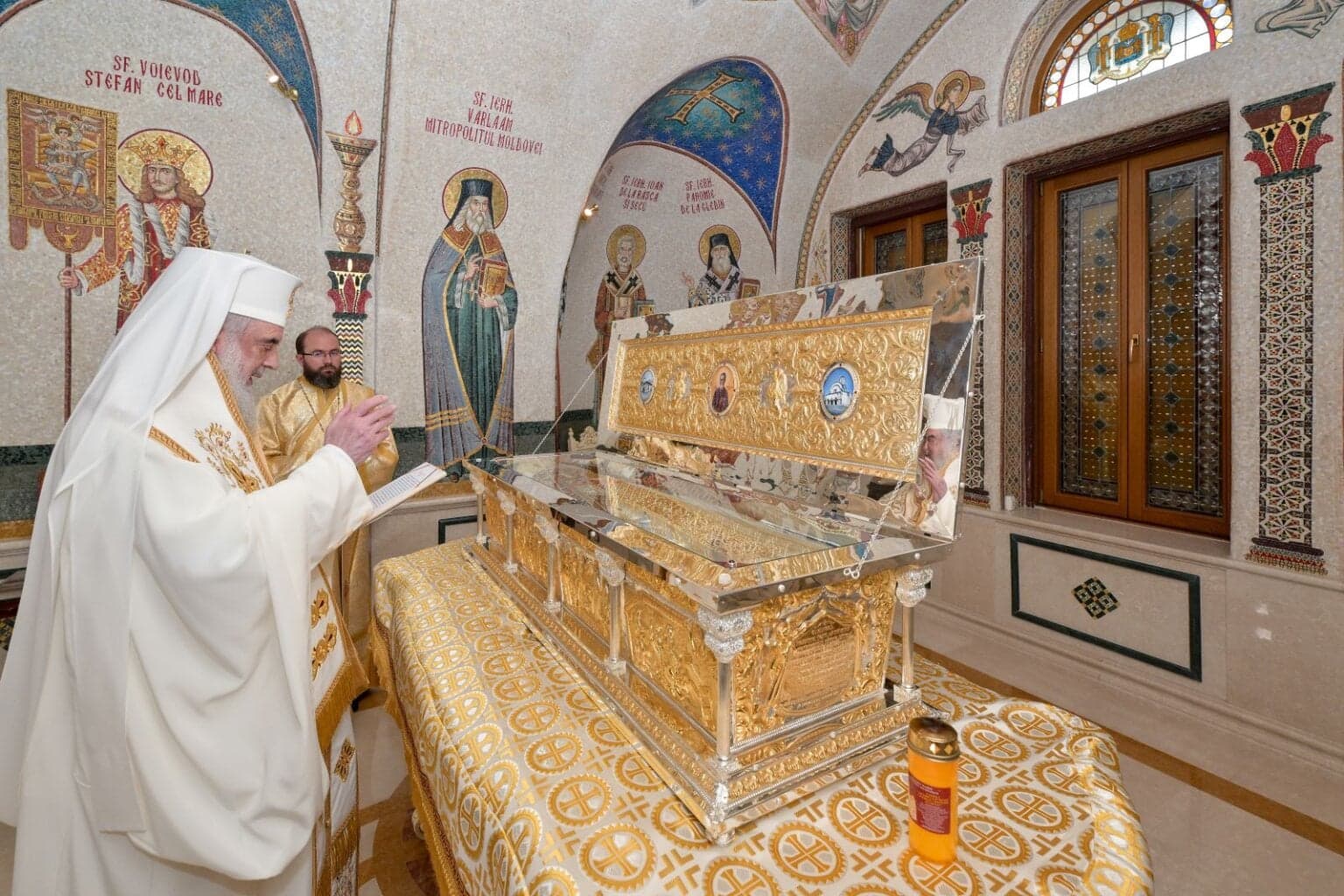
On 25 February 1958, the wonder-working icon of the Mother of God known as the “Syriac” Icon of the Theotokos was brought to Ghighiu Monastery near Bucharest by Metropolitan Basil Samaha of Sergiopolis, from the Greek Orthodox Patriarchate of Antioch and All the East.
Over the 68 years the icon has been kept at the monastery, numerous faithful who prayed before it have testified to receiving swift help, physical and spiritual healings, and strengthening in faith.
In recognition of these reported graces and miracles, the Holy Synod of the Romanian Orthodox Church decided, at its session of 15 February 2018, to include in the Church calendar the feast of the “Veneration of the Syriac Icon of the Mother of God from Ghighiu Monastery,” to be observed annually on Bright Friday (the Feast of the Life-Giving Spring).
Those wishing to pray before the icon may read the Akathist Hymn dedicated to the Syriac Icon of the Mother of God of Ghighiu, available in full in Romanian.
Accounts of miracles attributed to the icon’s intercession have been collected in a special volume of testimonies, documenting numerous cases of healings, protection and rapid answers to prayer.
Among them is the remarkable recovery of young Irene Ecaterina, daughter of Archdeacon Mihail Bucă, the Protopsaltes of the Patriarchal Cathedral in Bucharest. Shortly after the family fervently sought the Mother of God’s help through prayers before the icon at Ghighiu, the child’s medical tests reportedly improved dramatically and rapidly, to the astonishment of doctors and relatives.
Historical Background
The Syriac Icon of the Mother of God dates from the 16th century and is painted on sandalwood, a rare and precious material highly valued in Eastern sacred art.
Specialists consider it a faithful reproduction of the renowned Kazan Icon of the Mother of God, one of the most venerated Russian icons. Although its artistic origin is Russian, the details of how it reached Syria remain unclear.
It is believed that the close historical ties between the Patriarchate of Antioch and the Russian Church facilitated the transfer of this precious copy.
Within the Patriarchate of Antioch, the icon was known and venerated as the “Mother of God of Bhamdoun – Mount Lebanon,” serving as a sacred treasure for local Christian communities.
In 2008, marking 50 years since its arrival at Ghighiu Monastery (1958–2008), the icon underwent careful restoration and embellishment.
It was placed in an elegant gold frame, and golden halos adorned with natural pearls and rubies were added to the Mother of God and the Christ Child, enhancing both its radiance and its veneration.
Photo: Basilica.ro Files / Mircea Florescu