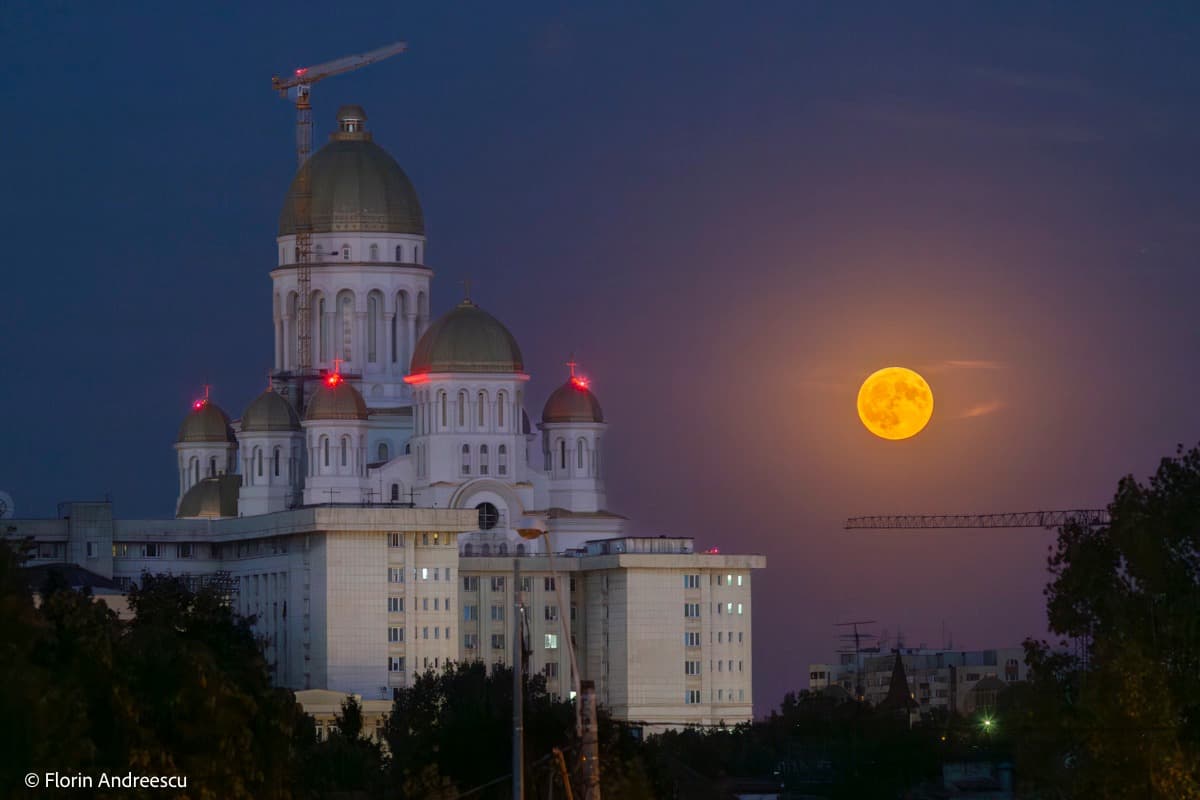
Florin Andreescu, one of Romania’s top photographers and a documentary filmmaker, captured rare images of the “Blue Supermoon” rising above the National Cathedral on Monday evening.
“Every month, the appearance of a full moon attracts photographers from around the globe, competing to create unique and spectacular images. I have always wondered why we don’t see such a photograph of Bucharest with an iconic building,” Florin Andreescu wrote on his personal Facebook page.
He further explained that Bucharest’s geography does not favour this type of photography: “We don’t have hills or mountains nearby, nor large bodies of water, and the few viewpoints we have are more suited to capturing sunsets, not the direction from which the full moon appears.”
Planning for the Perfect Shot
Andreescu planned to capture the photos that went viral on social media for a week. “Accessing a very tall building is a difficult task, so I gave up on that idea and searched for an accessible ‘station point,’ a photographic term. A day before the event, I found an almost perfect alignment with several buildings, and on August 19th, around noon, I set off around Bucharest to decide on the photography location.”
“I chose to photograph the National Cathedral and settled on one of the two locations that resulted from astronomical calculations. It seems I chose well,” he shared.
He set up his equipment 30 minutes before sunset. The results — photographs and a time-lapse video of the moon’s orbit — were published by the photographer without any digital manipulation. The video clip was sped up in post-production to fit the specific durations required for social media stories. The photographer provides more technical details on his Facebook page.
Florin Andreescu returned with a second series of full moon photos taken from the Lacul Morii area on Wednesday evening.
More of a popular term than a scientific one, a Supermoon occurs when a full moon phase synchronizes with an incredibly close approach to Earth. This usually happens only three or four times a year and consecutively, given the Moon’s elliptical orbit.
The term “Blue Moon” first appeared in Sky & Telescope magazine in 1946 and describes the second full moon that occurs within a single calendar month.
Photo: Florin Andreescu
Follow us on X.com: @BasilicaNews