Orthodox Calendar, May 4
St. Mavra of the Ceahlău Mountain

Troparion, tone 5
In the wilderness of Ceahlău, labouring in ascetic struggle and illumined by the grace of the divine Spirit, you appeared as a torch set upon a candlestick, O holy Mavra, shining with a multitude of virtues and the gift of spiritual guidance. Therefore, ever intercede with Christ for the salvation of us all.
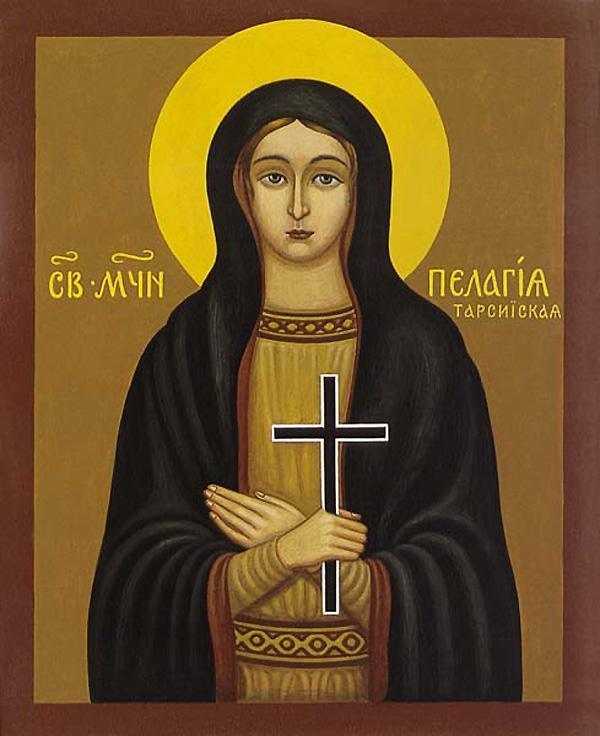
Saint Pelagia of Tarsus in Cilicia (southeastern Asia Minor)
She lived in the third century, during the reign of Diocletian (284-305), and was the daughter of illustrious pagans. When she heard about Jesus Christ from her Christian friends, she believed in Him and desired to preserve her virginity, dedicating her whole life to the Lord.
Pelagia’s reply greatly angered the young man, but he decided to leave her in peace for awhile, hoping that she would change her mind. At the same time, Pelagia convinced her mother to let her visit the nurse who had raised her in childhood. She secretly hoped to find Bishop Linus of Tarsus, who had fled to a mountain during a persecution against Christians, and to be baptized by him.
She had seen the face of Bishop Linus in a dream, which made a profound impression upon her. The holy bishop told her to be baptized. Saint Pelagia traveled in a chariot to visit her nurse, dressed in rich clothes and accompanied by a whole retinue of servants, as her mother wished.
Along the way Saint Pelagia, by the grace of God, met Bishop Linus. Pelagia immediately recognized the bishop who had appeared to her in the dream. She fell at his feet, requesting Baptism. At the bishop’s prayer a spring of water flowed from the ground.
Bishop Linus made the Sign of the Cross over Saint Pelagia, and during the Mystery of Baptism, angels appeared and covered the chosen one of God with a bright mantle. After giving the pious virgin Holy Communion, Bishop Linus offered a prayer of thanksgiving to the Lord with her, and then sent her to continue her journey. She then exchanged her expensive clothing for a simple white garment, and distributed her possessions to the poor. Returning to her servants, Saint Pelagia told them about Christ, and many of them were converted and believed.
She tried to convert her own mother to Christ, but the obdurate woman sent a message to Diocletian’s son that Pelagia was a Christian and did not wish to be his wife. The youth realized that Pelagia was lost to him, and he fell upon his sword in his despair.
Pelagia’s mother feared the emperor’s wrath, so she tied her daughter up and led her to Diocletian’s court as a Christian who was also responsible for the death of the heir to the throne. The emperor was captivated by the unusual beauty of the virgin and tried to turn her from her faith in Christ, promising her every earthly blessing if she would become his wife.
The holy virgin refused the emperor’s offer with contempt and said, “You are insane, Emperor, saying such things to me. I will not do your bidding, and I loathe your vile marriage, since I have Christ, the King of Heaven, as my Bridegroom. I do not desire your worldly crowns which last only a short while.
The Lord in His heavenly Kingdom has prepared three imperishable crowns for me. The first is for faith, since I have believed in the true God with all my heart; the second is for purity, because I have dedicated my virginity to Him; the third is for martyrdom, since I want to accept every suffering for Him and offer up my soul because of my love for Him.”
Diocletian sentenced Pelagia to be burned in a red-hot bronze bull. Not permitting the executioners to touch her body, the holy martyr signed herself with the Sign of the Cross, and went into the brazen bull and her flesh melted like myrrh, filling the whole city with fragrance.
Saint Pelagia’s bones remained unharmed and were removed by the pagans to a place outside the city. Four lions then came out of the wilderness and sat around the bones letting neither bird nor wild beast get at them. The lions protected the relics of the saint until Bishop Linus came to that place. He gathered them up and buried them with honor. Later, a church was built over her holy relics.
The Service to the holy Virgin Martyr Pelagia of Tarsus says that she was “deemed worthy of most strange and divine visions.” She is also commemorated on October 7.
During the reign of Emperor Constantine (306-337), when the persecutions against Christians had stopped, a church was built at Saint Pelagia’s burial place.
Troparion — Tone 3
Through your knowledge of the Faith you abandoned the darkness of ignorance, / fairest virgin of Christ. / You were refreshed by dew and finished your contest by fire. / Glorious martyr Pelagia, / entreat Christ our God to grant us His great mercy!
Saint Monica, mother of Blessed Augustine
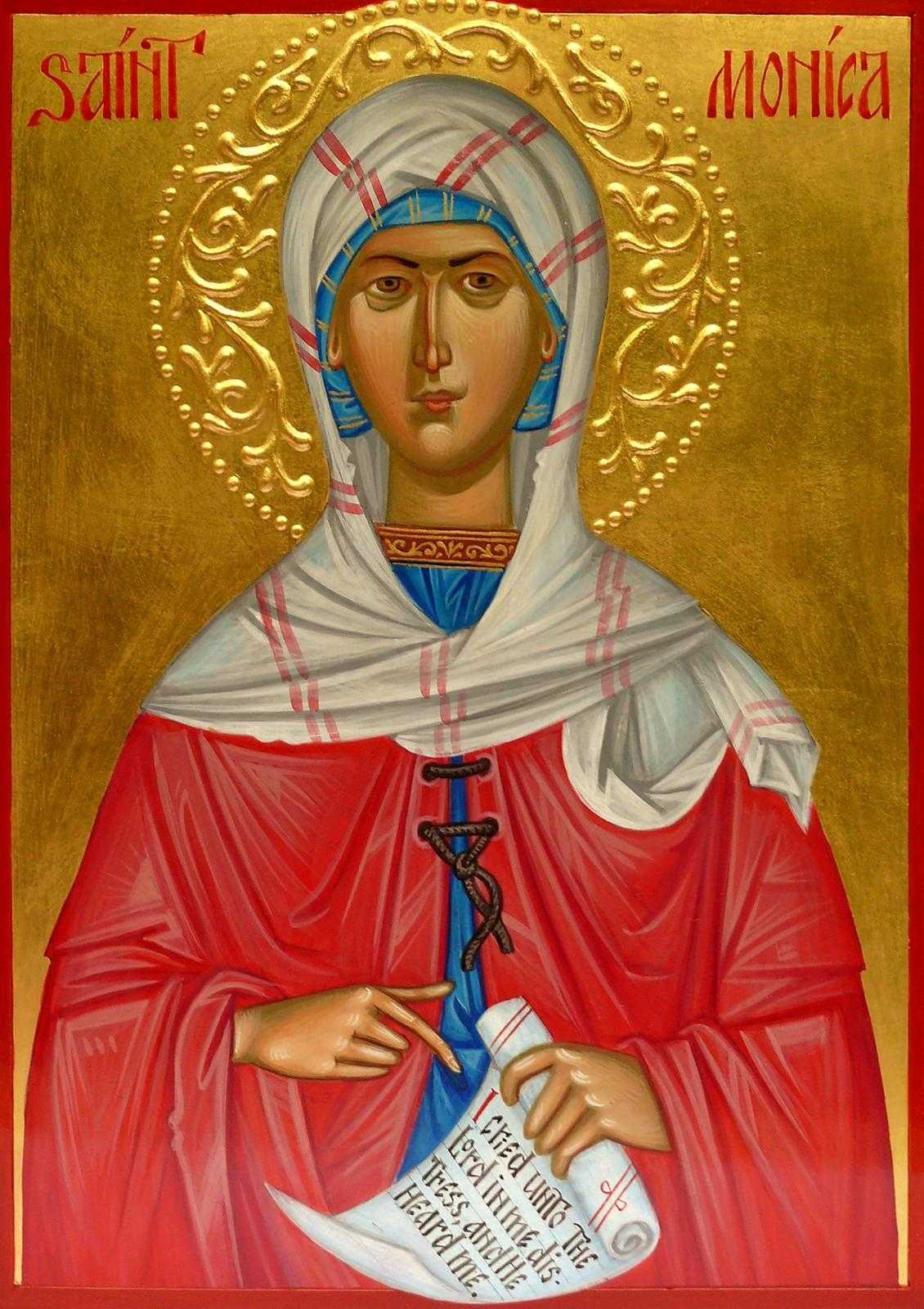
Saint Monica, the mother of Blessed Augustine of Hippo (June 15), was born in 322 in Tagaste, North Africa. Her parents were Christians, but little is known of her early life. Most of our information about her comes from Book IX of her son’s Confessions.
Saint Monica was married to a pagan official named Patritius, who had a short temper and lived an immoral life. At first, her mother-in-law did not like her, but Monica won her over by her gentle disposition.
Saint Monica and Patritius had three children: Saint Augustine, Navigius and Perpetua. It was a source of great sorrow to her that Patritius would not permit them to be baptized. She worried about Augustine, who lived with a young woman in Carthage and had an illegitimate son with her. Her constant prayers and tears for her son had the effect of converting her husband to Christ before his death. Augustine, however, continued on the path that led away from Christ.
While in Carthage, Augustine fell under the influence of the heretical Manichean sect. His mother was horrified and tried to turn him away from his error. She had a dream in which she was told to be patient and gentle with her son. Augustine, however, paid little attention to her arguments, and remained in his delusion for nine years. Saint Monica must have felt disheartened and disappointed, but she never gave up on him. She even tried to enlist the help of a bishop who had once been a Manichean himself, but he would not dispute with Augustine. He said he couldn’t reason with the young man, because he was still attracted by the novelty of the heresy. He did reassure her saying, “Go on your way, and God bless you, for it is not possible that the son of these tears should be lost.”
Saint Monica went to Rome with Augustine when he lectured there in 383. Later, he received an appointment to Milan, where he met Saint Ambrose (December 7) and was greatly impressed by his preaching. Bishop Ambrose came to have a high regard for Saint Monica, and often congratulated Augustine on having such a virtuous mother.
One day Augustine was reading the New Testament in a garden, and came to Romans 13:12-14. There and then Augustine decided to “cast off the works of darkness,” and to “put on the Lord Jesus Christ.” He was baptized on the eve of Pascha in 387.
After his baptism, Augustine and his mother planned to return to Africa. They stopped to rest in Ostia, where Saint Monica fell asleep in the Lord at the age of fifty-six. She was buried at Ostia, and her holy relics were transferred to the crypt of a church in the sixth century. Nine centuries later, Saint Monica’s relics were translated to Rome.
In the West, Saint Monica is considered the patron saint of wives and mothers whose husbands or sons have gone astray.
Tr by oca.org