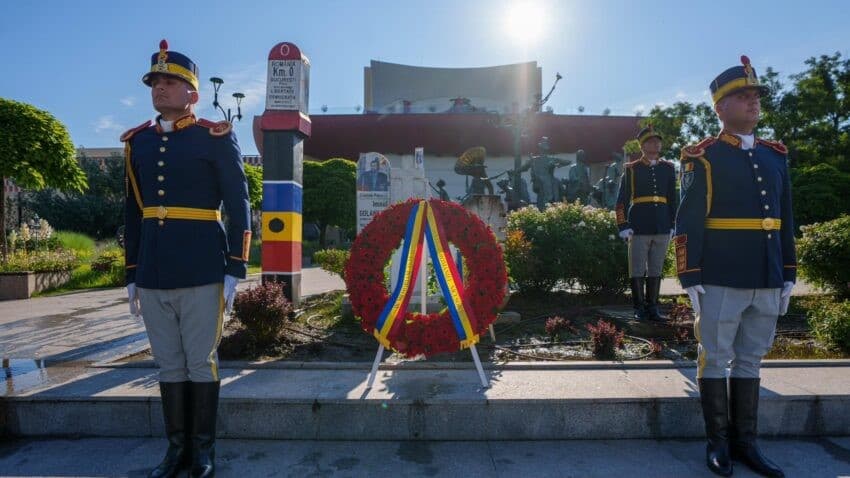
Romania on Monday marked for the first time the National Day of Remembrance for the Victims of the June 13–15, 1990 Mineriad and Anti-Democratic Repression, according to the national news agency Agerpres.
The observance was established under Law No. 93/2026, promulgated on June 10 by Romania’s president, the Presidential Administration said in a press release.
The legislation provides for cultural, educational and commemorative events dedicated to the victims of the repression and to strengthening civic education.
The bill’s initiators argued that establishing the day serves both as a recognition of the victims and their families and as an educational tool for younger generations. The law is also presented as a measure reaffirming Romania’s commitment to democracy and the rule of law.
The measure was approved by the Senate in February 2026 and by the Chamber of Deputies in May before becoming law.
Under the legislation, public authorities, educational institutions, non-governmental organisations and the media are encouraged to organise commemorative and awareness-raising activities.
To mark the occasion, Romanian Television and the Romanian Radio Broadcasting Corporation are airing special programmes dedicated to the events of June 1990, while the national flag is being flown at half-mast at central and local public institutions.
The June 13–15, 1990 Mineriad
The events known as the June 13–15, 1990, Mineriad took place against the backdrop of protests in University Square in Bucharest, which began in April 1990.
Demonstrators challenged the influence of former communist officials over political life and called for the implementation of the principles outlined in the Timișoara Proclamation.
The protests brought together students, intellectuals, representatives of civil society and numerous citizens who supported deeper democratic reforms following the fall of the communist regime.
For nearly two months, University Square became one of the main symbols of civic opposition to Romania’s new political leadership.
On the morning of June 13, 1990, security forces intervened to remove the remaining protesters from the square. The operation was followed by violent clashes, arrests and acts of vandalism that heightened tensions in the capital.
In the following days, thousands of miners from the Jiu Valley were brought to Bucharest.
Their intervention resulted in attacks on protesters and individuals perceived as opponents of the authorities, as well as the destruction of university facilities, media outlets and the headquarters of opposition political parties.
According to data recorded in subsequent investigations, the violence between June 13 and 15, 1990, led to the deaths of four people and left more than 1,000 others injured.
The events triggered international criticism and remain among the most controversial episodes in Romania’s transition to democracy.
Photo: Facebook / Nicușor Dan