Orthodox Calendar, November 18
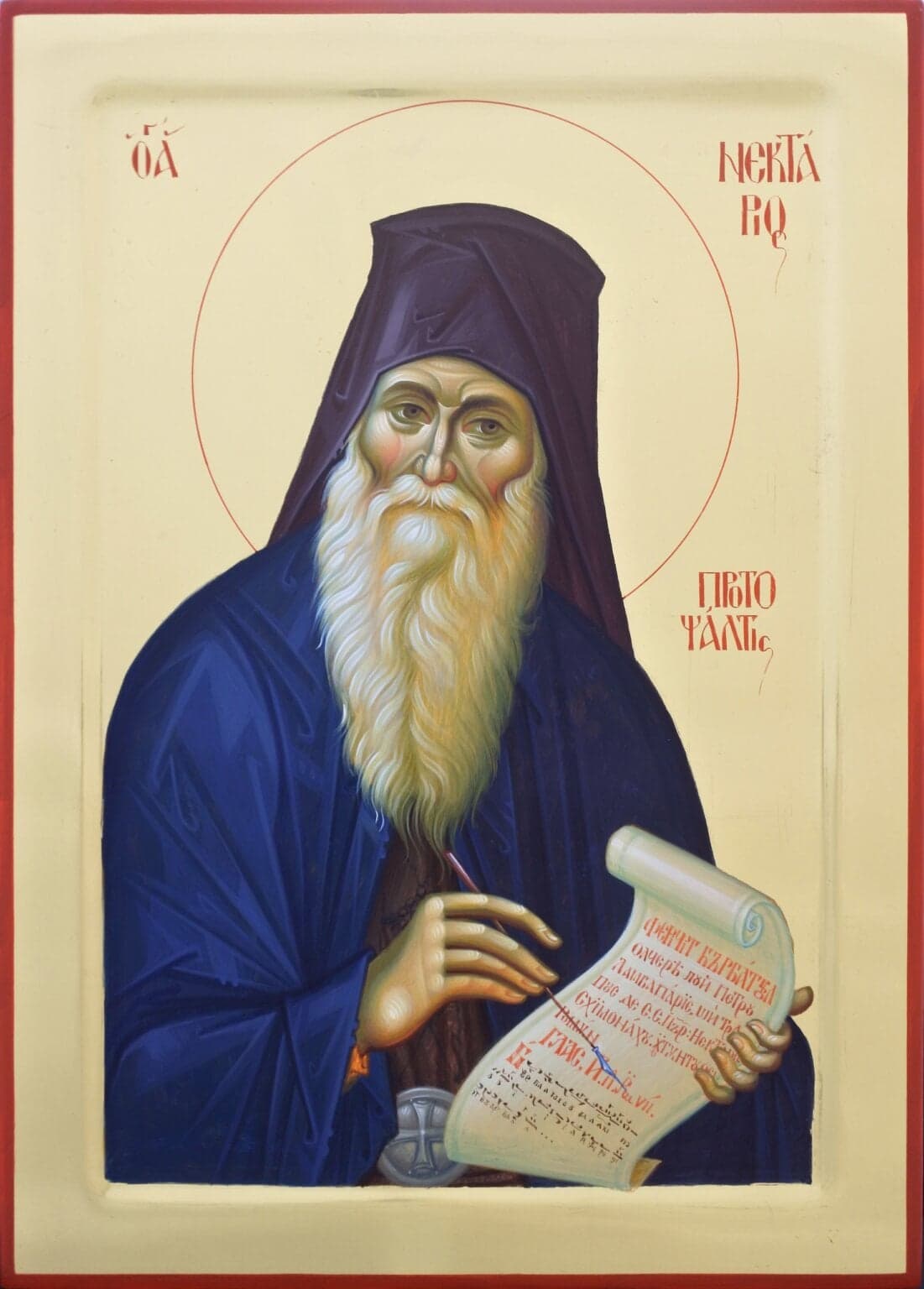
Saint Nectarius the Protopsaltis
He was born on the blessed soil of Romania, in the city of Huși, in 1804, receiving at Holy Baptism the name Nicolae. His parents, Vasile and Joița Crețu, had eight children: two sons, who embraced the monastic life at Neamț Monastery, and six daughters, three of whom chose to become nuns at Văratec Monastery. After the repose of his parents, Nicolae remained in the care of his brother, the schema-monk Athanasie, who had been a disciple for eight years of Saint George the Confessor at Cernica Monastery near Bucharest.
At the urging of Father Athanasie, Nicolae went to learn psaltic chant at the school of the Greek hierarch Gregory of Ephesus at Golia Monastery in Iași, becoming one of the best chanters of that school. He then followed his brother to Neamț Monastery, where he entered as a novice. After a period of trial, he was tonsured into the lesser schema, receiving the name Nectarios. He was appointed canonarch and psalt at the kliros. The abbot, knowing his humility, decided to ordain him deacon. Feeling himself unworthy of such a great dignity, and seeing the insistence of the fathers that he receive ordination, Saint Nectarios took a blessing and left, together with his brother, for Ciolanu Monastery in the region of Buzău.
After two years, he was again urged in that monastery to receive ordination as deacon. Therefore, together with Father Athanasie, he went to Căldărușani Monastery near Bucharest, where he received the great schema. The two brothers, Nectarios and Athanasie, lived in a secluded place at Cocioc Skete, where at that time Saint Macarios, the great teacher of Romanian psaltic music, was also labouring. From the life and teaching of Saint Macarios, the two brothers received much spiritual benefit.
In 1835 they set out for the Holy Mount Athos, where they lived at the Annunciation Skete, on the territory of Xenophontos Monastery. A year later, they both left on pilgrimage to Jerusalem, remaining in the Holy Places for six years. In 1842 Saint Nectarios and the schema-monk Athanasie returned to the Holy Mountain and settled at Saint Anne’s Skete, belonging to the Great Lavra. The skete had twenty Romanian cells, with great hesychast ascetics. There Saint Nectarios learned to carve small crosses, in order to provide for his food and to pay his dues to the monastery.
Seeing that Saint Nectarios was an excellent chanter, many monasteries invited him to chant at their patronal vigils, where he astonished all and was likened to Saint John Koukouzelis. On one occasion Saint Nectarios was invited to the feast of a monastery on Athos.
After the vigil, he was asked to attend the festal meal together with a church singer who had come from outside the Holy Mountain. After some time, the Greek psalt was requested to interpret a very beautiful chant, and Saint Nectarios was asked to write it down and then chant it from his notes.
The venerable father chanted it faithfully, to the amazement of all. Then that singer was filled with envy and anger, and prepared for him a cup of poisoned wine, which he offered to Saint Nectarios. The saint drank it and immediately began to feel unwell.
He told his brother what had happened, and Father Athanasie took the vigil lamp from before the wonder-working icon of the Mother of God, the Gate-keeper, and gave it to Saint Nectarios to drink from it. The saint drank the oil and, with much bitterness of soul, said: “Most Holy Virgin, deliver me! They have poisoned me!”
The Mother of God, the swift helper, the unfailing support and healer of those who call upon her, at once granted him healing. From that moment Saint Nectarios ceased attending the patronal feasts of the monasteries to which he was invited.
Around 1854 he and his brother followed the Venerable Niphon Ionescu, who laboured for the building of the Romanian Skete of Prodromu. Living at the skete, Saint Nectarios was the first to arrive in church, where he chanted like an angel.
Many people would come to the services to hear him. Yet, as much as he was praised, so much did he humble himself, keeping his gaze lowered and lifting his mind to the heavenly things. Many times he would remain in his stasidia with eyes filled with tears, rapt in the prayer of the mind before God.
In his obedience, Saint Nectarios was the first to go out and lift stones for the construction of the skete, placing them on the pack-saddle and on stretchers; and the novice fathers, seeing him, strove to labour even more. After much toil, the fathers would rest, while Saint Nectarios would withdraw.
He never raised his eyes, spoke little, and was never troubled. He sought never to sadden anyone. If someone began idle talk, the venerable father would feign that he had forgotten or lost something and would retire to his cell. For this he won the love of all the fathers and brothers. When he received obedience to speak a word of benefit in church or in the refectory, he spoke like a most wise orator.
After the consecration of the main church of Prodromu Skete, Saint Nectarios withdrew to a life of stillness at the Cell of Saint Menas in the Vigla Desert, together with his brother, and after the repose of Father Athanasie, he settled in a secluded place on the territory of the skete, near the sea.
In 1896 he passed through a great trial. Seeing his spiritual work, the devil, the common enemy of the salvation of humankind, sought to kill him, but God did not permit it. Going down to the sea to wash a towel, he tripped and fell among the rocks.
He lay there wounded for a night, in rain and wind. The next day he was found by the fathers, who took him and carried him on a mule to the skete’s infirmary, where he was cared for over three months, until he recovered.
He fell asleep in the Lord on 18 November 1899. Shining in virtue, piety, love, and humility, the Venerable Nectarios pleased God, became an example to monks through his angelic way of life, and was made a chosen vessel of the gifts of the Holy Spirit, receiving from God the grace of theologising through word and psaltic chant, as well as the gift of tears and of unceasing prayer.
Through his holy intercessions, Lord Jesus Christ, our God, have mercy on us. Amen.

Holy Martyr Platon
He was brother of the holy Martyr Antiochus the Physician (July 16), was born at the city of Ancyra in Galatia. While still a youth he left home and went through the cities, preaching the Word of God to pagans, amazing his audience with the persuasiveness and beauty of his speech, and his profound knowledge of Greek learning.
Because of his preaching, he was arrested and brought for trial to the temple of Zeus before the governor Agrippinus. At first, the judge attempted to persuade the saint to turn away from Christ by flattery. He assured the youth that he might be on a par of intellect with the greatest of the philosophers Plato, if only he worshipped also the pagan gods.
To this Saint Platon answered, that the wisdom of the philosopher, although great, was but ephemeral and limited, whereas the true, eternal and unbounded wisdom comprised the Gospel teachings. Then the judge promised to give him his beautiful niece for his wife if he would deny Christ. He also threatened him with torture and death if he refused.
Saint Platon replied that he chose a temporal death for the sake of eternal life. The patience of the governor was exhausted, and he gave orders to mercilessly beat the martyr, and then send him off to prison.
When they led Saint Platon off to prison, he turned to the people gathered about the temple, and he called on them not to forsake the Christian Faith. Seven days later they again led the Martyr Platon for trial before Agrippinus in the temple of Zeus, where they had the implements of torture already prepared: boiling cauldrons, red-hot iron and sharp hooks.
The judge offered the martyr a choice: either to offer sacrifice to the pagan gods, or to feel the effects of these implements of torture on his body. Again the saint steadfastly refused to worship idols, and after his tortures they threw him in prison for eighteen more days without bread or water.
But seeing that this did not shake the martyr, they offered him his life and freedom if he would only say, “Great is the god Apollo.” The martyr refused to deny Christ or to sacrifice to the idols. Therefore, Agrippinus ordered the holy Martyr Platon to be beheaded.
Troparion — Tone 4
Your holy martyrs Platon and Romanus, O Lord, through their sufferings have received incorruptible crowns from You, our God. For having Your strength, they laid low their adversaries, and shattered the powerless boldness of demons. Through their intercessions, save our souls!
Holy Martyr Romanus
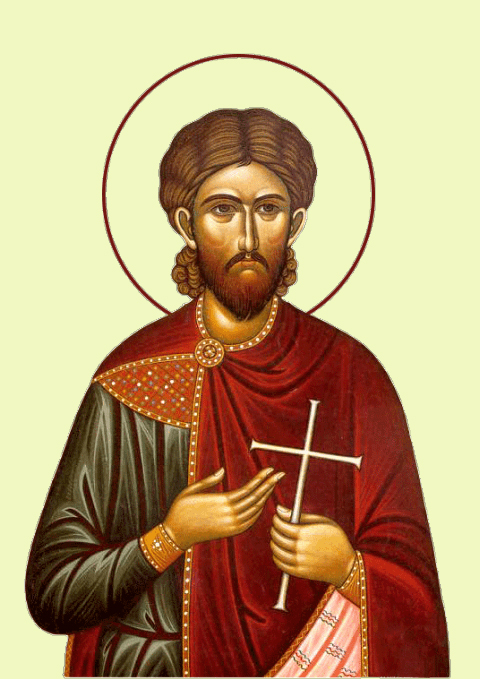
Information concerning Saint Romanus is found in Books 3 and 12 of the Church History of Eusebius. Saint Romanus was born in Palestine, and served as a deacon in Caesarea. At the time of the persecution against Christians, he was living in Antioch.
Through his preaching, he encouraged the faithful to stand firm in their confession of Christ when the Eparch Asclypiades wanted to raze the church to its foundations. Saint Romanus told the people that they must fight to prevent the destruction of the house of God, assuring them that even if they died in their efforts they would sing a hymn of victory in heaven.
At that time there a festival was being celebrated in honor of the idols, and Saint Romanus went to the pagan temple to upbraid the Eparch and the unbelievers for their impiety. As Asclypiades was about to enter the temple, Saint Romanus fearlessly proclaimed that the idols were not gods, and that only Jesus Christ was truly God.
Asclypiades ordered the saint to be beaten, and even tried to persuade him to deny Christ. When this failed, the Eparch ordered that Saint Romanus be tortured. He was suspended and beaten, and his sides were scraped with metal blades. Bravely enduring these torments, Saint Romanus confessed Christ, and chastised Asclypiades for his obstinate refusal to see the truth.
Then Saint Romanus was condemned to death by fire. As soon as the fire was lit, however, a rain fell and put it out. Then the Eparch ordered the saint’s tongue to be cut out, because he still confessed Christ and reviled the idolaters. Even after his tongue was cut out, the saint continued to speak as before.
Finally, Saint Romanus was nailed to a keg, and he was strangled in his prison cell. Having completed his contest for Christ, he was found worthy of the heavenly Kingdom, where he continuously glorifies the Father, the Son, and the Holy Spirit throughout all ages.
Holy Martyrs Zacchaeus, Deacon of Gadara, and Alphaeus, Reader of Caesarea
They suffered under the emperor Diocletian (284-305). Among those arrested during the most fierce persecution against Christians was Saint Zacchaeus, a deacon of the Gadara church, who openly confessed his faith and did not renounce Christ under torture.
The Diocletian persecution was so fierce that many did not endure, and frightened of the tortures, they agreed to offer sacrifice to the pagan gods. Saint Alphaeus, a reader of the church of Caesarea, zealous for the glory of God, approached a crowd of those fallen away from Christ on their way to offer pagan sacrifice. He urged them not to defile themselves with the impious sacrifices.
They arrested Saint Alphaeus and after tortures and torments they shackled him together with Saint Zacchaeus. They threw the martyrs into prison for the night, where they prayed continually, supporting one another in their resolve to endure all the sufferings for the name of Christ and thereby gain eternal life. The next morning, the holy Martyrs Zacchaeus and Alphaeus were beheaded for confessing Christ.
Tr by oca.org