Orthodox Calendar, January 4
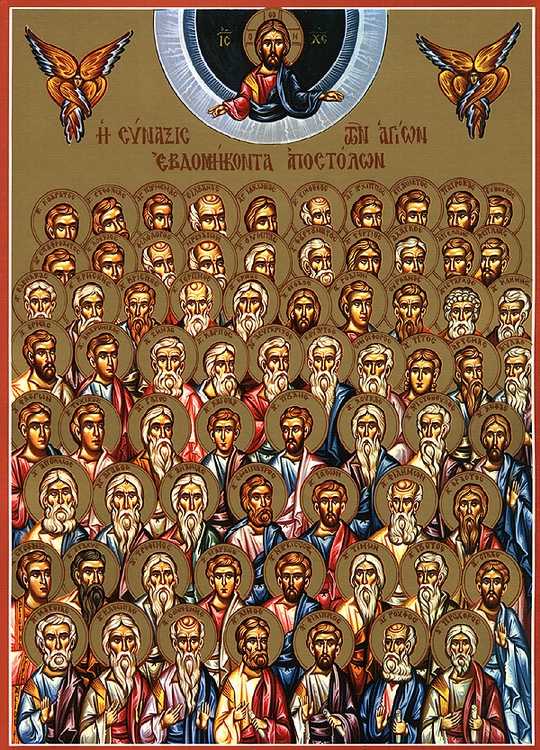
The Synaxis of the Seventy Apostles
The Synaxis was established by the Orthodox Church to indicate the equal honour of each of the Seventy. They were sent two by two by the Lord Jesus Christ to go before Him into the cities He would visit (Luke 10:1).
Besides the celebration of the Synaxis of the Holy Disciples, the Church celebrates the memory of each of them during the course of the year:
Saint James the Brother of the Lord (October 23); Mark the Evangelist (April 25); Luke the Evangelist (October 18); Cleopas (October 30), brother of Saint Joseph the Betrothed, and Simeon his son (April 27); Barnabas (June 11); Joses, or Joseph, named Barsabas or Justus (October 30); Thaddeus (August 21); Ananias (October 1); Protomartyr Stephen the Archdeacon (December 27); Philip the Deacon (October 11);
Prochorus the Deacon (28 July); Nicanor the Deacon (July 28 and December 28); Timon the Deacon (July 28 and December 30); Parmenas the Deacon (July 28); Timothy (January 22); Titus (August 25); Philemon (November 22 and February 19); Onesimus (February 15); Epaphras and Archippus (November 22 and February 19); Silas, Silvanus, Crescens or Criscus (July 30); Crispus and Epaenetos (July 30);
Andronicus (May 17 and July 30); Stachys, Amplias, Urban, Narcissus, Apelles (October 31); Aristobulus (October 31 and March 16); Herodion or Rodion (April 8 and November 10); Agabus, Rufus, Asyncritus, Phlegon (April 8); Hermas (November 5, November 30 and May 31); Patrobas (November 5); Hermes (April 8); Linus, Gaius, Philologus (November 5); Lucius (September 10); Jason (April 28);
Sosipater (April 28 and November 10); Olympas or Olympanus (November 10 ); Tertius (October 30 and November 10); Erastos (November 30), Quartus (November 10); Euodius (September 7); Onesiphorus (September 7 and December 8); Clement (November 25); Sosthenes (December 8); Apollos (March 30 and December 8); Tychicus, Epaphroditus (December 8); Carpus (May 26); Quadratus (September 21);
Mark (September 27), called John, Zeno (September 27); Aristarchus (April 15 and September 27); Pudens and Trophimus (April 15); Mark nephew of Barnabas, Artemas (October 30); Aquila (July 14); Fortunatus (June 15) and Achaicus (January 4).
With the Descent of the Holy Spirit the Seventy Apostles preached in various lands. Some accompanied the Twelve Apostles, like the holy Evangelists Mark and Luke, or Saint Paul’s companion Timothy, or Prochorus,the disciple of the holy Evangelist John the Theologian, and others. Many of them were thrown into prison for Christ, and many received the crown of martyrdom.
There are two more Apostles of the Seventy: Saint Cephas, to whom the Lord appeared after the Resurrection (1 Cor. 15:5-6), and Simeon, called Niger (Acts 13:1). They also were glorified by apostolic preaching.
There are discrepancies and errors in some lists of the Seventy Apostles. In a list attributed to Saint Dorotheus of Tyre (June 5) some names are repeated (Rodion, or Herodion, Apollos, Tychicus, Aristarchus), while others are omitted (Timothy, Titus, Epaphras, Archippus, Aquila, Olympas). Saint Demetrius of Rostov consulted the Holy Scripture, the traditions passed down by the Fathers, and the accounts of trustworthy historians when he attempted to correct the mistakes and uncertainties in the list in compiling his collection of Lives of the Saints.
The Church in particular venerates and praises the Seventy Apostles because they taught us to honour the Trinity One in Essence and Undivided.
In the ninth century Saint Joseph the Hymnographer composed the Canon for the Synaxis of the Seventy Apostles of Christ.
Troparion — Tone 3
Holy apostles of the Seventy, / entreat the merciful God / to grant our souls forgiveness of transgressions.
Saint Nikēphóros the Leper
Father Nikephoros (Nicholas Tzanakakis in the world) was born in 1890 in a mountainous village in Khania, in Sikari, Kastanohori to the west of the prefecture with a healthy climate, with beautiful forests, rich waters, gorges and caves. This village has a peculiarity that we do not often encounter: it is divided into eleven neighborhoods, which have also been named after the families who first settled there. So Saint Nikephoros was born in the neighborhood of Kostoyianides.
His parents were simple and pious villagers, who died when he was still a young child, leaving him as an orphan. So, at the age of thirteen, he left his home. His grandfather, who had undertaken to raise him, went to Khania to work there in a barber shop in order to learn the job. Then he showed the first signs of Hansen’s disease, i.e. leprosy. The lepers were isolated on the island of Spinalonga because leprosy was a contagious disease and it was treated with fear and dismay.
Nicholas was sixteen years old when signs of the disease began to become more conspicuous, so he left on a boat to Egypt in order to avoid being confined to Spinalonga. He remained in Alexandria, working in a barber shop again, but the signs of the disease became more and more apparent, especially on his hands and face. That is why, through the intervention of a cleric, he went to Chios, where there was a church for lepers at that time, and the priest was Father Anthimos Vagianos, later Saint Anthimos (February 15).
Nicholas arrived in Chios in 1914 at the age of twenty-four. In the leper hospital of Chios, which was a complex with many homesteads, there was a chapel of Saint Lazarus, where the wonderworking icon of Panagia Ypakoe – “Obedience” (Feb. 2) was kept. In this space, the course of virtues was opened for Nicholas. Within two years Saint Anthimos considered him ready for the angelic Schema and tonsured him with the name Nikephoros. The disease progressed and evolved in the absence of suitable drugs, causing many large lesions (a drug was found in 1947).
Father Nikephoros lived with unquestioning, genuine obedience to his Spiritual Father, and with austere fasting, working in the gardens. He also recorded the miracles of Saint Anthimos, which he had witnessed with his own eyes (many of these were related to the deliverance of those possessed by demons).
There was a special spiritual relationship between Saint Anthimos and the monk Nikephoros, who always remained close to him, as Father Theoklitos Dionysiatis writes in his book Saint Anthimos of Chios. Father Nikephoros prayed at night for hours on end making countless metanias, he did not quarrel with anyone, nor injure anyone’s heart, and he was the master chanter of the temple. Because of his illness, however, he slowly lost his sight, and so he chanted the troparia and the Epistles from memory.
The Chios leprosarium was closed in 1957 and the remaining patients, together with Father Nikephoros, were sent to Saint Barbara’s home for lepers in Athens, in Aigaleo. At that time, Father Nikephoros was about 67 years old. His members and his eyes were completely altered and distorted by the disease.
There, Father Eumenios also lived there at the home for lepers. He also suffered from Hansen’s disease, but with the medication he received, he was completely cured. However, he decided to remain in the home for lepers for the rest of his life near his fellow sufferers, caring for them with much love. Thus he submitted to Father Nikephoros, to whom the Lord had given many gifts as a reward for his patience. A crowd of people gathered in the humble cell of the leper Nikephoros, in Saint Barbara in Aigaleo to obtain his prayers. Here are some testimonies of those who met him:
“While he was prostrate with wounds and pains, he did not complain, but he showed great patience.”
“He had the charisma of consoling those who were sad. His eyes were permanently irritated, and he had limited sight. He also had stiffness in his hands and paralysis in his lower limbs. Nonetheless, he endured all of this in the sweetest, meek, smiling, delightful way, and he was also pleasant and lovable.”
“His face, which was eaten away by the marks of his illness, and his wounds, shone. It was a joy for those who saw this destitute and seemingly feeble man saying, May His holy name be glorified.”
Father Nikephoros reposed on January 4, 1964 at the age of 74. After three years, his holy relics were exhumed and found to be fragrant. Father Eumenios and other believers reported many cases where miracles occurred by calling on Saint Nikephoros to intercede with God.
The life of Saint Nikephoros was a brilliant example and model for everyone. He was pleasing to God because he had endured so much. For this reason, we have many testimonies that our saint received from the Holy Spirit the gift of discernment as and a host of other charisms. We should note that most of the miracles are recorded, and today the saint gives generous help to anyone in need. Surely there will be many more miracles which not have not yet been made manifest.
Troparion – Tone 1
All the angels were astonished by the struggles and and strict asceticism of the Venerable Nikēphóros the Leper; / for like another Job, patiently enduring his pain, he glorified God, / Who has crowned him now with glory, distinguishing him through miracles. / Rejoice, instructor of monastics! / Rejoice, beacon of light! / Rejoice, for a delightful fragrance pours forth from your relics!

Saint Theoctistus
The venerable saint founded a monastery in the city of Cucomo on the island of Sicily, where he became igumen. At his monastery were some Greek monks who fled persecution by the iconoclasts. He died in the year 800.
Saint Theoctistus of Sicily should not be confused with Saint Theoctistus of Palestine (September 3), the companion of Saint Euthymius (January 20) in the ascetic life.
Troparion — Tone 8
By a flood of tears you made the desert fertile, / and your longing for God brought forth fruits in abundance. / By the radiance of miracles you illumined the whole universe! / O our holy father Theoctistus, pray to Christ our God to save our souls!