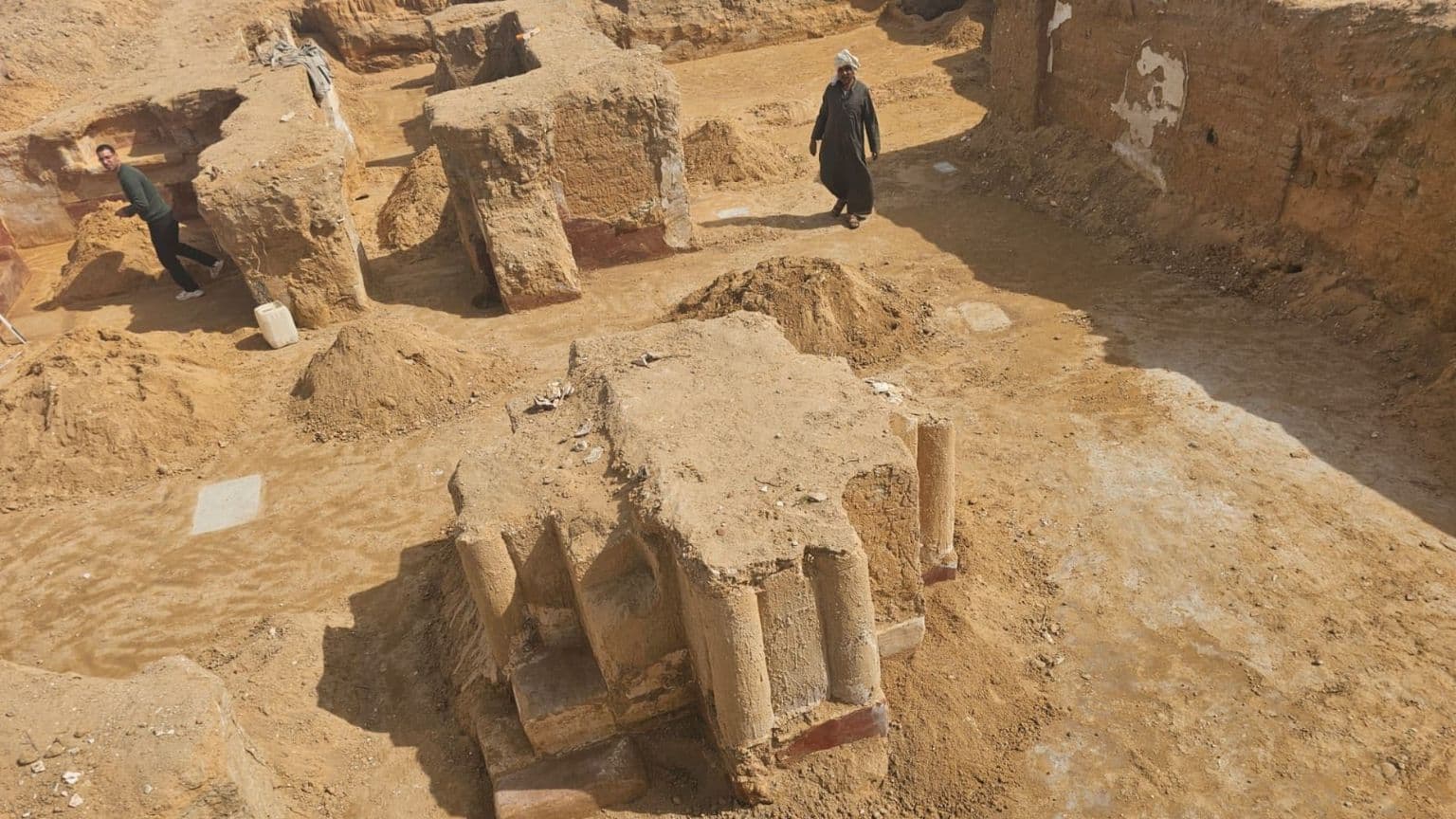
An Egyptian archaeological mission has uncovered a vast religious complex dating back around 1,500 years at the Al-Qalāyā site in Beheira Governorate in the Nile Delta, the Ministry of Tourism and Antiquities in Cairo said on Monday.
Researchers believe the complex represents the second-largest known monastic centre in Christian history, a discovery considered significant for understanding the origins of organised monastic life.
According to archaeologists from the Supreme Council of Antiquities, the site provides clear evidence of the transition from eremitic life to communal monastic organisation in a region distinct from southern Egypt’s desert areas, which have long been regarded as the cradle of early monasticism.
Among the findings is a 5th-century AD structure interpreted as a reception facility for pilgrims. The building comprises 13 rooms, including monastic cells, communal spaces and areas used for education and accommodation.
Prayer Space and Artefacts
Archaeologists also identified an east-facing prayer hall containing a limestone-carved cross set within a niche, a characteristic feature of early liturgical architecture.

The site is further notable for its well-preserved frescoes depicting monks, geometric motifs and vegetal elements. One of the most striking examples is a mural showing two gazelles within a vegetal setting, believed to carry symbolic meaning.
Excavations have also yielded numerous artefacts, including pottery, inscribed fragments, animal bones and shells, offering insight into daily life, diet and economic activity.
Researchers also discovered a funerary stele in the Coptic language dedicated to an individual named “Apa Kyr, son of Shenouda”.

Since 2023, excavations have revealed multiple clusters of monastic cells, known as manshubiyyat, along with auxiliary buildings, indicating the presence of a large and well-organised monastic centre.
Experts say the discovery could reshape current understanding of monasticism’s development, suggesting a more significant role for the Nile Delta in its evolution.
Research at the Al-Qalāyā site is ongoing.
Photo: Ministry of Tourism and Antiquities