From debate to concrete support: this is the direction proposed by the young generation involved in the pro-life movement. The theme of the 2026 March for Life – “Solidarity for Both” – invites a change of perspective: doing what is good is not choosing between two lives, but supporting both of them.
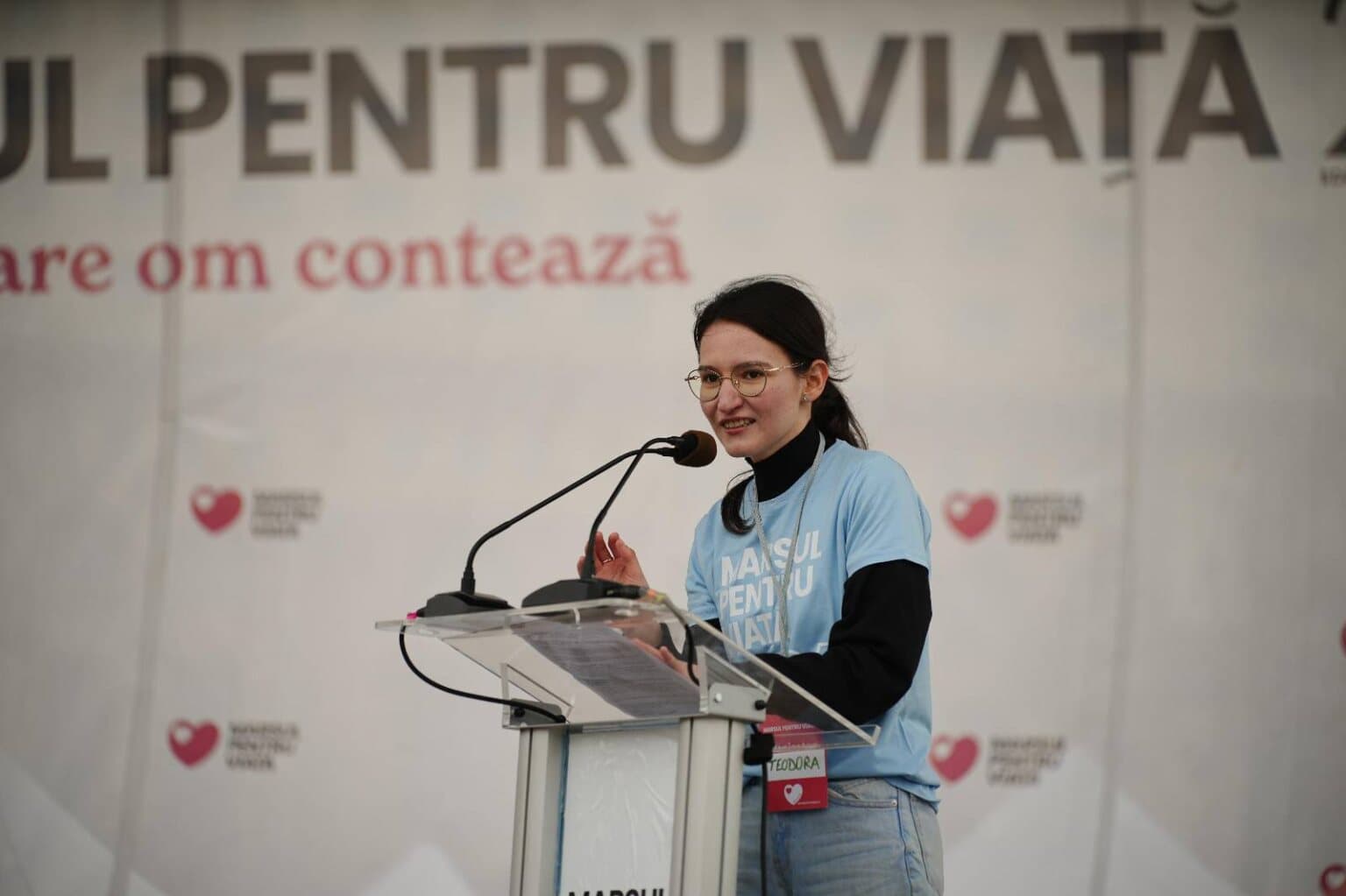
Teodora Diana Paul is the president of the Students for Life Association in Bucharest, Romania, which co-organizes the Bucharest March for Life. The Bucharest March for Life will take place on Saturday, March 28, 2026.
What does solidarity mean
Alexandra Nadane: Teodora, the theme of the 2026 March for Life is “Solidarity for Both.” How do young people understand this solidarity? What does it mean concretely for a female or male student—in the family, among friends, and in the university environment?
Teodora Diana Paul: First, I will speak about solidarity with one person, and then about solidarity with both. Because in youth the emphasis is placed very much on oneself, one’s own formation and career, I believe the first step to understand solidarity is to realize there are others around us and their well-being also matters besides our own.
The second step is to become aware of the other person’s needs. The third is to consider that we can offer something the other person needs. Perhaps these steps sound childish, but the journey from self-centeredness to supporting another person is difficult! Then we shall understand that we do not lose anything when we place our gifts, time, and energy at the service of others, because we grow in relationship with them.
Gradually, we realize that we have also grown in our relationship with God. And then the joy is multiplied compared to the joy of having something just for oneself: I can rejoice in what the other person has, in the fact that I have contributed something, and, finally, in the fact that God has brought us together so that we both grow.
It is good what is good for both
Let’s return to the concrete theme of the 2026 March for Life— “Solidarity for Both”. The moment you truly care about a person, I believe your mind and heart open to see more, including other people who need support.
And then, when you see a pregnant woman who is in a difficult situation, if you truly care about her, you also see the child in her womb. And you care about him, too. And you understand that both need support and that what you do for one is good for the other.
So, it is out of the question to think in terms of “I shall do something good for the woman, but harm the child” or “I shall harm the woman to do something good for the child.” Rather, you think, “I will do something that is good for both.”
Last year, a volunteer from the Students for Life Association saw how her roommate ended up in a pregnancy crisis. They were both enrolled in a master’s program at the same faculty. And she chose to support both of them—her roommate and the child in her womb.
She did not look the other way, she did not say it was her problem to solve alone, she did not say, “Get rid of the problem.” Instead, she said: “I am here for you; there are people who are there for you; there are organizations that will help you with love, without judging you, but understanding that you are in a difficult situation, as anyone can be”. The child was born on January 9, 2026!
The Pro-Life Movement as Seen by Young People
A.N.: The Month for Life and the March for Life have grown significantly in recent years. From your perspective, as students directly involved in organizing it, how has the pro-life movement changed, and why is it important that these events continue year after year?
T.D.P.: There are two aspects. One is numerical growth; the other is a change or, more precisely, a deepening of what it means to be pro-life. Let us discuss them one at a time.
Yes, there is visible numerical growth. More Marches for Life, more pro-life activities being organized, more centers supporting pregnant women, more people who want to pray for these women and their little children, more volunteers who want to get involved.
Looking back, in 20 years, the movement has grown from organizing the March for Life in 3 cities to organizing marches and pro-life activities in March in hundreds of cities and towns. I believe a careful statistic would find well over a thousand activities in March, but, since the pro-life movement is not centralized, it is difficult to produce an exact statistic.
And these numbers are the visible expression of something profound. Some young people are grappling with the issue of unborn children’s lives and the situation of women in pregnancy crisis, moving beyond the trivialization of “abortion is good/bad, abortion legal/illegal.”
More and more are becoming aware of the causes of pregnancy crisis. On one hand, they know that no little girl grows up with the ideal, “When I grow up, I will have an abortion”; no boy grows up with the ideal, “When I grow up, I will tell her to have an abortion.”
The deep cause: Lack of support
So, how do abortions occur, which are reportedly extremely numerous in Romania? What intervenes along the way? Why do most people who end up choosing abortion—women and men, mothers and fathers of the children—know that it is not right to take the child’s life, and yet do it? It is as if you see people walking down the street and, suddenly, they fall; naturally, you ask: what is happening?
These young people begin to understand reality, especially after hearing women’s testimonies—how much turmoil, how much anguish, how much loneliness, how much abandonment they felt during the pregnancy crisis, and the regret, sometimes deeply hidden.
They realize that what determines abortion or birth is not the factual reason for these crises, but the absence or the presence of crisis support. When someone says, “I am here for you and your child,” the woman grows wings to protect her child. When she hears nothing but, “Figure it out, have an abortion, and you’ll be free,” then loneliness crushes her.
Thus, there are young hearts moved by the pain near them. There are hearts moved by the pain for children who were not allowed to be born. There are hearts set aflame to pray for the children in the womb, for their mothers, for their fathers, for their doctors—that they may have love and wisdom, that they may value and respect their lives. For those who have left this life before birth. For parents who have gone through the pain of miscarriage and for those who have chosen abortion on request. For doctors who have helped children be born, for those who have chosen to do something else.
Ideas for public policies and civic initiatives
And, as a practical application of what some young people think and feel, I periodically receive personal messages with ideas that can be implemented, with articles or posts on pro-life topics, and messages from young people who say they wish to get involved.
The second aspect is related to the fact that many people began with the understanding that abortion destroys a child and profoundly affects the woman, and have sought to understand what social factors contribute to avoiding the multiple harms caused by abortion. One of the themes of the March for Life a few years ago was “Adoption – a Noble Choice.” That is, if adoption were valued in all its aspects, it would be chosen more often as a solution.
Another issue is that the difficulty associated with childbirth—both in the process of natural childbirth and in cases when the woman is faced with a colder approach by the medical staff—can lead to fear of having another child; here, the solution is to humanize as much as possible the way pregnant women are cared for.
Another major problem is the lack of support groups for parents facing a prenatal diagnosis and for parents of children with disabilities or neurodivergences that affect their lives. Being pro-life also means creating such support networks.
The need for support groups also exists in the case of losing a child through miscarriage, when grief is intensified by treating the child under 28 weeks of gestation as biological waste and not releasing the body for burial if the family wishes to do so.
The long-term gravity of abuse, which to a very great extent destroys the life of a girl or adolescent, has been increasingly identified as another issue, and among its consequences are mental health conditions and vulnerability to toxic relationships and to abortion—unfortunately, very little is done here for prevention and recovery.
The last issue I will mention is related to the tension between the responsibilities a married woman with children seeks to fulfill while also holding a job—some people acutely recognize the lack of a social framework in which part-time work can be viewed as normal, enabling them to dedicate the time and energy resources so necessary to children.
Such elements appear in the second part of the 2026 March for Life press release for Romania and the Republic of Moldova, with public policy proposals to support pregnant women.
The March for Life, a global movement
A.N.: Marches for Life are organized in many cities around the world. How do you feel about being part of an international movement? What unites all these people, and what kind of atmosphere is at such an event?
T.D.P.: There is this human feeling of belonging to something greater at the local level. Personally, I watch with deep emotion and feel that I receive a great deal of strength when I see marches from other countries online. I have even participated in the ones held in Paris and Rome.
I would like to go—although it is more expensive—to the one in Washington, which is the oldest (since 1974) and the largest in the world—there are years when hundreds of thousands of participants gather, many of them high-school and college students from all over the United States.
In recent years, I have met young people involved in the pro-life movement from France, Italy, the United Kingdom, the United States, Croatia, and India. And everywhere I have seen passion, determination, and a firm resolve to protect life and to love every person. It is energizing to see that others share these values with you.
There is also something profound: you feel a kind of validation—that you are using the gifts received from God for a work according to God, and that God is moving the hearts of sincere people in every corner of the world.
What unites them, what unites us? I hope it is love for every little child, born and unborn, for every pregnant woman, for every family. The desire to do good things, to live in truth. Above all, the desire to help people rejoice in life by offering them the chance at life when they are the most vulnerable, during the intrauterine period.
Specifically, as students, we have wanted to collaborate, at least minimally, with student organizations in other countries. In the United States, there are several thousand; there is a pro-life organization in every university and college, and there is a level of organization that is hard for us to imagine.
They are so active that many people interested in supporting the pro-life cause offer their donations, and they have several dozen full-time trainers who form the leaders of the university associations. One concrete thing we do at Students for Life Bucharest is translate into English “For Life” magazine, which we publish annually on the occasion of the March for Life, and post it online.
From one share to building a community
A.N.: For many young people, participating in the March for Life is a first step. What could follow after this step? How can a student or a university community transform the enthusiasm of one day into concrete support for pregnant women and mothers?
T.D.P.: If you truly want this, it is not impossible. You can volunteer with a pro-life association. Or you can be the founder of such an organization in your community. There is at least one other person who will stand with you there—you will find each other, if that desire exists!
At Students for Life, we are always glad to welcome new members. Especially as a young person, it is very beneficial to be part of an association, because here you find a community of young people who share the same values, who are pro-life, with whom you can speak openly and deeply.
You will not find perfect people, but you will not feel isolated. A community gives you the strength to act in accordance with your values, not only to believe them. It helps enthusiasm turn into consistent activity.
The first step is to post and share pro-life materials on social media. In this way, you will meet others, and you will also carry a life-saving message to those who need it. I find it essential that today, online, we have the opportunity to transmit the message beyond our immediate circle.
The online space is a place where pregnant women in difficulty are present. Following certain posts, I have received testimonies from women who went through a pregnancy crisis and messages in which someone asked me for help for an acquaintance who was in a pregnancy crisis at that very moment.
The Pro-Life Youth Congress
A.N.: The Pro-Life Youth Congress is one of the landmark events organized by Students for Life Bucharest. What does this Congress look like from the inside? What themes are addressed, and what type of guests manage to attract students’ interest?
T.D.P.: We hope that the 2026 Pro-Life Youth Congress will be a transformative experience for young people who want to understand what pro-life means beyond theory and to take a clear stand in a confused and divided society.
We worked on the program together with colleagues from Students for Life Bucharest and with several collaborators from different organizations in the country. After two days of training and networking, we believe participants will return home equipped with a deeper vision, with tools, and with a spiritual community ready to support them.
In this way, they will have greater chances to build together with those around them a culture that celebrates life from the moment of conception and protects it.
There will be 25 speakers from several youth organizations in the country. Alongside them, our keynote speakers will be Fr. Assist. Prof. Petru Cernat, coach Lavinia Stan, Dr. Eliza-Maria Cloțea, obstetrician-gynecologist.
A practical panel on the topic of pregnancy crisis will include Alexandra Nadane, a social entrepreneur in the field of supporting pregnant women and families, Dr. Iulia Rădeanu, family physician and president of the GIO organization, and Manuela Cernat, psychologist. We will have international guests and a surprise—a theatrical performance on the theme of the Congress.
We are trying to prepare everything as professionally as possible because we are aware of—although we do not rejoice in—the fact that young people come to the congress because of its uniqueness. In general, there are few events dedicated to young people with pro-life values.
Why small changes matter
A.N.: What would you say to your colleagues who may look at the March for Life from a distance and wonder whether their involvement really matters? Why do you believe the voice of young people is important in this debate?
T.D.P.: I believe it is important, first of all, to realize that our choices are of two types: either good or bad. There are no neutral choices.
Choices that seem neutral are, in fact, missed opportunities for doing something good or even openings through which something bad enters. So, if someone has the real opportunity to come to the March for Life, as a participant or as a volunteer organizer, I encourage them 100% to do so. They cannot predict the goodness that may come out of it!
I can give you an example that deeply moved me. Two years ago, a few days after the march, a volunteer found out that his aunt was in a pregnancy crisis—her family and those around her were pressuring her to have an abortion. He knew he had a community beside him and that he had somewhere to direct his aunt so she could receive support, which is what happened, and the child was born, bringing joy not only to the aunt but also to her husband and to those family members who, just a few months earlier, had been pressuring her toward something else.
Yes, each person’s voice, thought, feeling, and prayer matter. The March for Life and any pro-life activity are like a puzzle. The whole is beautiful, and within it every piece of the puzzle—every person, in our case—has a unique role. Without it, things would be incomplete. Something would be missing. Perhaps not everyone would feel its absence, but someone would. Perhaps that person could make a difference in someone’s life through the information they received at the March for Life.
Let us not neglect how much good we can do. Through our good deeds, we pave the way for other good deeds and for others to build further goodness in the world. You cannot build a house without a foundation, nor the roof without first building the walls.
We do not know what purpose each of us serves in relation to those before us and those who come after us, but God has love for every person and wishes to work through each person His saving love for others.