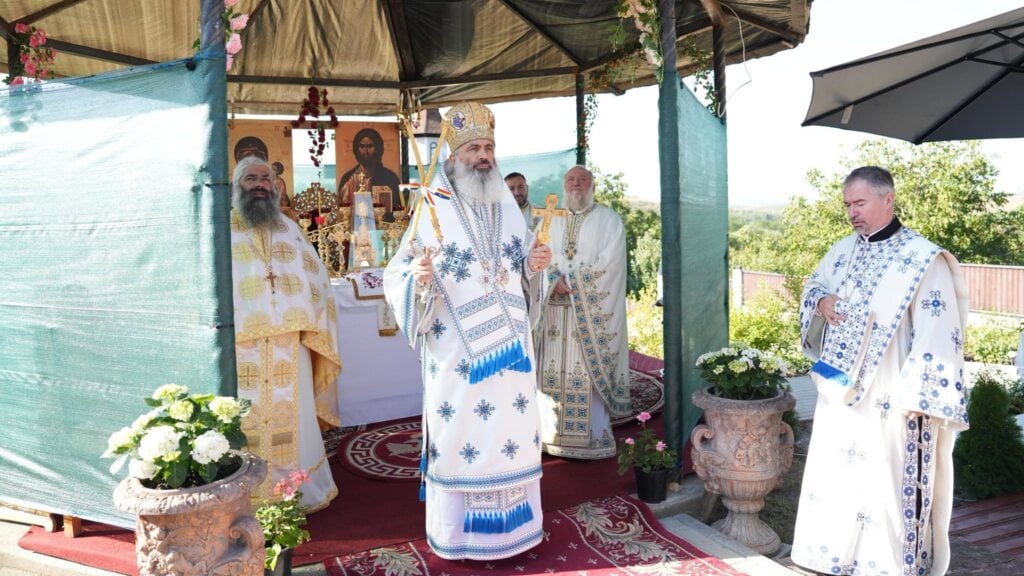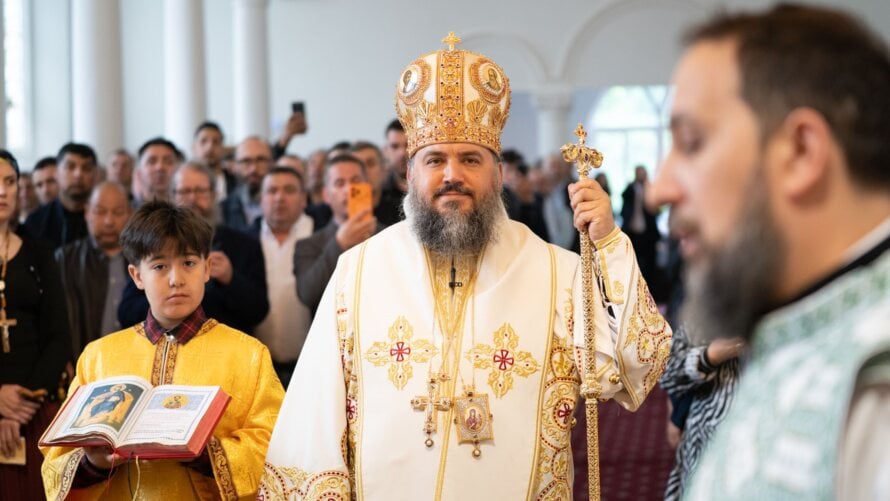
“It becomes a choice, a heritage we preserve and, above all, a gift we are called to entrust to our children,” Archbishop Atanasie of Great Britain and Northern Ireland said in a message, marking Romanian Language Day.
His Eminence explained that distance cannot erase the bond between language, family and homeland.
“A person may travel far from the place where they were born. They may cross countries and seas, learn other languages and come to call another place home. And yet, somewhere deep within, there remains a home that no one can take away: language.”
The Archbishop of Great Britain and Northern Ireland stressed the need to pass on this cultural heritage as a marker of Romanian identity: “It is a way of preserving memory and communion between generations. A way of showing that my country is with me, even when I am far from it.”
“A child who learns their parents’ language receives more than a vocabulary. They receive the key to a world,” His Eminence added.
The language through which faith is passed on
His Eminence Archbishop Atanasie highlighted the spiritual value of language, through its role in prayer and in the transmission of faith: “Through words, a fallen soul can be lifted up, and a wounded heart can be healed. The word reveals love and raises a person to the highest peaks.”
“There is, therefore, also a spiritual memory of language. When we say the same prayers our parents and grandparents said, we are not simply repeating words. We enter an unseen line of generations who sought, loved, suffered and, above all, hoped in the same tongue.”
At the same time, His Eminence highlighted parents’ mission to children raised outside Romania.
“A child can fully belong to the society in which they grow up and, at the same time, can joyfully carry the memory of the family they come from. They can have two languages without having two hearts.”
“This is where the vital role of our families, parishes and parish schools is revealed. Language is preserved when it is spoken with love. When a child encounters it in prayer, in song, in storytelling, in friendship, in the Liturgy and in the joy of community, it ceases to be an obligation and becomes belonging,” the Archbishop said.
Words that build up
Archbishop Atanasie highlighted the responsibility that comes with using words: “The language is beautiful not only for the words it has inherited, but also for what we choose to do with them.”
“For the Christian, honouring language thus begins with the sanctification of the word. A language is truly honoured when truth is spoken in it with love,” His Eminence stated.
The Romanian Archbishop of Great Britain and Northern Ireland explained that language “sometimes becomes a kind of home carried within the soul,” being passed on “not as a burden of the past, but as a gift for the future.”
“Let us, then, preserve the Romanian language in our homes, in our prayer and in the hearts of our children. Let us keep it pure and alive, capable of uniting generations and carrying forward the faith and memory of those who came before us,” Archbishop Atanasie concluded.
Romanian Language Day is celebrated annually on 31 August. The date marks the moment in 1989 when the Chișinău Parliament adopted the law on the return to the Romanian language and the Latin script. The Republic of Moldova subsequently designated this day as the “Our Language” holiday, and the Romanian Parliament established it in 2013 through Law 53.
Photo: roarch.org.uk