Orthodox Calendar August 31
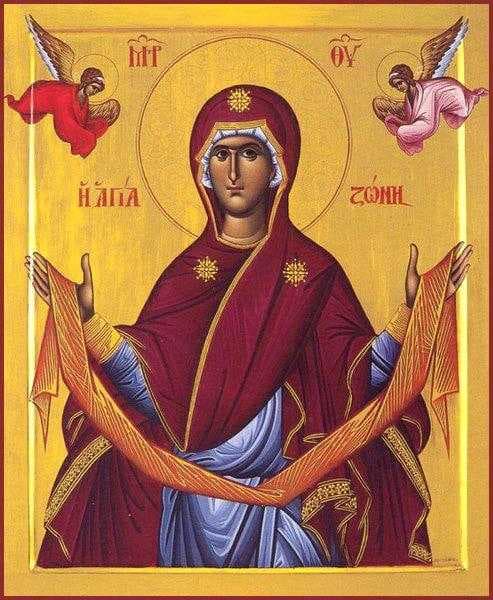
The Placing of the Cincture (Sash) of the Most Holy Theotokos
The Placing of the Cincture (Sash) of the Most Holy Theotokos in a church of Constantinople’s Chalcoprateia district took place during the reign of the emperor Theodosius the Younger. Before this the holy relic, entrusted to the Apostle Thomas by the Mother of God Herself, was kept by pious Christians at Jerusalem after Her Dormition.
During the reign of Emperor Leo the Wise (886-911), his wife Zoe was afllicted with an unclean spirit, and he prayed that God would heal her.
The empress had a vision that she would be healed of her infirmity if the Belt of the Mother of God were placed upon her. The emperor then asked the Patriarch to open the coffer. The Patriarch removed the seal and opened the coffer in which the relic was kept, and the Belt of the Mother of God appeared completely whole and undamaged by time.
The Patriarch placed the Belt on the sick empress, and immediately she was freed from her infirmity. They sang hymns of thanksgiving to the Most Holy Theotokos, then they placed the venerable Belt back into the coffer and resealed it.
In commemoration of the miraculous occurrence and the twofold Placing of the venerable Belt, the Feast of the Placing of the Venerable Belt of the Most Holy Theotokos was established. Parts of the holy Belt are in the Vatopedi monastery on Mt. Athos, in Trier monastery, and in Georgia.
Troparion, tone 8:
Ever-Virgin Theotokos, protectress of mankind, you have given your people a powerful legacy: the robe and sash of your most honored body which remained incorrupt throughout your seedless childbearing; for through you time and nature are renewed! Therefore we implore you: “Grant peace to your people and to our souls great mercy!”
Trd. by oca.org
Saint Macarius Protopsaltes
He was born in 1763 in a devoutly Christian family with three children. Two of the siblings embraced monastic life in youth: Ven. Macarius and his sister, Nun Iustina Periețeanu, who later became abbess of the Viforâta Monastery in Wallachia.
Venerable Macarius strived early in learning psaltic music. He learned Greek in Odessa and returned to Bucharest, where he became a disciple of Macarius the Chanter and of Monk Dionisius, both preachers at the princely court, clergymen of the Bucharest Metropolitan Cathedral and disciples of Saint Paisius of Neamț.
The communion with these holy people planted in him the longing for Holy Mount Athos, where he was took the monastic vows and received the name of Macarius. In Athos, he stared translating psaltic chants.
After a while, he returned to Bucharest, where he was ordained a hieromonk for the Metropolitan Cathedral. For his sound theological knowledge and his rhetorical abilities, he was appointed a preacher at the Princely Court in 1804 – 1805.
Then, until 1808, he studied in Iași with Petros Byzantios, protopsaltes of the Ecumenical Patriarchate in Constantinople. Returning to Bucharest, he was appointed abbot of Golgotha Monastery near Târgoviște. Saint Macarius revived the former monastery shool, where he served as a preacher and a teacher of psaltic music.
In 1817, Saint Macarius returned to Bucharest to study the new musical notation with Peter of Ephesus. In 1819, Metropolitan Dionisie Lupu revived the music school of the Metropolis of Wallachia, appointing Saint Macarius as its director.
Seeing Saint Macarius’s knowledge of the Greek language and psaltic chant, Metropolitan Dionisie Lupu asked him to translate and adapt the chants into Romanian according to the new musical notation, so that people could understand what was sung in church. St. Macarius fulfilled this obedience, working all his life to translate liturgical chants into Romanian.
Some Greeks, however, did not approve of his books of psaltic chant in Romanian, preventing him from printing his works in Wallachia. He tried in Sibiu, then Budapest, but met with resistance from some Greeks. He went to Vienna where, in 1823, with great difficulty, he succeeded in printing the Theoreticon, the Heirmologion and the Anastasimatarius, the first psaltic books printed in Romanian.
Thanks to his hard work and his gift for teaching and enlightening young people, after only ten years of service at the school of psaltic music in Bucharest, many had learned the art of psaltic music and his disciples founded music schools in all the large cities of the Metropolis of Wallachia.
God worked that through the prayer and labour of St. Macarius Protopsaltes so that, in this short period, Greek chanting, understood only by a few, was replaced with chanting in Romanian.
Saint Macarius published, in 1827, at Bucharest, the second volume of his Antologion, a work gathering psaltic chants for the Matin offices throughout the year.
After St. Gregory, Metropolitan of Wallachia, was ousted from the metropolitan throne, (February 10, 1829), Saint Macarius Protopsaltes, who was close to him, withdrew to Iași, Metropolitan Veniamin Costachi of Moldova had him establish a school of psaltic music similar to the one in Bucharest.
He was also appointed abbot of the Bârnova Monastery near Iași. Following some resistance, he retired to Neamț Monastery, where he translated many psaltic chants and founded a music school.
When Metropolitan Gregory recalled him to Wallachia (August 22, 1833), St. Macarius returned and received the obedience to print the Lives of the Saints at Căldărușani Monastery near Bucharest, which he accomplished with great zeal.
During this period, St. Macarius founded music schools for monks at the Monasteries of Căldărușani and Țigănești. At Căldărușani he met Schemamonk Nectarius Protopsaltes, a great hesychast who later lived in the Romanian Hermitage of Prodromou in the Holy Mount Athos. Seeing how beautifully he chanted, he encouraged him to multiply his talent.
On February 6, 1836, with the blessing and support of Bishop Chesarie Căpățână, he printed the text and music of the Lamentations of the Lord.
In the summer of the same year, St. Macarius Protoposaltes fell ill and was confined to bed. He chose to live the last days of his life at Viforâta Monastery, where Nun Iustina, his sister, was abbess and fondly took care of him.
St. Macarius Protopsaltes passed away into the Lord on August 30, 1836, after a short period of suffering.