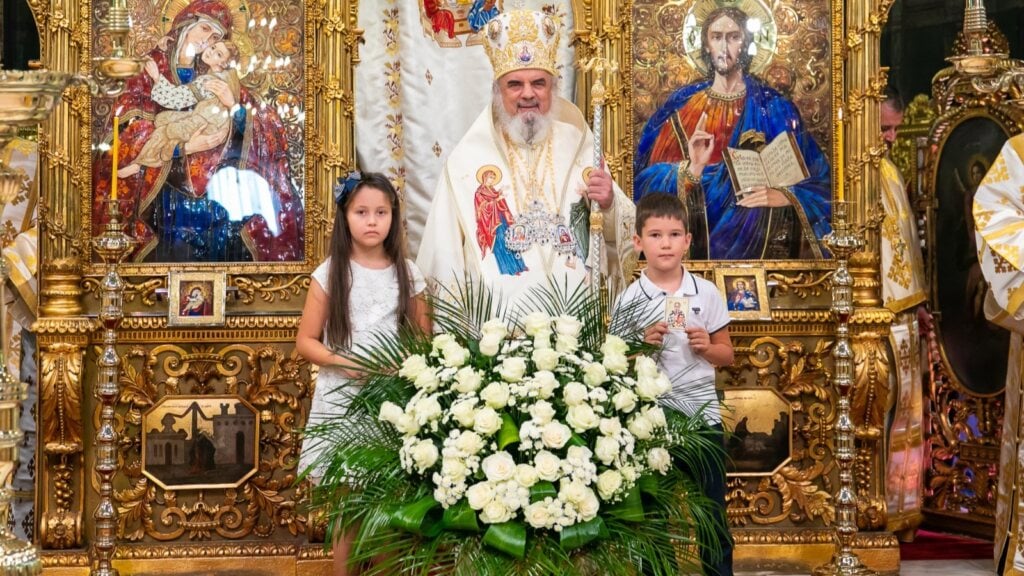
“The Great Canon has been called Adam’s Lament—that is, the lament of the man who realised that, in losing God, he lost himself. For this reason, the Canon is the biography of each of our souls, written in the form of prayer,” said patriarchal auxiliary bishop Paisie of Sinaia on Tuesday evening at the Patriarchal Cathedral Bucharest.
The Patriarchal Auxiliary Bishop officiated Great Compline, during which the second part of the Great Canon of Saint Andrew of Crete was read.
Reflecting on the text, the bishop stressed that it “is not merely a historical meditation on Scripture, but an archaeology of the soul. We dig beneath the layers of sin’s slag in order to rediscover the image of light that God planted within us at creation and renewed at Baptism.”
“For this reason, spiritual fathers recommend that we read the text of the Canon attentively, not simply listen to it, so that this wealth of spiritual ideas and insights does not pass us by without becoming active within us,” he added.
A Mirror of the Old Testament
Bishop Paisie noted that the portion of the Canon read on Tuesday evening “placed before us a stern mirror of the Old Testament, revealing our own wounds as people of today.”
“We see the falls of our forefather Adam, of Cain and of others mentioned, not as stories about someone else, but as diagrams of our own fall and alienation.”
“In Eastern spirituality, sin is not merely the violation of a juridical law, but a sickness of being, in which man separates himself from God, the Source of Life,” he explained.
He added that perhaps no other phrase penetrates so deeply as the cry repeated in every troparion of the Canon: “Have mercy on me, O God, have mercy on me!”
“With these words, like the publican, we acknowledge that we can do nothing by ourselves; our entire salvation depends on the boundless mercy of God.”
The History of the Fall and of Mercy
The Patriarchal Auxiliary Bishop reviewed the themes of the Great Canon: “It leads us through the entire history of humanity’s fall, but also through the entire history of God’s mercy. It shows us how low we can fall and how high we are called to ascend.”
“Today, in the midst of a hurried and restless world, the same ancient and ever-new cry resounds: ‘Have mercy on me, O God!’ Let it not remain merely a liturgical refrain. Let it become the breath of our heart, purified through tears, restoring our living bond with Christ,” he urged.
He emphasised the necessity of confessing sins: “The service of the Canon does not ask us to hide them, but to bring them before God. Let us not depart unhealed when we have come to the Physician, the Physician of our souls and bodies, Who is Christ.”
Concluding his homily, Bishop Paisie prayed that the Lord, “our Help and Protector, Whose mercy is greater than all our falls,” may grant the faithful the strength to unite repentance with prayer, fasting with almsgiving and love for God and neighbour, so as to receive divine assistance in the spiritual ascent toward the Resurrection, in hope of attaining the Kingdom of Heaven.
For more pictures, please visit our Facebook page.
Photo: Basilica.ro / Raluca Ene