Orthodox Calendar, May 3
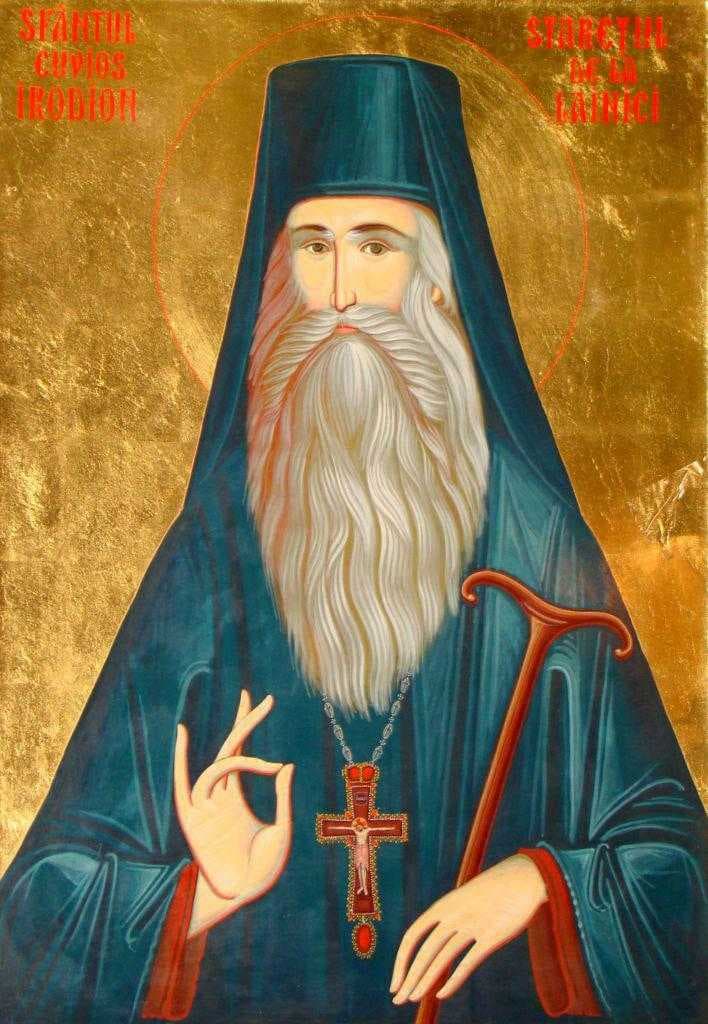
Venerable Irodion of Lainici
Saint Irodion was born in 1821 in Bucharest and received the name John at baptism. His parents gave him good education and taught him Christian behaviour ever since he was a child.
At that time, at Cernica Monastery, nearby Bucharest, under the guidance of Saint abbot George, disciple of Saint Paisios from Neamţ, the spiritual work of prayer and obedience was growing, work which would be continued by Saint abbot Callinicus, the future bishop of Râmnic.
Having heard of the fame of the spiritual life over there, young John, aged 22, asked for the blessing of his bodily parents and retired to Cernica Monastery, under the guidance of abbot Callinicus. There, the young novice was submitted to various trials and soon he passed through all forms of obedience, courageously resisting to all temptations.
Blessed John slept only three or four hours at night and spent all the rest of his time in prayer and prostrations. He was present at all the services in the church, which he attended with much spiritual joy, his lips always saying the prayer: “Jesus Christ, Son of God, have mercy on me, the sinner”.
In 1846, he was tonsured into monasticism with the name of Irodion and ordained deacon and, soon after, priest, according to the decision of his abbot Saint Callinicus. After ordination, blessed hieromonk Irodion fasted, prayed and made prostrations more than before, so that his new quality as a priest did not change anything in his way of living; on the contrary, made him even more humble towards all those around.
In 1850, following the insistence of ruler prince Barbu Ştirbei, Saint abbot Callinicus accepted to be bishop to the Eparchy of Râmnic. The worthy abbot shed many tears when he left the community of Cernica Monastery and took a few fathers with him to help him with the administration of the Diocese of Râmnic. One of those who accompanied him was Venerable Irodion, whom he appointed ecclesiarch at Lainici Skete, in 1851, when he also made him protosyncelos. Soon after that, Saint Callinicus would appoint protosyncelos Irodion igumen of this skete, where he would remain until the end of his life.
As soon as Venerable Irodion became igumen, he increased even greater the trials with more endeavour. For him, the greater responsibility to God and people, the greater endeavour had to be. Having seen Irodion’s thought and efforts, God bestowed great spiritual gifts into his heart. But the devil, the permanent enemy of the humankind, could not put up with the humbleness and spiritual efforts of Venerable Irodion, so that he hit him with his poisonous arrows.
Thus, that enemy entered into the hearts of some monastic brothers and brought to the blessed Irodion much bitterness. Some lay people came together with those rebels, successors of the founders of the skete, who were eager to rule the monastic community as they wished. Consequently, Venerable Irodion has been removed from leading that community for a while. But, being called back, God has blessed him with numerous spiritual gifts.
Soon, administrated by Venerable Irodion, Lainici Skete had gathered the biggest monastic community of Oltenia, exceeding even bigger and older monasteries. His fame was greater and greater so that when the father confessor of Saint Hierarch Callinicus, Bishop of Râmnic, died he decided to take Venerable Irodion as his spiritual father, although he was much younger than him and had been his disciple.
The gift of Father Irodion was really great because all those who came to him could find peace for their souls and hearts, healing of diseases and casting out bad spirits. Venerable Irodion lived an even stricter life and God bestowed even greater and richer gifts upon him, so that he came to foreknow what would happen. Given all the virtues Venerable Irodion had, Saint Hierarch Callinicus called him the “Morning Star from Lainici”, because he guided and advised many people on the path to salvation just like a star in the sky.
As a monk, his heart and mind were directed to heaven, but as abbot he took good care of the fathers and brethren of the monastery whom he protected from temptations and devilish attacks.
Saint Irodion performed a great act of love for his nation in 1877, when he sent 12 brothers from his monastery as health workers to look after the sick and injured in the War of Independence. He has also shown great love for the lay faithful in need, sending relief aid to the poor and hungry.
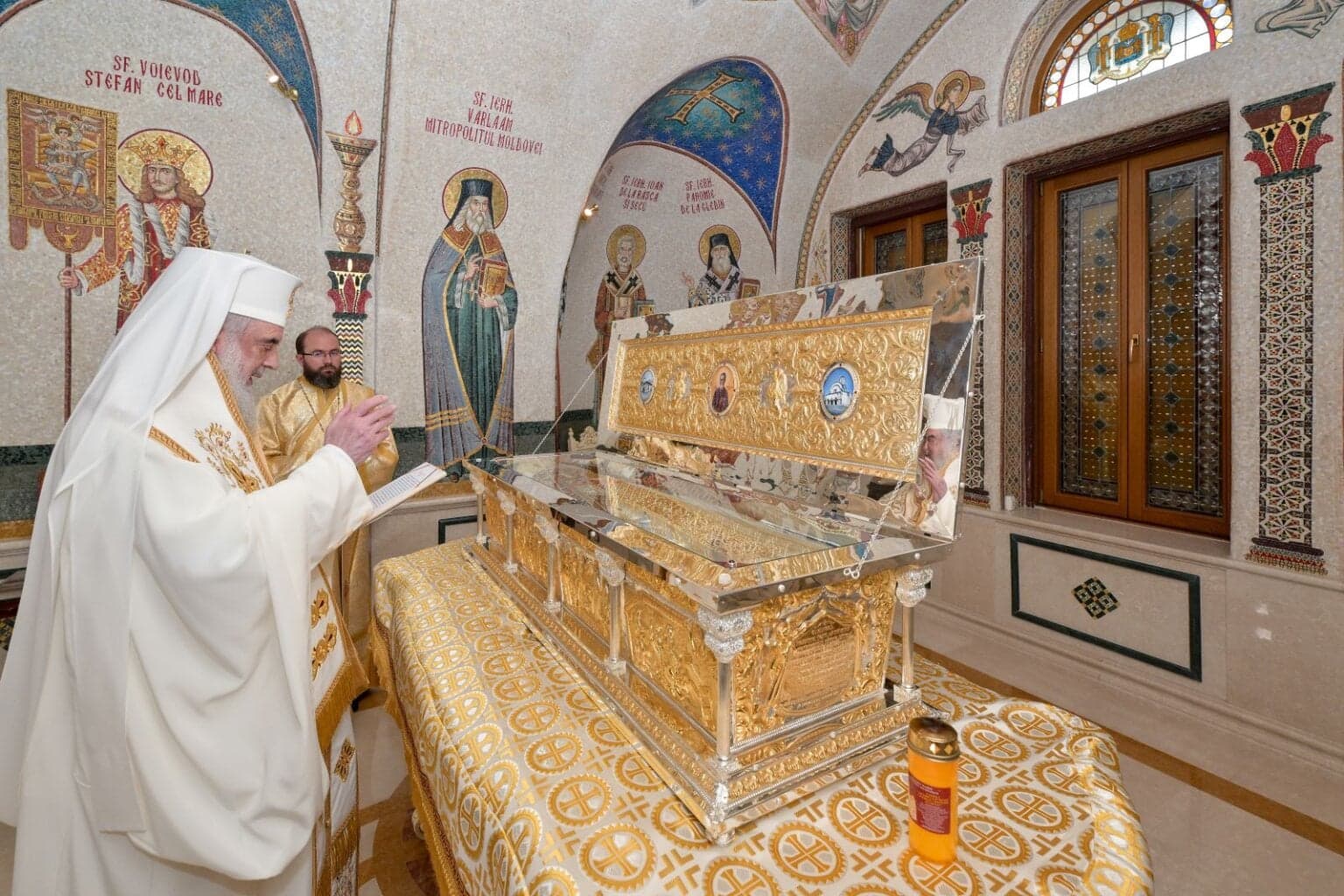
Venerable Irodion passed away on 3 May 1900. His relics were found on 10 April 2009 and laid at Lainici Monastery for veneration, where they can still be seen today.
On 29 October 2010, the Holy Synod of the Romanian Orthodox Church placed him among saints, being celebrated on 3 May.
Through his holy prayers, Lord Jesus Christ, our God, have mercy on us. Amen.
Troparion, tone 1
Spiritual Father of Saint Callinicus of Cernica, advisor of monastics and morning star of Oltenia, helper of those in need and wonderworker, oh, Holy Venerable Irodion, pray to Christ our God to save our souls.
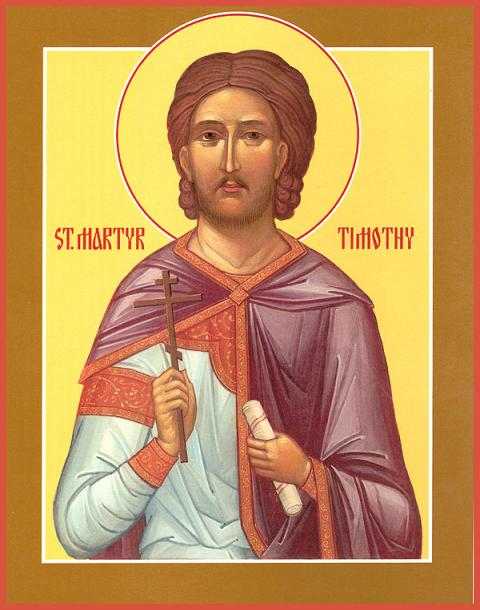
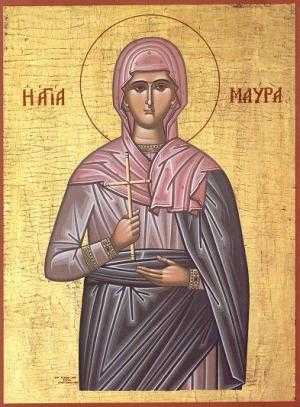
Saints Timothy and Maura
They suffered for the faith during the persecution under the emperor Diocletian (284-305). Saint Timothy came from the village of Perapa (Egyptian Thebaid), and was the son of a priest named Pikolpossos. He was made a reader among the church clergy, and also a keeper and copyist of divine service books.
Saint Timothy was denounced as a keeper of Christian books, which the emperor ordered to be confiscated and burned. They brought Saint Timothy before the governor Arian, who demanded that he hand over the sacred books. They subjected the saint to horrible tortures for his refusal to obey the command. They shoved two red-hot iron rods into his ears, from which the sufferer lost his eyesight and became blind.
Saint Timothy bravely endured the pain and he gave thanks to God, for granting him to suffer for Him. The torturers hung the saint head downwards, putting a piece of wood in his mouth, and they tied a heavy stone to his neck. Saint Timothy’s suffering was so extreme, that even those who tortured him implored the governor to ease up on the torture.
About this time they informed Arian that Timothy had a young wife named Maura, whom he had married only twenty days before. Arian ordered Maura to be brought, hoping that with her present, they could break Saint Timothy’s will. Saint Timothy urged his wife not to fear the tortures, but to follow his path. Saint Maura answered, “I am prepared to die with you,” and she boldly confessed herself a Christian. Arian commanded that the hair be torn from her head, and to cut the fingers off her hands.
Saint Maura underwent the torment with joy and even thanked the governor for the torture, which she endured so that her sins might be forgiven. Then Arian gave orders to throw Saint Maura into a boiling cauldron, but she did not feel any pain, and she remained unharmed.
Suspecting that the servants had filled the cauldron with cold water out of sympathy for the martyr, Arian went up and ordered the saint to splash him on the hand with water from the cauldron. When the martyr did this, Arian screamed with pain and drew back his scalded hand. Then, momentarily admitting the power of the miracle, Arian confessed God in Whom Maura believed as the True God, and he ordered her to be released. But the devil still held great power over the governor, and soon he again began to urge Saint Maura to offer sacrifice to the pagan gods.
Having gotten nowhere, Arian was overcome all the more by a satanic rage and he came up with new tortures. Then the people began to murmur and demand a stop to the abuse of this innocent woman. But Saint Maura, turning to the people, said, “Let no one defend me. I have one Defender, God, in Whom I trust.”
Finally, after torturing them for a long time, Arian ordered the martyrs to be crucified. For ten days they hung on crosses facing each other.
On the tenth day of martyrdom the saints offered up their souls to the Lord. This occurred in the year 286. Later, a solemn celebration of the holy martyrs Timothy and Maura was instituted at Constantinople, and a church was built in their honor.
Troparion, tone 4
Let us the faithful honor Timothy with Maura his faithful fellow-athlete, and bride of Christ, / and let us praise their bold endurance; / for being crucified they lovingly followed Him Who was slain / and Who has nailed all our sins to the Cross.
4th Sunday after Pascha (of the Paralytic)
Gospel (John 5:1-15)
After this there was a feast of the Jews, and Jesus went up to Jerusalem. Now there is in Jerusalem by the Sheep Gate a pool, which is called in Hebrew, Bethesda, having five porches. In these lay a great multitude of sick people, blind, lame, paralyzed, waiting for the moving of the water. For an angel went down at a certain time into the pool and stirred up the water; then whoever stepped in first, after the stirring of the water, was made well of whatever disease he had. Now a certain man was there who had an infirmity thirty-eight years.
When Jesus saw him lying there, and knew that he already had been in that condition a long time, He said to him, “Do you want to be made well?” The sick man answered Him, “Sir, I have no man to put me into the pool when the water is stirred up; but while I am coming, another steps down before me.” Jesus said to him, “Rise, take up your bed and walk.” And immediately the man was made well, took up his bed, and walked.
And that day was the Sabbath. The Jews therefore said to him who was cured, “It is the Sabbath; it is not lawful for you to carry your bed.” He answered them, “He who made me well said to me, ‘Take up your bed and walk.’” Then they asked him, “Who is the Man who said to you, ‘Take up your bed and walk’?” But the one who was healed did not know who it was, for Jesus had withdrawn, a multitude being in that place.
Afterward Jesus found him in the temple, and said to him, “See, you have been made well. Sin no more, lest a worse thing come upon you.” The man departed and told the Jews that it was Jesus who had made him well.

Tr by oca.org