26
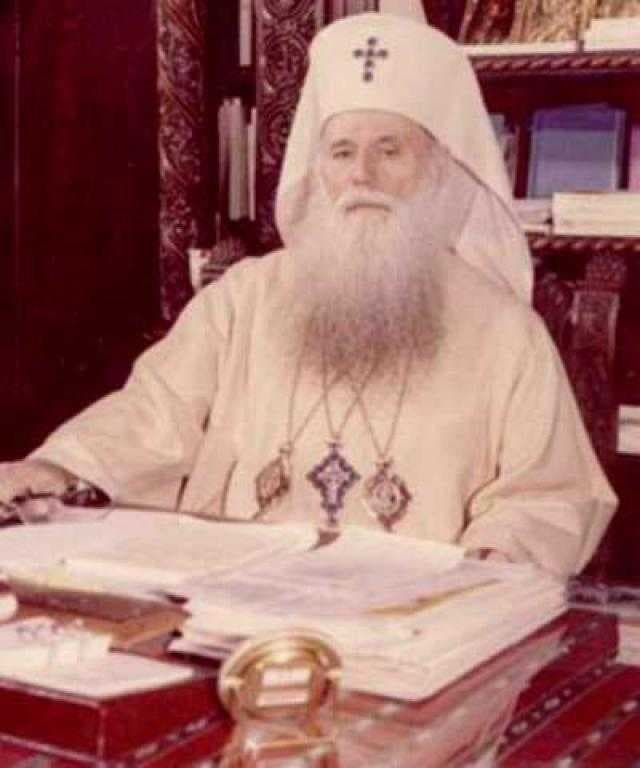
March 1977 – JUSTINIAN MARINA (baptised Ioan), Patriarch of the
Romanian Orthodox Church passed away. Studies at the Theological
Seminary of “Saint Nicholas” of Râmnicu Vâlcea (1915 – 1923) and at the
Faculty of Theology of Bucharest (1925 – 1929), teacher in
Olteanca-Vâlcea (1923 – 1924) and in Băbeni-Vâlcea (1924 – 1930), in
parallel parish priest in Băbeni (1924 – 1932), director of the
Theological Seminary and servant priest at the Episcopal Cathedral of
Râmnicu Vâlcea (1932-1933), parish priest at the church of “Saint
George” in the same locality 81933 – 1945).
He became a widower
and, in 1945, he is elected assistant hierarch to the Archdiocese of
Iași, with the title of “Vasluianul” (1945 – 1947); locum tenens of the
Metropolitan See of Iași (since August 1947), Archbishop of Iași and
Metropolitan (elected on 19 November 1947, enthroned on 28 December);
Patriarch locum tenens (since February 1948); on 24 May 1948 he is
elected, and on 6 June 1948 enthroned as Archbishop of Bucharest,
metropolitan of Ungrowallachia and Patriarch of the Romanian Orthodox
Church, serving till his death.
As Patriarch, he remains in the
history of the Romanian Church through his well-known “Social
Discipleship”, in which he knew how to give a new orientation to the
activity of the Church, in the conditions of life provided by the
communist regime, in spite of all difficulties. During his 29 years of
patriarchal service, a series of events and changes occurred which
raised the prestige of the Romanian Orthodoxy a lot in the Christian
world and made him a representative personality of the entire Orthodoxy.
From 19-20 October 1948, the Holy Synod voted a new Statutes for the
Organisation and Functioning of the Romanian Orthodox Church, the
Patriarchate having only 5 metropolitan sees at the time, with 13
suffragan eparchies, plus 2 Romanian eparchies in Diaspora. In 1950, the
Holy Synod decided – for the first time – to pass a few hierarchs,
monks and Romanian faithful among the saints and to generalise the cult
of certain saints whose relics are in our country; their solemn
canonisation took place in 1955. In 1948 the Orthodox theological
education was re-organised; from that year till 1989 University
Theological Institutes operated (Bucharest and Sibiu) and six
Theologcal Seminaries (in Bucharest, Buzău, Neamț Monastery, Cluj,
Craiova and Caransebeș). New church periodicals were edited and the old
ones continued to appear: “Romanian Orthodox Church” (since 1874),
“Ortodoxia”, “Theological Studies” (central magazines), “Voice of the
Church” (of the Metropolitan See of Ungrowallachia), “Metropolitan See
of Moldova and Suceava”, “Metropolitan See of Transylvania”, ”
Metropolitan See of Oltenia” and “Metropolitan See of Banat”
(metropolitan magazines), besides a series of periodicals edited by the
Romanian Orthodox communities abroad.
The Synodal Bible was
re-edited in two editions (1968 and 1975), the New Testament (1951), all
the books of rite (each of them in several editions), as well as almost
all the manuals necessary for the theological university and seminary
education, plus a series of works with theological and historical
character written by hierarchs, professors of theology and priests or
doctorate thesis. The Patriarch himself published 12 volumes with the
significant title Social Discipleship (Bucharest, 1948 – 1976), with all
his pastoral letters, speeches and articles. He had tens of churches
monuments of art restored, new churches raised, and either old or new
ones painted, about one hundred museums and collections of church
objects were opened, especially in the precincts of the monasteries. He
took good care of the married priests, ensuring their salaries and
pensions; he set up centres of social assistance for old priests and
monks, for old nuns and priests’ wives (at Viforâta Monastery).
He
entertained relationships with other sister Orthodox Churches and other
Christian Churches. He himself paid visits, heading synodal
delegations, to the following Churches: Russian (several times),
Georgian (1948), Serb (1957), Bulgarian (1953, 1966 and 1971), the
Ecumenical Patriarchate (1968, Patriarchate of Alexandria (1971) and of
Jerusalem (1975), Church of Greece (1963, 1971 and 1975). Relations with
the Old Oriental Churches were set up through mutual visits: the
Patriarch visited the Ethiopian Church (1969 and 1971), Coptic Church
(1969 and 1971), Syrian Church of Malabar – India (1969). Relations were
set up and entertained with a series of national Roman Catholic
Churches, some of them he visited heading synodal delegations; Austria
(1969), Germany (1970), Belgium (1972), with the Church of the Old
Catholics and the Anglican Church. Delegates of all these Churches
visited Patriarch Justinian and his Church, in their turn. After 1961,
when the Romanian Orthodox Church re-joined the World Council of
Churches, she has participated in all the activity unfolded within the
present ecumenical movement: World Council of Churches, Conference of
the European Churches, etc.
He was buried at “Radu Vodă” church of Bucharest.