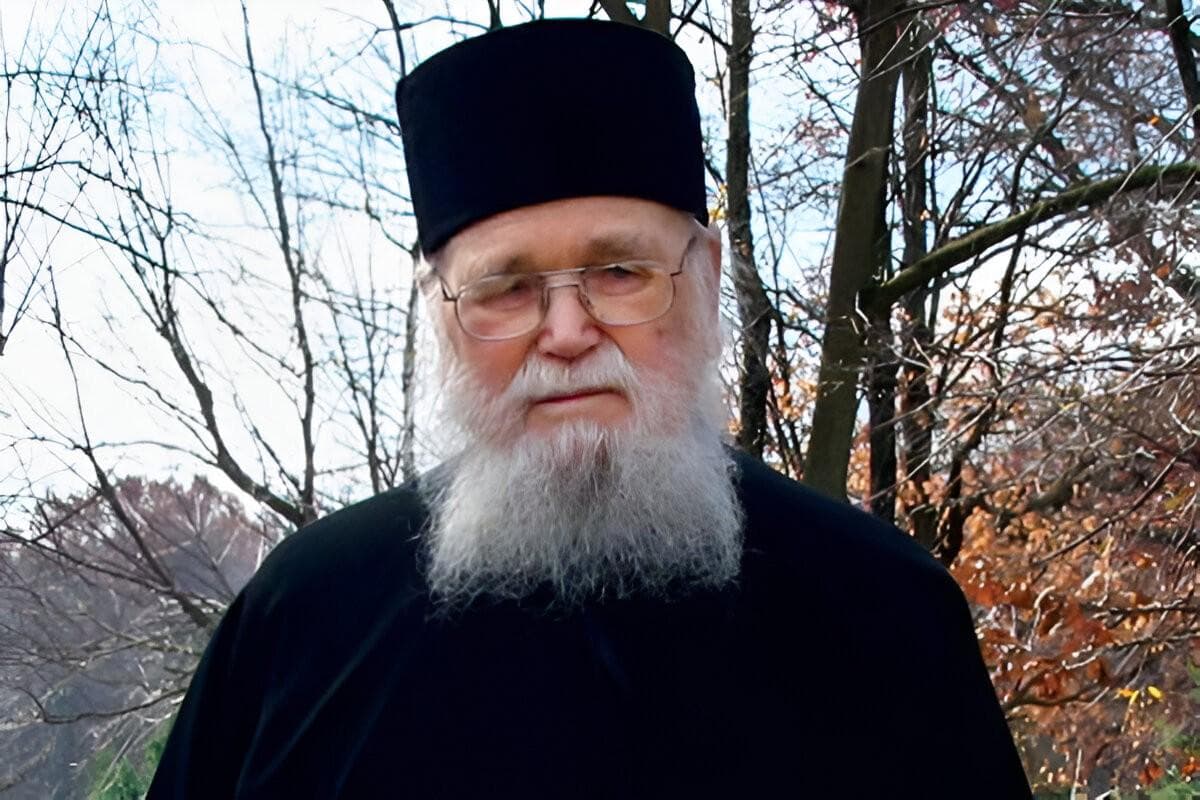
Wednesday, April 29, marks 11 years since the repose of Archimandrite Roman Braga, the Bessarabian-born confessor who began practising the Jesus Prayer through the Burning Bush spiritual gatherings at Antim Monastery in Bucharest, endured communist imprisonment twice in Romania, and later served the Church in exile.
Born in 1922 in Condrița, Bessarabia, Fr Roman entered Căldărușani Monastery at just 12 years old. He later graduated in Bucharest from the Faculties of Theology (with magna cum laude honours) and Philosophy, as well as the Titu Maiorescu Pedagogical Seminary.
In 1948, he was arrested and accused of ties to the Legionary movement — a charge for which no evidence was produced — and sentenced to five years of hard labour. He was imprisoned at Pitești Prison and later in a forced labour colony on the Danube–Black Sea Canal.
Secret Tonsure and Imprisonment in the Burning Bush Case

In 1954, Metropolitan Sebastian Rusan secretly tonsured him a monk and ordained him to the deaconate. But he was arrested again in 1959, when communist authorities opened the political investigation into the Burning Bush movement and discovered he had attended the spiritual meetings at Antim Monastery during his student years.
He was sentenced to 18 years of hard labour for “hostile activity against the regime,” serving five years at Balta Albă before being released in the 1964 general amnesty.
After his release, he wandered through various dioceses and metropolises in Romania, often received with indifference or rejection. Bishop Valerian Zaharia of Oradea eventually succeeded in ordaining him to the priesthood. For a time, Fr Roman also worked in the diocesan archives.
Pilgrim in Romania and the Wider World

From 1965 to 1968, he served in Negrești, in Țara Oașului, before being transferred to the parish of Sârbi near Oradea.
He was eventually sent as a missionary to Brazil, serving the Romanian community in São Paulo from 1968 to 1972.
In 1972, Bishop Valerian Trifa invited him to the Romanian Orthodox Episcopate in America, also known as the Vatra Episcopate, in Grass Lake, Michigan. There, for seven years, he worked in children’s religious education, translated spiritual texts, and adapted church chant into English.
Between 1979 and 1983, he served in Youngstown, Ohio, and Southfield, Michigan. He then became the spiritual father of Transfiguration Monastery, founded by Mother Alexandra (Princess Ileana of Romania), where he served until 1988.
That year, he retired to Dormition of the Mother of God Monastery, where his sister, Nun Benedicta, was abbess. He reposed in the Lord on 29 April 2015 after a long illness.
In September 2025, the Congress of the Romanian Orthodox Episcopate of America forwarded a proposal to the Holy Synod of Bishops of the Orthodox Church in America to canonise Father Roman Braga. The proposal was reviewed later in November.
Teachings of Fr Roman Braga
Fr Roman Braga left behind a deeply personal and experiential spiritual teaching centred on inner prayer and living communion with God.
“We must speak with Him. You must feel God within you, not outside yourself, not externally, but inwardly, in your heart, for our heart is infinite because Christ dwells there from Baptism. A person possesses infinite dimensions of personhood; in its unfathomable depth, the human person is eternal.”
“Conversation with God gives you this awareness of God’s presence. Tell God when you are hungry, when you are thirsty. Tell God you are going to Rădăuți. Tell God something along the road. Show God how beautiful the flowers are. Speak with God about everything. ‘Lord, what should I do? I must do this and that; I am hungry, I am going to eat a piece of bread.’ Keep these things in mind. They may seem childlike, but this conversation with God becomes prayer. For what is prayer? It is the unceasing communion of man with God.”
Sources: Doxologia.ro; Putna.ro
Photo: Doxologia.ro