In a fast-paced and overburdened world, the inner formation of children and adolescents has become one of the most difficult – and at the same time most essential – responsibilities of parents, educators and society as a whole.
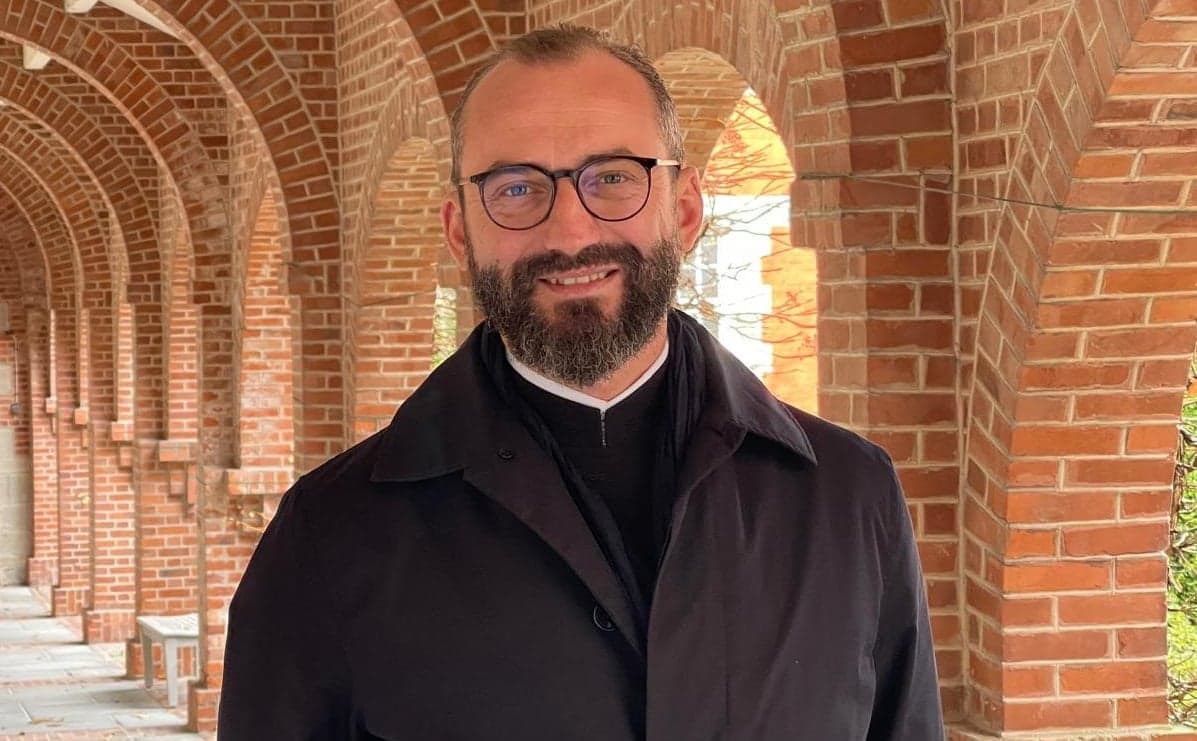
In an interview with Alexandra Nadane hosted by the Basilica News Agency, Father Liviu Vidican-Manci discussed the challenges of education in the digital age, the need for discernment, and the importance of building real, living relationships with adolescents. A university lecturer at the Faculty of Orthodox Theology of Babeș-Bolyai University in Cluj-Napoca, Fr Liviu Vidican-Manci is concerned, in both his academic and pastoral activities, with the relationship among faith, technology, and the formation of the contemporary human person.
Alexandra Nadane: What affects a child’s inner formation most today: the lack of parents’ time, digital culture, or the absence of clear reference points? And how can these challenges be overcome?
Fr Liviu Vidican-Manci: First, thank you for the opportunity to address a topic that is extremely important in our time. Secondly, I would not rigidly separate these three realities, because they do not act in isolation; they intertwine and reinforce one another. Digital culture is not inherently evil. It becomes problematic when the child is left alone in front of it, without mediation, reference points, or a meaningful adult presence.
In this sense, the lack of parents’ time and the absence of clear reference points are not merely secondary shortcomings, but deep vulnerabilities that allow the digital environment to become the child’s primary source of inner formation. And this is, indeed, one of the major problems of our present time.
In my view, a child’s inner formation is not achieved primarily through moralising speeches or rules imposed from the outside, but through stable presences, rhythm, and living relationships. A child is shaped inwardly by what they experience every day, not only by what they are told. When a parent is constantly rushed, fragmented or absorbed by their own screens, the child internalises a state of anxiety, lack of meaning and emotional instability. That is why overcoming these challenges does not begin with drastic technological prohibitions, but with the restoration of quality time, authentic dialogue and a coherent way of life, in which values are lived naturally, not merely declared formally.
In this context, I consider a real and functional partnership among the family, the school, and the Church essential. The family may not know how to manage children’s immersion in virtual spaces and may adopt a defensive or even hostile attitude toward school initiatives promoting the moderate and responsible use of technology.
For this reason, this partnership must be expanded and strengthened, with an important ally: the media. There is a need to rebuild trust between parents and the school, between parents and the Church, and to foster honest, balanced, and empathetic public communication about children’s real needs.
We are therefore speaking about a concerted effort, free of institutional pride and marked by sensitivity towards the fragility of human beings who are still in the process of formation. I would not frame the issue as “what affects children the most,” but rather as “how do we responsibly manage this delicate cocktail of time, digital culture and reference points?” This is where our shared attention should be focused.
And above all, I firmly believe that balance cannot be established without prayer. The prayers of the family, the children, and the community are essential to safeguarding both the present and the future of our children. Becoming aware that prayer is not a crisis gesture, practised only in difficult moments, but a constant of daily life, is in itself a fundamental reference point for a child’s inner formation.
Alexandra N.: How can a parent remain a meaningful presence in their child’s life in the digital age in which we live?
Fr Liviu V.-M.: It is, without doubt, an essential question. In short, I would say: through consistency and authenticity. A child does not need perfect parents, but present parents, and this presence is decisive in the parent–child relationship. But what does this presence truly mean in a fast-paced, highly digitalised world?
To be a meaningful presence does not only mean being physically close, but also being emotionally available, listening without immediately judging, understanding before correcting, and offering clear yet warm reference points. A child needs to feel that he or she is taken seriously, that his or her experiences and questions matter, even when they are uncomfortable or difficult to manage.
In this context, it is essential that the parent not compete with the digital environment. Such a competition is lost from the outset. Far more important is for the parent to know this environment, understand it, and mediate it, offering the child criteria for orientation. Speaking openly about risks and acknowledging one’s own limits and vulnerabilities in relation to the digital world does not weaken parental authority; it humanises it and makes it credible.
Equally important is cultivating principles, especially discernment. Because there will inevitably be situations in which the parent is not present. What will help the child then: a set of prohibitions or the capacity to make responsible choices? That is why the child must feel in the parent an ally, a support and an adviser, not a controller. Unfortunately, parents often act reactively, intervening only when things have already deteriorated, like a “firefighter” called too late. This is not education, but crisis management.
There are, however, simple gestures, seemingly minor, which build a solid relationship in the medium and long term: family prayer, meals taken together, honest dialogue and the assumption of clear and consistent limits. These are not merely habits, but true structures of stability. Through them, the child acquires inner security, rhythm and meaning – reference points without which neither the digital environment nor the world of tomorrow can be navigated in a healthy way.
Alexandra N.: Many adolescents live with anxiety and identity confusion. What can those who have a formative role around them do?
Fr Liviu V.-M.: First of all, it is essential not to minimise these experiences. Today’s adolescents are exposed to an enormous volume of information, comparisons, and symbolic pressures that often exceed their capacity to process and integrate. Identity confusion is not a sign of personal weakness, but the consequence of a profoundly overburdening context. Informational obesity affects society as a whole; all the more so, young people who are still searching for their own direction and a stable sense of meaning.
Those who play a formative role – parents, teachers, and priests – can offer stability, first and foremost, through their constant presence. But this presence is not passive or neutral. It presupposes availability, continuity and relational fidelity, especially in difficult moments. Adolescents need to know that they are not emotionally abandoned between assessments, performance targets, and expectations, and that there are adults who remain close even when things become uncomfortable or difficult to manage.
Validation, properly understood, is just as important. Not every behaviour must be approved, but every person must be acknowledged. Validation does not mean relativising the truth or avoiding reality, but recognising the dignity of the person in front of you. At this point, the ability to offer real feedback becomes essential – feedback that is different from judgement: feedback expressed with love, but without embellishing the truth. Very often, out of a desire to preserve an apparently good relationship, we agree to build on half-truths or on convenient silences. This form of false protection does not help the adolescent; it makes him or her more vulnerable.
An adolescent raised without honest confrontation with reality risks becoming a fragile adult, poorly adaptable and incapable of dealing with failure or responsibility. That is why authentic feedback is an act of love, not of severity. It helps the young person know themselves, recognise their limits, and grow in a realistic, not illusory, way.
In this sense, it is essential to encourage an identity built on relationships, not solely on performance. Performance fluctuates and depends on comparison; a relationship, on the other hand, offers stability and continuity. An adolescent who knows that he or she is valued for who they are, not just for what they achieve, can build their identity in a healthy, balanced way.
Adolescents also need safe spaces where they can ask questions without fear, express doubts, and speak openly about their vulnerabilities. In such spaces, faith should not be presented as an additional pressure or a rigid set of moral requirements, but as real support, a horizon of meaning, and a resource for inner healing. From this perspective, Confession can become such a privileged space when it is lived properly and with discernment: not as a moment of blame or harsh evaluation, but as a healing encounter, as a dialogue in truth, carried out in a climate of trust and discretion.
I firmly believe that when a family has a wise spiritual father and the adolescent feels respected in the rhythm of their growth, a profound form of psychological and spiritual security is created. The spiritual father neither replaces the parent nor competes with them, but completes the process of formation by offering a space distinct from the family, where the truth can be spoken without fear and fragility is not sanctioned but accompanied. In such a framework, the adolescent learns that truth does not destroy the relationship, but purifies it and deepens it.
Alexandra N.: In your pastoral work, do you encounter young people who search for meaning but are afraid to assume their faith in a hostile cultural context? What thoughts do you have for them?
Fr Liviu V.-M.: I would answer this question starting from an experience that obliges me, above all, to gratitude. God has arranged for me to know many young people who have embraced their faith more clearly and more courageously than their parents. I would begin my answer with them, and I thank God for them. They are authentic young people, anchored in reality, who live their faith not demonstratively, but naturally, according to the image of Christ and His Saints. They inspire others without intending to.
To them I say: continue on this path of authenticity, without pride and without fear, because your quiet witness is often stronger than any speech. Faith lived with discretion, coherence and peace becomes, in itself, a reference point for others.
There is, however, a second category, also very present: the “lukewarm” young people, to use the Holy Apostle Paul’s term. To them, I would say that this fear is natural and that they are not alone. We live in a culture that relativises values, ironises deep commitment and suspects any form of fidelity. In such a context, it is understandable that assuming one’s faith may seem risky.
Faith should not be lived as a flag waved ostentatiously, but as an inner light that gives meaning and direction. Assuming it begins discreetly: through fidelity to one’s conscience, through prayer, through small acts of good, through the refusal of inner compromise. Courage is not born from direct confrontation with the world, but from a personal encounter with Christ. And a young person who lives coherently, with peace and discernment, becomes himself or herself an answer – even in a hostile cultural context. What other form of witness could be more convincing?
I cannot conclude this answer without mentioning a living and concrete example of such a witness from within the Church itself: the apostolic work carried out by Iustin Miron, known to many as Iustin of Oașa (currently the abbot of Nicula Monastery, in Cluj County). Together with his disciples, for more than two decades, they have aimed to bring young people closer to the real life of the Church, not through pressure or moralising discourse, but through presence, accompaniment, and authentic lived experience. It is proof that when faith is lived naturally and in communion, it does not frighten, but attracts.
At this point, parents’ responsibility becomes essential. Adolescents do not reach such spaces of formation and support on their own. They need to be guided, supported, and encouraged to approach communities, camps, monasteries, or initiatives that offer a healthy framework for spiritual and human growth. Guiding your child toward such places does not mean delegating your responsibility; it means exercising it responsibly, recognising that adolescent development requires community, living models, and contexts that the family alone cannot always provide.
Alexandra N.: How can contemporary people preserve their attention and discernment in the rhythm of everyday life today?
Fr Liviu V.-M.: I think we must be honest with ourselves. You see, contemporary people cannot do this easily. It is well known that attention and discernment are the first victims of speed, and the modern city functions precisely on the logic of continuous acceleration. In such a context, preserving one’s inner life becomes an act of resistance.
You have surely heard, or perhaps personally experienced, how difficult it is to remain attentive in a world that constantly demands your attention. We are fragmented, distracted, pulled in multiple directions. Discernment cannot be formed in an over-saturated and exhausted mind, because it requires space, silence and depth. Without these, people no longer choose; they are chosen by circumstances.
That is why contemporary people need not only technological breaks, but a re-ordering of their entire way of life. They need prayer, reflection, and consciously assumed limits. But perhaps more than ever, they need to leave urban captivity and reconnect with nature. City dwellers must learn again to look at the sky, to listen to the silence of the forest, to feel the water of rivers, and to slow down. Nature unteaches haste and brings us back to measure.
Discernment is not a rapid reflex, but a virtue cultivated over time. Knowing when to stop, when to remain silent and when to choose what is essential presupposes a protected inner life. Ultimately, it is not speed that saves us, but direction. And direction is not discovered in noise, but in silence, in prayer and in communion with God’s creation.
Photo: Personal archive