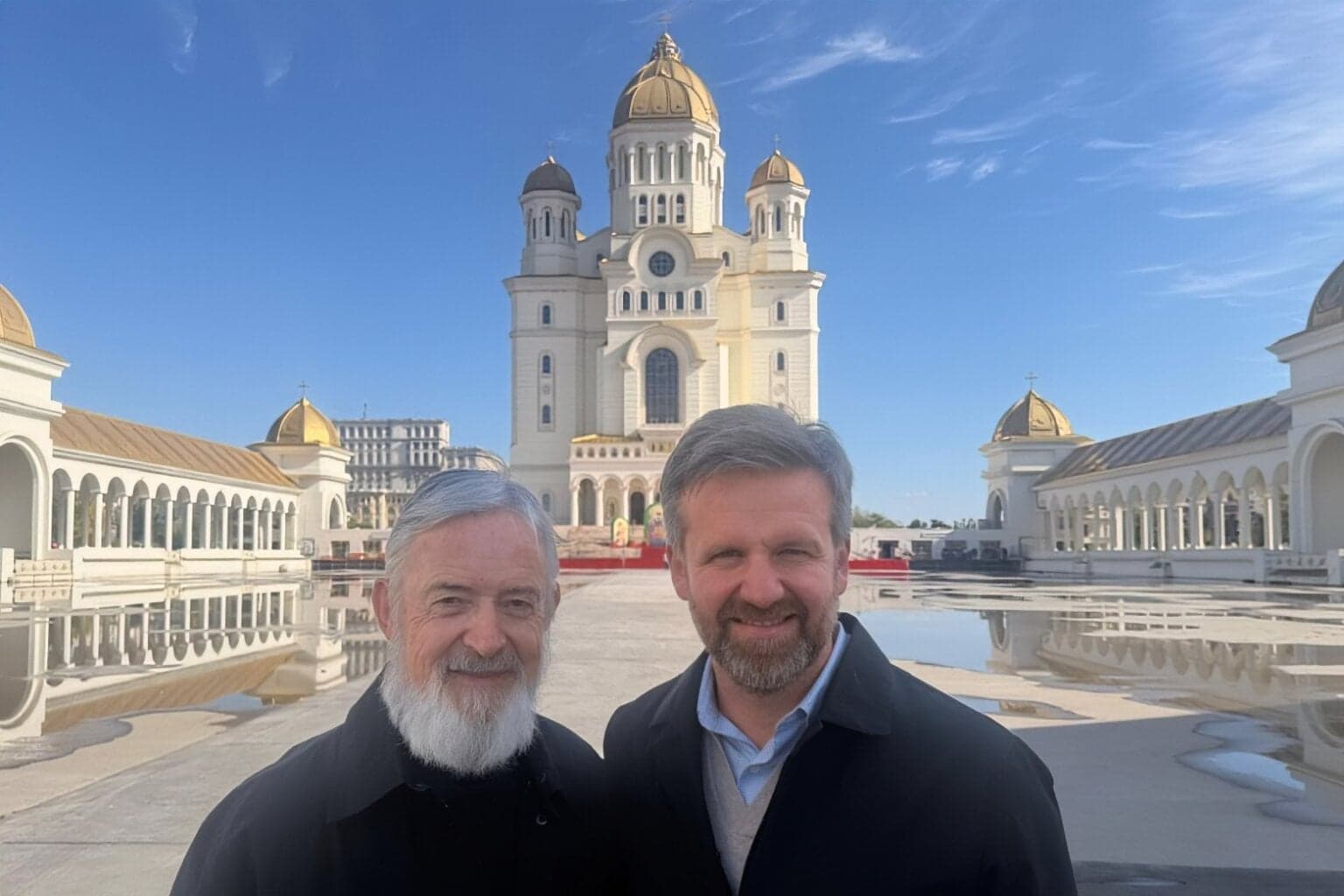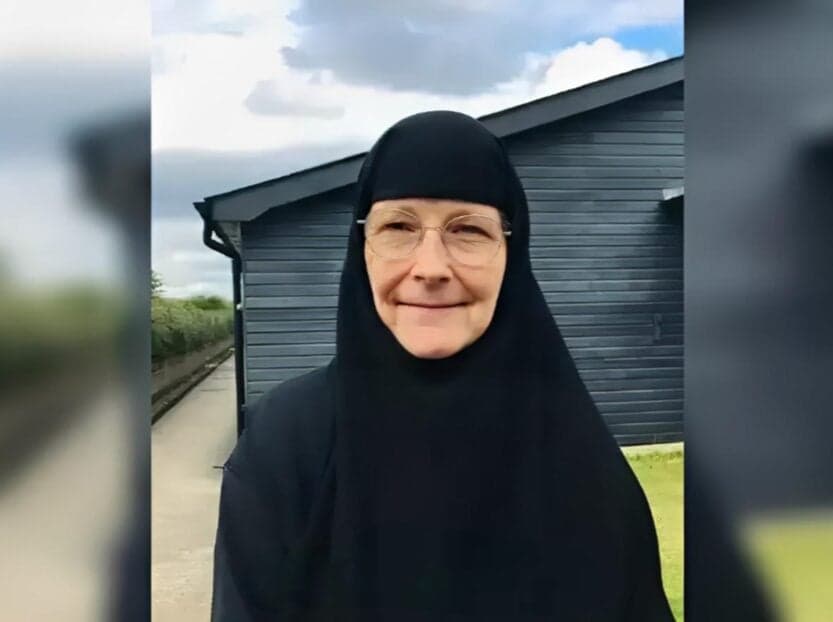
Mother Magdalen of the Monastery of Saint John the Baptist in Essex worked for decades with children, young people, parents, and mothers, with the blessing and guidance of Saint Sophrony Sakharov. From this experience emerged dialogues and conferences, and books were published.
In the interview given to the #vinereapentruviață column, Mother Magdalen speaks about the child as a unique person created by God, about motherhood as a school of self-sacrificial love, and about the deep wounds of a culture that has forgotten how to see life as a gift.
Alexandra Nadane: Mother Magdalen, thank you so much for this interview. Please, tell us something about your experience in the Essex monastery, about the relationship with Saint Sophrony.
Mother Magdalen: Yes, it may seem strange that a nun is speaking about children. I’m not trained in child psychology, I’m not trained as a teacher. It just so happened by the providence of God that I got a lot of experience meeting the children on Sundays and speaking with them. This happened early on in my monastic life and Saint Sophrony blessed me to give my Sundays to the children and he gave me advice all the time about the questions the children had, my questions, the parents’ questions.
After a while then parents started to ask me to give talks and advice and it spiralled from there in a natural way. For 18 years I had the concrete and practical and prayerful advice of Saint Sophrony and this is what I gathered in the books that I wrote. So, it’s really because of his blessing and teaching that I became known as somebody who deals with children. It’s not a full time, it’s mostly Sundays that I’m dealing with children, except perhaps when we have groups here or if I’m invited somewhere else.
AN: You have made an important contribution to the spiritual formation of the young people and children; when the children visit the monastery and outside of the monastery. What does the child bring to the life of the world and to the spiritual life of those around him?
MM: When Christ spoke about suffering, he gave the example of a mother who has pain giving birth, but after the birth she forgets her pain in a joy that an anthropos has come into the world. That means that for God even, the birth of each new child is a great event, a new other person, completely unique, who is other to God, even though God has created that child and arranged the providence of his birth. What the child brings is a new person.
What the child brings to the spiritual life of those around him is another person to love, to practice the commandments and to become closer to Christ.
AN: You have written and spoken about the need for spiritual answers to the struggles of children and adolescents. In what way do you think the lack of an education that values the gift of life affects young people?
MM: It affects young children drastically. In the world, nowadays, they don’t teach spiritual life. They even scorn spiritual life, in most of the schools of today which have a secular ethos. And there are people who grow up without any prayer. This affects them deeply, because we know from our own church that we begin the prayer life of children from childhood, from babyhood, from before. And because of this, prayer and their relationship with Christ is natural for them.
Children who do not have this upbringing have to discover God when they are already filled with the propaganda of the world. So this is very serious. I think you meant this spiritual education rather than education in general. So, we leave it at that. But I will add that the most important education of a child, the strongest influence, is in the family. Because we see that Orthodox families manage to raise Orthodox children even in societies where Christian education was forbidden, even church schools were forbidden, under the muslims, under the atheists. So, the strongest influence, positive or negative, is the family.
AN: In a time when many no longer see a child as a blessing but as a burden or an obstacle, how can we rekindle in people’s hearts the joy of children coming into the world?
MM: Our world has become like a supermarket. Because of certain technological advances, people think that they can choose what child to have, when to have. It’s like a supermarket purchase, centered on the desires of the parents, and not even the desires, the convenience of the parents. This is a terrible attitude towards children. How to change that mentality, I do not know. But certainly, we should encourage the idea that each child is a gift from God.
AN: Your books and talks have offered great encouragement to mothers. What can you share from your experience of speaking with women who have carried deep pain, whether from abortion or from giving birth in loneliness or without support?
MM: I think your question must be very clearly divided in two. The women who have suffered from abortion must be distinguished from the pain of giving birth in loneliness or without support. Abortion is murder, killing another human being. Abortion takes place in many different contexts and the mother has some blame, but the degree of blame depends on the circumstances, which I do not wish to go into in detail. Not all mothers are equally blameworthy.
However, all mothers should try to avoid abortion and there should be support for adopting the child, if the mother cannot face raising that child. And there should be repentance for abortion.
The children who are killed are millions every year. Everybody knows that thousands were killed in the Second World War by those who were against Jews. This is a crime. And every year we kill many more people in smart hospitals with doctors and nurses as part of their medical profession. This is a scandal. The sin of abortion is very great, but every sin with repentance can be forgiven.
If we go to the second part of the question, the mothers who have pain from giving birth in loneliness or without support. Even so, the mothers can give love to the child. And this usually is enough to motivate the mother and inspire her to project even some happiness in her life with the child. However, it makes us think that a lot of thinking and praying should go on before the birth of a child. And this is when the couple is thinking of getting engaged or when the couple is thinking of getting close.
Nowadays, all the mass media treats full relations too casually. God for people who are married for life together and God joins them together; and we cheapen it. This is where education should be working, against this casual attitude. Every advert for cars and for clothes and for everything has some kind of message of this, let us say – not to use another word – romantic kind. It’s a mad world, full of passions, and we should put the love commanded by God before the passions.
AN: How can a young woman be helped to discover that being a mother is not the end of her, but a new beginning, a cooperation with God?
MM: First of all, she must realize that she is a mother from her child’s conception. A pregnant woman is not a future mother, she is a mother. Everything that she thinks and does affects the child. If she being pregnant has negative thoughts towards the child in her womb, the child will suffer. This has been medically documented that certain development of the embryo is harmed by times of depression during the pregnancy when a certain organ is being developed.
You cannot be a mother and live for yourself. You live for your child because you are responsible. The child is innocent and completely ignorant about how to live. So, it is your responsibility, and it doesn’t really matter how you feel or how disrupted your life is. You have to be unselfish and if you resent the child, you will have much more difficulty to have a good relationship with the child and to raise it. If you have a loving relationship with your child it is a joy from beginning to end.
God has given you a child, and you must turn to God for help and offer to collaborate with him in the creation of a new person. People will say you have given up your life or your career. No, you have found a way to learn selfless love that you cannot learn in your job or in your selfish life.
AN: What would you say to those who are involved in associations, support centres and communities and are afraid to open their hearts in love toward the people they are trying to help?
MM: It’s understandable. Anybody in a caring profession has to preserve themselves. They cannot bear the burden of all the suffering of all their clients. And that is normal. The associations, when they train their staff, should train them in this matter, sharing their worries, having meetings together, where the more experienced can help the less experienced; and giving rest when it’s needed and so on. I think they shouldn’t be afraid. I don’t like the word „afraid”.
If their heart is getting tired, they should think about resting. Or, it is possible, professionally, to be not so involved in the problem once the work hours stop, so that you rest your mind ready for the next day at work. This does not mean coldness. You give your patients, your clients to God and then you give yourself rest, time to look after yourself.
It’s like you have some tools to help them. You need time to practice using your tools, to clean the tools, to eat and to get strong like any gardener using tools. This is part of your work and your life and you need to look after yourself and watch when you are getting too near to the edge of psychological exhaustion. Giving them in prayer is the best relief to the saints and to the Lord. “St. Nicholas, take your servant, Maria. It’s too heavy for me”. But you do your part for Maria.
Photo: Essex Monastery