- The Holy Martyrs Leontius, Hypatius, and Theodulus were Roman soldiers. The holy Martyr Leontius, a Greek by origin, served as a military-chief in the imperial army in the Phoenician city of Tripoli during the reign of Vespasian (70-79). Leontius was distinguished for his bravery and good sense, and the people of Tripoli held him in deep respect because of his virtue.
The emperor appointed the Roman senator Adrian as governor of the Phoenician district, with full powers to hunt out Christians, and in case of their refusal to offer sacrifice to the Roman gods, to give them over to torture and death. And on his way to Phoenicia Adrian received a report that Saint Leontius had turned many away from worshipping the pagan gods. The governor sent the tribune Hypatius with a detachment of soldiers to Tripoli so as to find and arrest the Christian Leontius. Along the way the tribune Hypatius fell seriously ill, and being near death, he saw in a dream an angel, which said: “If you wish to be healed, you and your soldiers should say three times: ‘God of Leontius, help me.’”
Opening his eyes Hypatius beheld the angel and said: “I was sent to arrest Leontius, how is it that I should appeal to his God?” At this moment the angel became invisible. Hypatius told his dream to the soldiers, among whom was his friend Theodulus, and all of them together asked for help from the God Whom Saint Leontius confessed. Hypatius was immediately healed to the great joy of his soldiers, but only Theodulus sat aside, pondering the miracle. His soul was filled with love for God, and he told Hypatius to proceed twice as quickly to the city in search of Saint Leontius.
Upon their arrival in the city, a stranger met them and invited them to his house, where he lavishly hosted the travellers. Learning that their hospitable host was Saint Leontius, they fell on their knees and asked him to enlighten them with faith in the True God. They were baptized here, and when Saint Leontius prayed over them calling on the Name of the Most Holy Trinity, a luminous cloud overshadowed the newly-baptized and poured forth rain. The remaining soldiers in search of their commander arrived in Tripoli, where the governor Adrian had also arrived. Learning what had happened, he ordered Saints Leontius, Hypatius, and Theodulus to be brought to him. After threatening them with torture and death, he demanded that they renounce Christ and offer sacrifice to the Roman gods.
All the martyrs firmly confessed their faith in Christ. Saint Hypatius was put under a column and raked with iron claws, and Saint Theodulus was mercilessly beaten with rods. Seeing the steadfastness of the saints, they beheaded them. And after torture, they sent Saint Leontius to prison. In the morning he came before the governor. Adrian tried to entice the holy martyr with honors and rewards, and accomplishing nothing, he gave him over to new tortures. The holy martyr was suspended head downwards from a pillar with a heavy stone about his neck, but nothing could make him renounce Christ. The governor gave orders to beat the sufferer with rods until he died. They then threw the body of the holy Martyr Leontius outside the city, but Christians reverently gave it burial near Tripoli. The death of the holy martyrs occurred between 70-79.
The accusation against Saint Leontius, and his sufferings and death are recorded on tin tablets prepared by the court scribe [commentarisius]. These tablets were placed at the grave of the holy martyr.
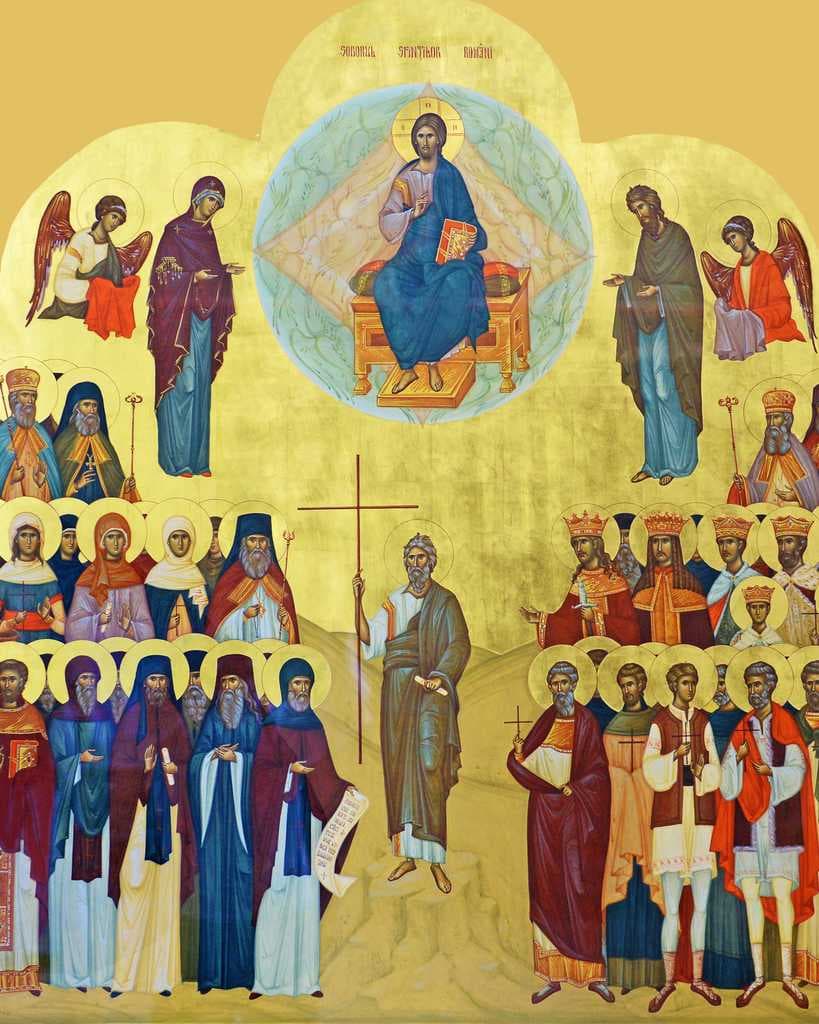
Martyrs Leontius, Hypatius, and Theodulus; Synaxis of the Romanian Saints (Fish allowed)
- Holy Apostle James the Brother of the Lord; Holy Priest-Martyr Constantine Sârbu; St. Macarius the Roman of Mesopotamia
- Holy Equal-to-the-Apostles Abercius, bishop and wonderworker of Hierapolis; 7 Holy Youths of Ephesus
- Ven. Confessors: Bessarion, Sophronius, Martyr Oprea; Priest-Confessors: John of Gales and Moses Macinic of Sibiel; St. Hilarion the Great