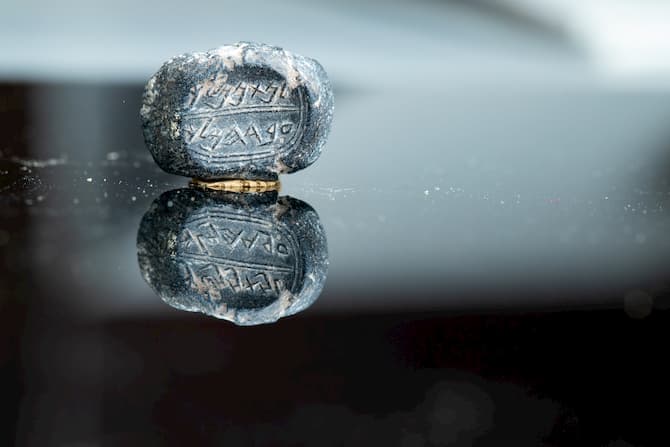
Archaeologists in Jerusalem have uncovered a 2,600-year-old clay seal they believe belonged to Nathan-Melech, who is mentioned in 2 Kings and was a servant to King Josiah.
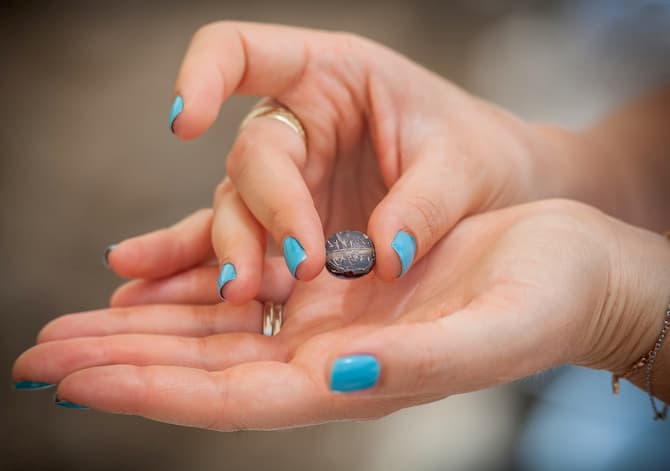
The clay seal – called a “bulla” – is about one centimeter (four-tenths of an inch) across and reads in Hebrew, “(belonging) to Nathan-Melech, Servant of the King.”
It is the first archaeological evidence of the biblical name of Nathan-Melech, according to a press release from the City of David.
He is mentioned in 2 Kings 23:11 in the context of King Josiah renewing the covenant with God.
‘He removed from the entrance to the temple of the Lord the horses that the kings of Judah had dedicated to the sun. They were in the court near the room of an official named Nathan-Melech. Josiah then burned the chariots dedicated to the sun’.
“Since he’s not mentioned with his last name, only [his] first name, we can understand that he was a pretty famous person here in Jerusalem during the mid-7th century [B.C.], the time of King Josiah,” said Anat Mender-Geberovich of The Hebrew University.
Josiah was one of the godly or “good” kings of Judah long after David and Solomon and after the kingdom was divided. Josiah became king at age eight and destroyed idols, leading the people to repent of their sins. It was during his time that a scroll containing the Word of God was found.
Mender-Geberovich said she believes it is the Nathan-Melech of the Bible because the name is rare, the bulla is from the correct time period, and it lists his title (servant).
Bullae were small pieces of clay impressed by personal seals, used in ancient times to sign letters. While the parchment that they sealed didn’t survive the fires that devastated ancient Jerusalem, the bullae, which are made of ceramic-like material, were preserved, leaving evidence of the correspondence and those behind them.
Photography courtesy of Eliyahu Yanai / City of David